Kraiwattanapong Chaiwat, Wechmongkolgorn Supaporn, Chatriyanuyok Bangon, Woratanarat Patarawan, Udomsubpayakul Umaporn, Chanplakorn Pongsathorn, Keorochana Gun, Wajanavisit Wiwat
Department of Orthopaedics, Ramathibodi Hospital, Mahidol University, Bangkok, Thailand.
Department of Nursing, Ramathibodi Hospital, Mahidol University, Bangkok, Thailand.
Asian Spine J. 2014 Apr;8(2):119-28. doi: 10.4184/asj.2014.8.2.119. Epub 2014 Apr 8.
A prospective cohort.
To report the short and long term outcomes of fluoroscopically guided lumbar transforaminal epidural steroid injection (TFESI) in degenerative lumbar spondylolisthesis (DLS) patients.
TFESI has been widely used for the treatment of lumbosacral radicular pains. However, to our knowledge, there has been no study which has evaluated the outcomes of TFESI in patients with DLS.
The DLS patients received fluoroscopically guided lumbar TFESI with 80 mg of methylprednisolone and 2 mL of 1% lidocaine hydrochloride. Patients were evaluated by an independent observer before the initial injection, at 2 weeks, at 6 weeks, at 3 months, and at 12 months after the injections. Visual analog scale (VAS), Roland 5-point pain scale, standing tolerance, walking tolerance, and patient satisfaction scale were evaluated for outcomes.
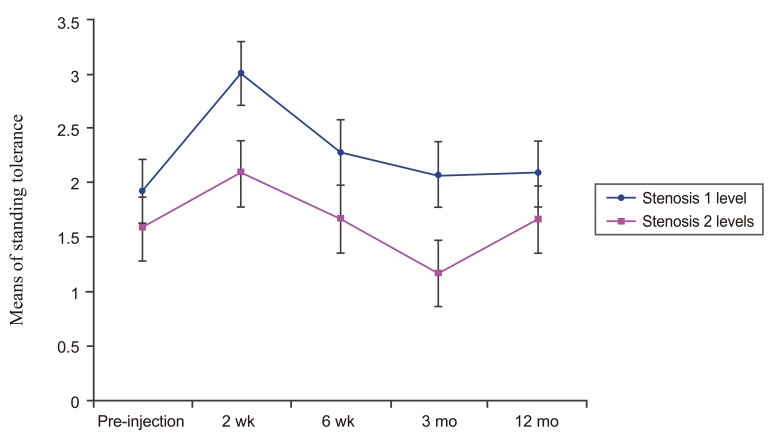
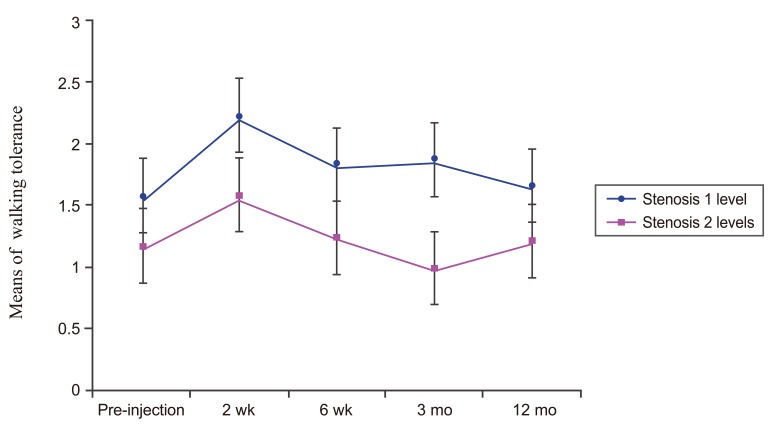
Thirty three DLS patients treated with TFESI, who were completely followed up, were included in this study. The average number of injections per patient was 1.9 (range from 1 to 3 injections per patient). Significant improvements in VAS and Roland 5-point pain scale were observed over the follow up period from 2 weeks to 12 months. However, the standing and walking tolerance were not significantly improved after 2 weeks. At 2 weeks, the patient satisfaction scale was highest, although, these outcomes declined with time. The DLS patients with one level of spinal stenosis showed significantly better outcome than the DLS patients with two levels of spinal stenosis. Five patients (13%) underwent surgical treatment during the 3 to 12 months follow up.
TFESI provides short term improvements in VAS and Roland 5-point pain scale, standing tolerance, walking tolerance and patient satisfaction scale in DLS patients. In the long term, it improves VAS but limits the improvements in Roland 5-point pain scale, standing tolerance, walking tolerance and patient satisfaction scale.
前瞻性队列研究。
报告在退行性腰椎滑脱(DLS)患者中,在透视引导下进行腰椎经椎间孔硬膜外类固醇注射(TFESI)的短期和长期结果。
TFESI已广泛用于治疗腰骶部神经根性疼痛。然而,据我们所知,尚无研究评估TFESI在DLS患者中的结果。
DLS患者在透视引导下接受腰椎TFESI,注射80mg甲泼尼龙和2mL 1%盐酸利多卡因。在初次注射前、注射后2周、6周、3个月和12个月,由独立观察者对患者进行评估。评估视觉模拟量表(VAS)、罗兰5点疼痛量表、站立耐受度、行走耐受度和患者满意度量表以评估结果。
本研究纳入了33例接受TFESI治疗且得到完整随访的DLS患者。每位患者的平均注射次数为1.9次(每位患者1至3次注射)。在2周至12个月的随访期内,VAS和罗兰5点疼痛量表有显著改善。然而,2周后站立和行走耐受度没有显著改善。在2周时,患者满意度量表得分最高,不过,这些结果随时间下降。单节段椎管狭窄的DLS患者的结果明显优于双节段椎管狭窄的DLS患者。5例患者(13%)在3至12个月的随访期间接受了手术治疗。
TFESI可使DLS患者的VAS、罗兰5点疼痛量表、站立耐受度、行走耐受度和患者满意度量表在短期内得到改善。从长期来看,它可改善VAS,但限制了罗兰5点疼痛量表、站立耐受度、行走耐受度和患者满意度量表的改善。