Department of Psychiatry, Centre for Age-Related Medicine, Stavanger University Hospital Stavanger, Norway.
Department of Neurobiology, Care Sciences and Society, Karolinska Institutet Stockholm, Sweden.
Front Syst Neurosci. 2014 Apr 3;8:45. doi: 10.3389/fnsys.2014.00045. eCollection 2014.
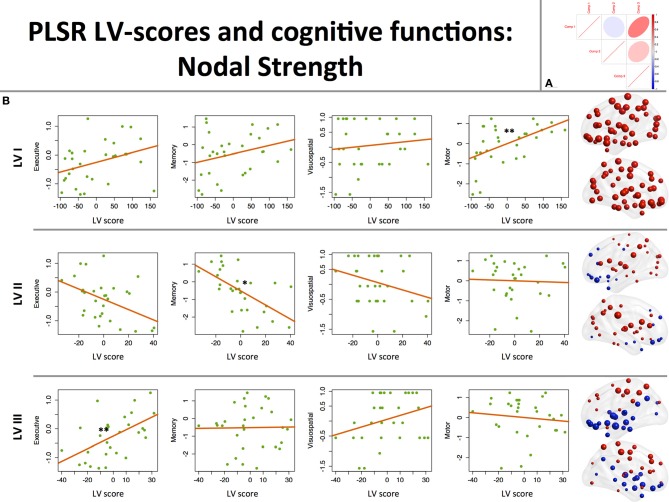
Cognitive impairment is a common non-motor feature of Parkinson's disease (PD). Understanding the neural mechanisms of this deficit is crucial for the development of efficient methods for treatment monitoring and augmentation of cognitive functions in PD patients. The current study aimed to investigate resting state fMRI correlates of cognitive impairment in PD from a large-scale network perspective, and to assess the impact of dopamine deficiency on these networks. Thirty PD patients with resting state fMRI were included from the Parkinson's Progression Marker Initiative (PPMI) database. Eighteen patients from this sample were also scanned with (123)I-FP-CIT SPECT. A standardized neuropsychological battery was administered, evaluating verbal memory, visuospatial, and executive cognitive domains. Image preprocessing was performed using an SPM8-based workflow, obtaining time-series from 90 regions-of-interest (ROIs) defined from the AAL brain atlas. The Brain Connectivity Toolbox (BCT) was used to extract nodal strength from all ROIs, and modularity of the cognitive circuitry determined using the meta-analytical software Neurosynth. Brain-behavior covariance patterns between cognitive functions and nodal strength were estimated using Partial Least Squares. Extracted latent variable (LV) scores were matched with the performances in the three cognitive domains (memory, visuospatial, and executive) and striatal dopamine transporter binding ratios (SBR) using linear modeling. Finally, influence of nigrostriatal dopaminergic deficiency on the modularity of the "cognitive network" was analyzed. For the range of deficits studied, better executive performance was associated with increased dorsal fronto-parietal cortical processing and inhibited subcortical and primary sensory involvement. This profile was also characterized by a relative preservation of nigrostriatal dopaminergic function. The profile associated with better memory performance correlated with increased prefronto-limbic processing, and was not associated with presynaptic striatal dopamine uptake. SBR ratios were negatively correlated with modularity of the "cognitive network," suggesting integrative effects of the preserved nigrostriatal dopamine system on this circuitry.
认知障碍是帕金森病(PD)的常见非运动特征。了解这种缺陷的神经机制对于开发有效的治疗监测方法和增强 PD 患者的认知功能至关重要。本研究旨在从大规模网络角度探讨 PD 认知障碍的静息态 fMRI 相关性,并评估多巴胺缺乏对这些网络的影响。从帕金森进展标志物倡议(PPMI)数据库中纳入了 30 名具有静息态 fMRI 的 PD 患者。从该样本中还对 18 名患者进行了(123)I-FP-CIT SPECT 扫描。使用标准化神经心理学测试包评估了患者的语言记忆、视空间和执行认知领域的认知功能。图像预处理使用基于 SPM8 的工作流程进行,从 AAL 大脑图谱中定义的 90 个感兴趣区(ROI)中获得时间序列。使用 Brain Connectivity Toolbox(BCT)从所有 ROI 中提取节点强度,并使用元分析软件 Neurosynth 确定认知回路的模块性。使用偏最小二乘法(PLS)估计认知功能与节点强度之间的脑-行为协方差模式。使用线性建模将提取的潜在变量(LV)分数与三个认知领域(记忆、视空间和执行)的表现以及纹状体多巴胺转运蛋白结合率(SBR)进行匹配。最后,分析了黑质纹状体多巴胺能缺陷对“认知网络”模块性的影响。对于研究范围内的缺陷,更好的执行功能与增加背侧额顶叶皮质处理以及抑制皮质下和初级感觉参与有关。这种特征还表现为黑质纹状体多巴胺能功能的相对保留。与更好的记忆表现相关的特征与前扣带回-边缘处理的增加相关,与纹状体多巴胺摄取的突触前无关。SBR 比值与“认知网络”的模块性呈负相关,表明保留的黑质纹状体多巴胺系统对该回路的整合作用。