Li Shuhua, Guo Xuefeng, Ma Xudong, Tang Cuilan, Ke Zunfu, Huang Wenhua
Department of Pathology, The First Affiliated Hospital of Sun Yat-Sen University, Guangzhou, Guangdong 510080, P.R. China.
Department of Gastrointestinal Surgery, The Sixth Affiliated Hospital of Sun Yat-Sen University, Guangzhou, Guangdong 510655, P.R. China.
Oncol Lett. 2014 May;7(5):1447-1454. doi: 10.3892/ol.2014.1950. Epub 2014 Mar 7.
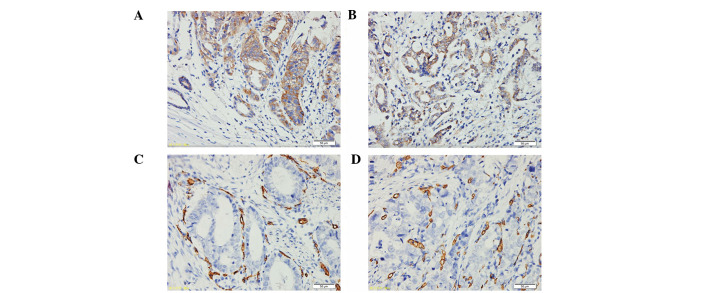
Previous studies have demonstrated that astrocyte elevated gene-1 (AEG-1) is overexpressed in several cancer types and that its upregulation may promote cell proliferation, cell transformation and tumor progression. The present study investigated the expression and prognostic value of AEG-1 in primary gastric cancer (GC) as well as its role in angiogenesis. The results obtained from real-time reverse transcription polymerase chain reaction and western blotting revealed the upregulation of AEG-1 mRNA (P=0.007) and protein expression (P<0.001) in the majority of cancerous tissues compared with matched adjacent non-cancerous gastric tissues. To further investigate the clinicopathological and prognostic roles of AEG-1, immunohistochemical analysis of 216 GC tissue blocks was performed. The results showed that high AEG-1 expression closely correlated with differentiation degree (P<0.001 ), T stage (P<0.001), N stage (P=0.003) and M stage (P=0.013). Consistent with the abovementioned results, AEG-1 upregulation was also found to significantly correlate with poor survival in GC patients (P<0.001). Furthermore, carcinomas with elevated AEG-1 expression demonstrated high vascular endothelial growth factor (VEGF) expression and microvessel density, which was labeled by cluster of differentiation 34. In addition, an AEG-1 siRNA assay in MGC-803 cells showed that the AEG-1 gene may promote VEGF and hypoxia-inducible factor-1α protein and mRNA expression. The results of the current study indicated that AEG-1 may serve as a valuable prognostic marker for GC and may be involved in regulating tumor angiogenesis.
以往研究表明,星形胶质细胞上调基因-1(AEG-1)在多种癌症类型中均有过表达,其上调可能促进细胞增殖、细胞转化及肿瘤进展。本研究调查了AEG-1在原发性胃癌(GC)中的表达及预后价值,以及其在血管生成中的作用。实时逆转录聚合酶链反应和蛋白质印迹结果显示,与配对的癌旁非癌性胃组织相比,大多数癌组织中AEG-1 mRNA(P = 0.007)和蛋白表达(P < 0.001)上调。为进一步研究AEG-1的临床病理及预后作用,对216个GC组织块进行了免疫组化分析。结果显示,AEG-1高表达与分化程度(P < 0.001)、T分期(P < 0.001)、N分期(P = 0.003)及M分期(P = 0.013)密切相关。与上述结果一致,还发现AEG-1上调与GC患者的不良生存显著相关(P < 0.001)。此外,AEG-1表达升高的癌组织显示出高血管内皮生长因子(VEGF)表达及微血管密度,微血管密度用分化簇34标记。另外,在MGC-803细胞中进行的AEG-1 siRNA检测显示,AEG-1基因可能促进VEGF及缺氧诱导因子-1α蛋白和mRNA表达。本研究结果表明,AEG-1可能作为GC的一个有价值的预后标志物,并可能参与调节肿瘤血管生成。