Department of Biology, Carleton University, 1125 Colonel By Drive, Ottawa K1S 5B6, Canada.
BMC Evol Biol. 2014 Apr 26;14:90. doi: 10.1186/1471-2148-14-90.
Semelparity and iteroparity are considered to be distinct and alternative life-history strategies, where semelparity is characterized by a single, fatal reproductive episode, and iteroparity by repeated reproduction throughout life. However, semelparous organisms do not reproduce instantaneously; typically reproduction occurs over an extended time period. If variation in reproductive allocation exists within such a prolonged reproductive episode, semelparity may be considered iteroparity over a shorter time scale.This continuity hypothesis predicts that "semelparous" organisms with relatively low probability of survival after age at first reproduction will exhibit more extreme semelparity than those with high probability of adult survival. This contrasts with the conception of semelparity as a distinct reproductive strategy expressing a discrete, single, bout of reproduction, where reproductive phenotype is expected to be relatively invariant. Here, we manipulate expected season length--and thus expected adult survival--to ask whether Lobelia inflata, a classic "semelparous" plant, exhibits plasticity along a semelparous-iteroparous continuum.
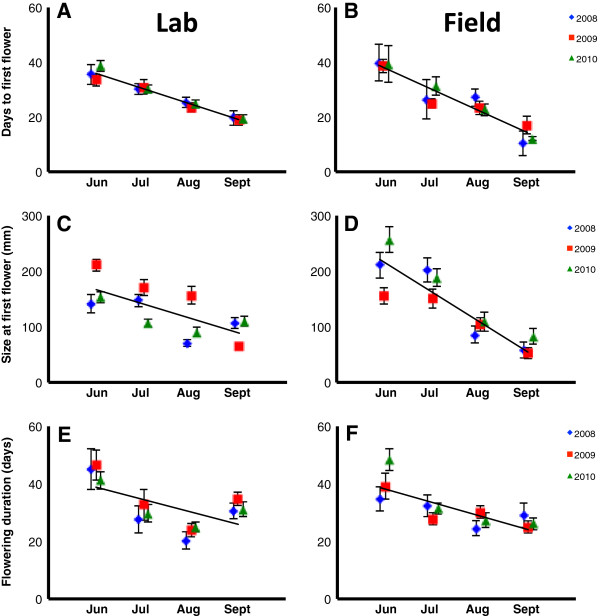
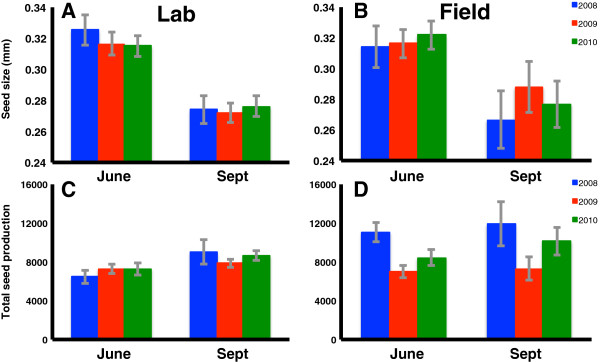
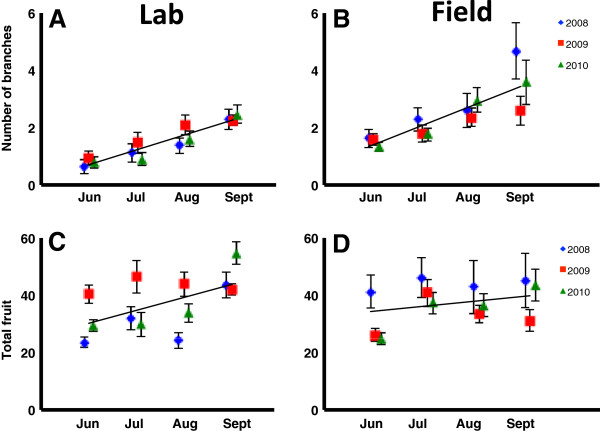
Groups of replicated genotypes were manipulated to initiate reproduction at different points in the growing season in each of three years. In lab and field populations alike, the norm of reaction in parity across a season was as predicted by the continuity hypothesis: as individuals bolted later, they showed shorter time to, and smaller size at first reproduction, and multiplied their reproductive organs through branching, thus producing offspring more simultaneously.
This work demonstrates that reproductive effort occurs along a semelparous-iteroparous continuum within a "semelparous" organism, and that variation in parity occurs within populations as a result of phenotypic plasticity.
孤雌生殖和多次生殖被认为是截然不同的、可替代的生活史策略,其中孤雌生殖的特征是单次致命的繁殖事件,而多次生殖则是一生中多次繁殖。然而,孤雌生殖生物并非瞬间繁殖;通常,繁殖会持续较长时间。如果在如此漫长的繁殖过程中存在繁殖分配的变化,那么在较短的时间尺度上,孤雌生殖可能被视为多次生殖。这个连续性假说预测,在首次繁殖后生存概率相对较低的“孤雌生殖”生物,将表现出比那些具有较高成年生存概率的生物更为极端的孤雌生殖。这与孤雌生殖作为一种独特的生殖策略形成对比,后者表达了一种离散的、单次的繁殖爆发,生殖表型预计相对不变。在这里,我们操纵预期的季节长度——从而影响成年生存概率——来探讨半边莲(一种经典的“孤雌生殖”植物)是否在孤雌生殖-多次生殖连续体上表现出可塑性。
在三年中的每一年,我们操纵了复制基因型的组,使其在不同的生长季节开始繁殖。在实验室和野外种群中,一个季节内的生殖策略反应规律都如连续性假说所预测的那样:随着个体延迟开花,它们首次繁殖的时间更短,繁殖器官更小,并且通过分枝繁殖更多的生殖器官,从而更同时地产生后代。
这项工作表明,在一个“孤雌生殖”生物中,繁殖努力沿着孤雌生殖-多次生殖连续体发生,并且由于表型可塑性,在种群内生殖策略的变异性发生。