Toth Ann M, Kuo Chu-Wei, Khoo Kay-Hooi, Jarvis Donald L
Department of Molecular Biology, University of Wyoming, Laramie, WY 82071, USA.
Institute of Biological Chemistry, Academia Sinica, Nankang, Taipei 115, Taiwan.
J Biotechnol. 2014 Jul 20;182-183:19-29. doi: 10.1016/j.jbiotec.2014.04.011. Epub 2014 Apr 24.
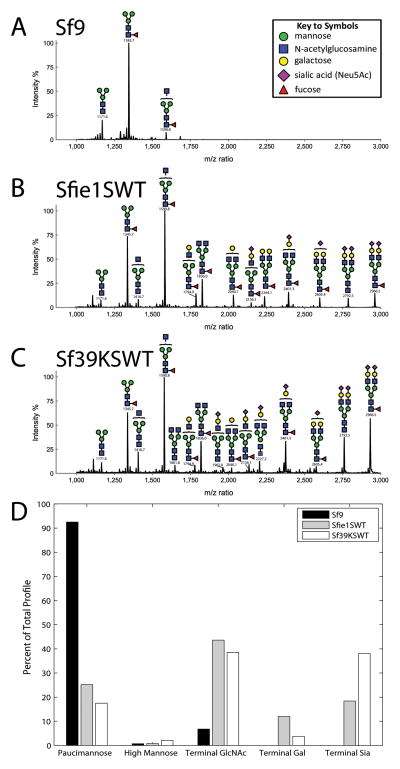
Insect cells are often glycoengineered using DNA constructs encoding foreign glyocoenzymes under the transcriptional control of the baculovirus immediate early promoter, ie1. However, we recently found that the delayed early baculovirus promoter, 39K, provides inducible and higher levels of transgene expression than ie1 after baculovirus infection (Lin and Jarvis, 2013). Thus, the purpose of this study was to assess the utility of the 39K promoter for insect cell glycoengineering. We produced two polyclonal transgenic insect cell populations in parallel using DNA constructs encoding foreign glycoenzymes under either ie1 (Sfie1SWT) or 39K (Sf39KSWT) promoter control. The surface of Sfie1SWT cells was constitutively sialylated, whereas the Sf39KSWT cell surface was only strongly sialylated after baculovirus infection, indicating Sf39KSWT cells were inducibly-glycoengineered. All nine glycogene-related transcript levels were induced by baculovirus infection of Sf39KSWT cells and most reached higher levels in Sf39KSWT than in Sfie1SWT cells at early times after infection. Similarly, galactosyltransferase activity, sialyltransferase activity, and sialic acid levels were induced and reached higher levels in baculovirus-infected Sf39KSWT cells. Finally, two different recombinant glycoproteins produced by baculovirus-infected Sf39KSWT cells had lower proportions of paucimannose-type and higher proportions of sialylated, complex-type N-glycans than those produced by baculovirus-infected Sfie1SWT cells. Thus, the 39K promoter provides baculovirus-inducible expression of foreign glycogenes, higher glycoenzyme activity levels, and higher human-type N-glycan processing efficiencies than the ie1 promoter, indicating that this delayed early baculovirus promoter has great utility for insect cell glycoengineering.
昆虫细胞通常使用在杆状病毒立即早期启动子ie1转录控制下编码外源糖基酶的DNA构建体进行糖基工程改造。然而,我们最近发现,杆状病毒延迟早期启动子39K在杆状病毒感染后比ie1提供可诱导的且更高水平的转基因表达(Lin和Jarvis,2013年)。因此,本研究的目的是评估39K启动子在昆虫细胞糖基工程中的效用。我们使用在ie1(Sfie1SWT)或39K(Sf39KSWT)启动子控制下编码外源糖基酶的DNA构建体,平行产生了两个多克隆转基因昆虫细胞群体。Sfie1SWT细胞表面组成性地进行唾液酸化,而Sf39KSWT细胞表面仅在杆状病毒感染后强烈唾液酸化,表明Sf39KSWT细胞是可诱导糖基工程改造的。杆状病毒感染Sf39KSWT细胞可诱导所有九个糖基因相关转录水平,并且在感染后的早期,大多数在Sf39KSWT细胞中达到的水平高于Sfie1SWT细胞。同样,半乳糖基转移酶活性、唾液酸转移酶活性和唾液酸水平在杆状病毒感染的Sf39KSWT细胞中被诱导并达到更高水平。最后,杆状病毒感染的Sf39KSWT细胞产生的两种不同重组糖蛋白与杆状病毒感染的Sfie1SWT细胞产生的相比,寡甘露糖型比例更低,唾液酸化、复合型N-聚糖比例更高。因此,与ie1启动子相比,39K启动子提供杆状病毒诱导的外源糖基因表达、更高的糖基酶活性水平和更高的人源型N-聚糖加工效率,表明这种杆状病毒延迟早期启动子在昆虫细胞糖基工程中具有很大的效用。