White Alexandra J, Reeve Bryce B, Chen Ronald C, Stover Angela M, Irwin Debra E
Department of Epidemiology, University of North Carolina, Chapel Hill, NC, 27599-7435, USA,
J Cancer Surviv. 2014 Sep;8(3):497-507. doi: 10.1007/s11764-014-0360-8. Epub 2014 Apr 26.
This study evaluates the prevalence and factors associated with major depressive disorder (MDD) in a population of cancer survivors and the impact of co-occurring MDD and urinary incontinence (UI) on health-related quality of life (HRQOL).
The prevalence of MDD risk among cancer survivors (breast, prostate, bladder, colorectal, lung, and endometrial/uterine cancers) and those without cancer was estimated using the Surveillance, Epidemiology and End Results Program-Medicare Health Outcomes Survey (SEER-MHOS) linked database (n = 9,282 with cancer/n = 289,744 without cancer). Risk for MDD was measured using three items from the Diagnostic Interview Schedule, and HRQOL was measured by the SF-36. UI was defined as self-reported leakage of urine causing a problem in previous 6 months. Factors associated with MDD were investigated using logistic regression, and the impact of co-occurring MDD and UI on HRQOL scores was determined using linear regression.
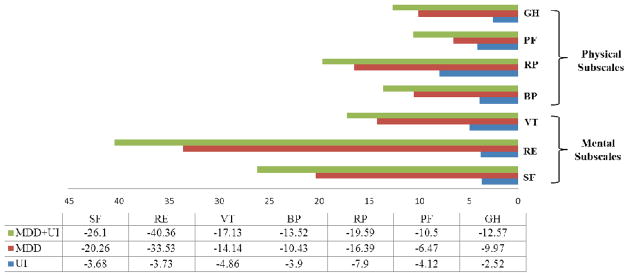
The prevalence of MDD risk ranged from 19.2 % for prostate to 34.1 % for lung. Lung cancer diagnosis was associated with risk of MDD. Being ≥5 years from diagnosis was associated with decreased risk of MDD (prevalence odds ratio (POR) = 0.82, 95 % confidence interval (95 % CI) 0.71, 0.95). The coexistence of both UI and MDD was associated with a decrease across HRQOL subscales; including 40 points on role-emotional (RE) score.
Cancer survivors reporting co-occurrence of UI and MDD experienced significant decrements in HRQOL.
Understanding the combined effect of UI and MDD may help clinicians to better recognize and alleviate their effects on cancer survivors' HRQOL.
本研究评估癌症幸存者群体中重度抑郁症(MDD)的患病率及相关因素,以及同时存在的MDD和尿失禁(UI)对健康相关生活质量(HRQOL)的影响。
使用监测、流行病学与最终结果计划 - 医疗保险健康结果调查(SEER - MHOS)关联数据库(n = 9282例癌症患者/n = 289744例非癌症患者)估算癌症幸存者(乳腺癌、前列腺癌、膀胱癌、结直肠癌、肺癌和子宫内膜癌/子宫癌)及非癌症患者中MDD风险的患病率。使用诊断访谈表中的三个项目测量MDD风险,并用SF - 36测量HRQOL。UI定义为在过去6个月内自我报告的尿液泄漏并造成问题。使用逻辑回归研究与MDD相关的因素,使用线性回归确定同时存在的MDD和UI对HRQOL评分的影响。
MDD风险的患病率从前列腺癌的19.2%到肺癌的34.1%不等。肺癌诊断与MDD风险相关。诊断后≥5年与MDD风险降低相关(患病率比值比(POR)= 0.82,95%置信区间(95%CI)0.71,0.95)。UI和MDD同时存在与HRQOL各子量表得分降低相关;包括角色情感(RE)得分降低40分。
报告同时存在UI和MDD的癌症幸存者的HRQOL显著下降。
了解UI和MDD的综合影响可能有助于临床医生更好地认识并减轻它们对癌症幸存者HRQOL的影响。