Kent Erin E, Ambs Anita, Mitchell Sandra A, Clauser Steven B, Smith Ashley Wilder, Hays Ron D
Applied Research Program, National Cancer Institute, Rockville, Maryland.
Cancer. 2015 Mar 1;121(5):758-65. doi: 10.1002/cncr.29119. Epub 2014 Nov 4.
Research on health-related quality of life (HRQOL) among older adult cancer survivors is mostly confined to breast cancer, prostate cancer, colorectal cancer, and lung cancer, which account for 63% of all prevalent cancers. Much less is known about HRQOL in the context of less common cancer sites.
HRQOL was examined with the 36-Item Short Form Health Survey, version 1, and the Veterans RAND 12-Item Health Survey in patients with selected cancers (kidney cancer, bladder cancer, pancreatic cancer, upper gastrointestinal cancer, cancer of the oral cavity and pharynx, uterine cancer, cervical cancer, thyroid cancer, melanoma, chronic leukemia, non-Hodgkin lymphoma, and multiple myeloma) and in individuals without cancer on the basis of data linked from the Surveillance, Epidemiology, and End Results cancer registry system and the Medicare Health Outcomes Survey. Scale scores, Physical Component Summary (PCS) and Mental Component Summary (MCS) scores, and a utility metric (Short Form 6D/Veterans RAND 6D), adjusted for sociodemographic characteristics and other chronic conditions, were calculated. A 3-point difference in the scale scores and a 2-point difference in the PCS and MCS scores were considered to be minimally important differences.
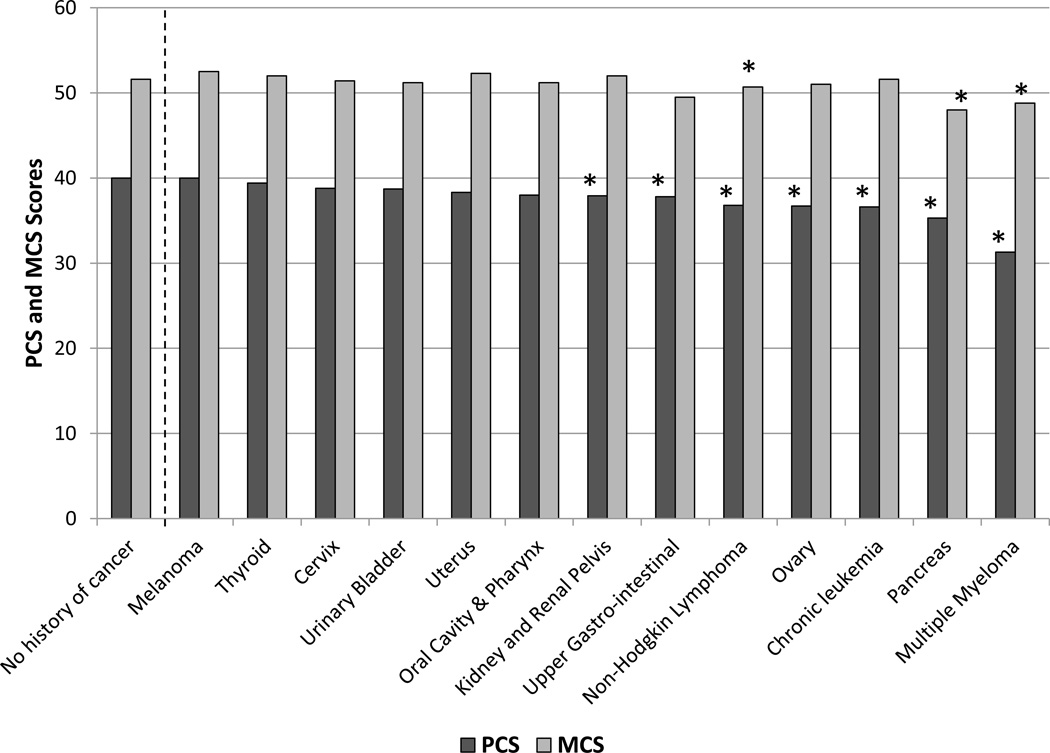
Data from 16,095 cancer survivors and 1,224,549 individuals without a history of cancer were included. The results indicated noteworthy deficits in physical health status. Mental health was comparable, although scores for the Role-Emotional and Social Functioning scales were worse for patients with most types of cancer versus those without cancer. Survivors of multiple myeloma and pancreatic malignancies reported the lowest scores, with their PCS/MCS scores less than those of individuals without cancer by 3 or more points.
HRQOL surveillance efforts revealed poor health outcomes among many older adults and specifically among survivors of multiple myeloma and pancreatic cancer.
老年癌症幸存者的健康相关生活质量(HRQOL)研究大多局限于乳腺癌、前列腺癌、结直肠癌和肺癌,这些癌症占所有常见癌症的63%。对于较少见癌症部位的HRQOL了解较少。
使用36项简明健康调查问卷第1版和退伍军人兰德12项健康调查问卷,对选定癌症(肾癌、膀胱癌、胰腺癌、上消化道癌、口腔和咽癌、子宫癌、宫颈癌、甲状腺癌、黑色素瘤、慢性白血病、非霍奇金淋巴瘤和多发性骨髓瘤)患者以及无癌症个体进行HRQOL检查,数据来自监测、流行病学和最终结果癌症登记系统与医疗保险健康结果调查的关联数据。计算调整了社会人口学特征和其他慢性病的量表分数、身体成分总结(PCS)和心理成分总结(MCS)分数以及效用指标(简明健康调查问卷6维度/退伍军人兰德6维度)。量表分数相差3分以及PCS和MCS分数相差2分被认为是最小重要差异。
纳入了16095名癌症幸存者和1224549名无癌症病史个体的数据。结果表明身体健康状况存在显著缺陷。心理健康状况相当,尽管大多数癌症类型患者的角色情感和社会功能量表分数比无癌症者更差。多发性骨髓瘤和胰腺恶性肿瘤幸存者报告的分数最低,其PCS/MCS分数比无癌症个体低3分或更多。
HRQOL监测结果显示,许多老年人,特别是多发性骨髓瘤和胰腺癌幸存者的健康状况较差。