Ahmad Ali Akbari Kamrani, Iranian Research Center on Ageing, University of Social Welfare & Rehabilitation Sciences, Tehran, Iran.
Amir Shams, Department of Physical Education and Sport Sciences, Shahid Beheshti University, Tehran, Iran.
Pak J Med Sci. 2014 Mar;30(2):417-21. doi: 10.12669/pjms.302.4386.
Sleep is an active and complex rhythmic state that may be affected by the aging process. The purpose of present research was to investigate the effect of low and moderate intensity aerobic exercises on sleep quality in older adults.
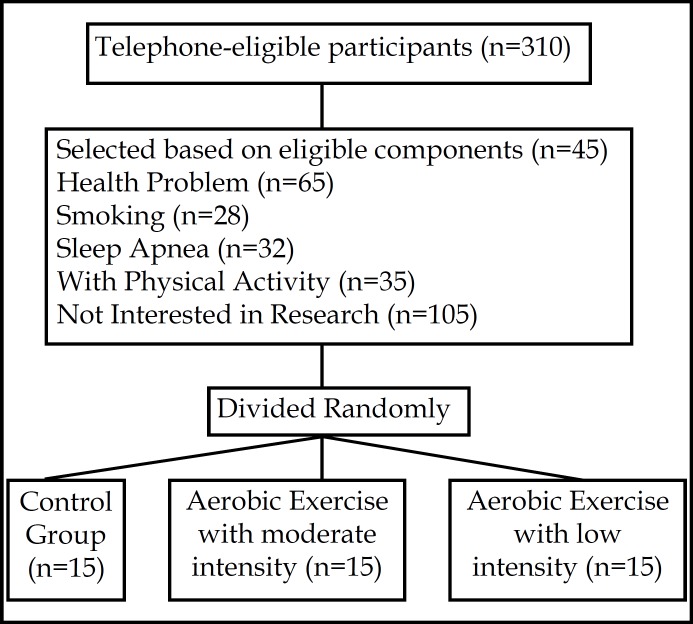
The research method is quasi-experimental with pre-test and post-test design. The statistical sample included 45 volunteer elderly men with age range of 60-70 years-old that divided randomly in two experimental groups (aerobic exercise with low and moderate intensity) and one control group. In each group selected 15 older adults based on inclusion and exclusion criteria (such as, without sleep apnea, not smoking, and no taking hypnotic drugs). First, all subjects were evaluated by a doctor to confirm their physical and mental health. Also, the maximum heart rate (MaxHR) of subjects was obtained by subtracting one's age from 220. Furthermore, based on aerobic exercise type (40-50% MaxHR for low intensity group and 60-70% MaxHR for moderate intensity group) the target MaxHR was calculated for each subject. The exercise protocol consisted of 8 weeks aerobic exercises (2 sessions in per-week) based on Rockport one-mile walking/running test and the control group continued their daily activities. All subjects in per-test and post-test stages completed the Petersburg Sleep Quality Index (PSQI).
In pre-test stage, results showed that there were no significant differences between control and experimental groups in sleep quality and its components (P>0.05). On the other hand, results in post-test stage showed that there were significant differences between control and experimental groups in these variables (P<0.05). Also, the Tukey Post Hoc showed that the moderate intensity group scores in total sleep quality and its components were better than other groups (P<0.05). Finally, the low intensity group scores in total sleep quality and its components were better than control group (P<0.05).
Generally, the present research showed that the aerobic exercises with moderate intensity (60-70% MaxHR) have a positive and significant effect on sleep quality and its components. Thus, based on these findings, the aerobic exercises with moderate intensity is a useful to improve the sleep quality and its components among community older adults were recommended.
睡眠是一种活跃而复杂的有节奏状态,可能会受到衰老过程的影响。本研究的目的是调查低强度和中等强度有氧运动对老年人睡眠质量的影响。
研究方法为准实验性,采用前后测设计。统计样本包括 45 名年龄在 60-70 岁之间的志愿老年男性,随机分为低强度和中等强度有氧运动两个实验组和一个对照组。在每个组中,根据纳入和排除标准(如无睡眠呼吸暂停、不吸烟、不服用催眠药物)选择 15 名老年人。首先,所有受试者都由医生进行评估,以确认他们的身心健康。此外,通过从 220 中减去一个人的年龄来获得受试者的最大心率(MaxHR)。此外,根据有氧运动类型(低强度组为 40-50% MaxHR,中等强度组为 60-70% MaxHR),为每个受试者计算目标 MaxHR。运动方案包括基于 Rockport 一英里步行/跑步测试的 8 周有氧运动(每周 2 次),对照组继续进行日常活动。在每个测试和测试后阶段,所有受试者都完成了彼得堡睡眠质量指数(PSQI)。
在预测试阶段,结果表明对照组和实验组在睡眠质量及其各组成部分方面无显著差异(P>0.05)。另一方面,在测试后阶段的结果表明,对照组和实验组在这些变量方面存在显著差异(P<0.05)。此外,Tukey 事后检验显示,中等强度组在总睡眠质量及其各组成部分的评分均优于其他组(P<0.05)。最后,低强度组在总睡眠质量及其各组成部分的评分均优于对照组(P<0.05)。
总体而言,本研究表明,中等强度(60-70% MaxHR)的有氧运动对睡眠质量及其各组成部分有积极显著的影响。因此,根据这些发现,建议社区老年人进行中等强度的有氧运动,以提高睡眠质量及其各组成部分。