State Key Laboratory of Biotherapy, West China Hospital, Sichuan University, Chengdu 610041, Sichuan, China.
West China School of Pharmacy, Sichuan University, Chengdu 610041, Sichuan, China.
Int J Mol Sci. 2014 Apr 25;15(5):7199-212. doi: 10.3390/ijms15057199.
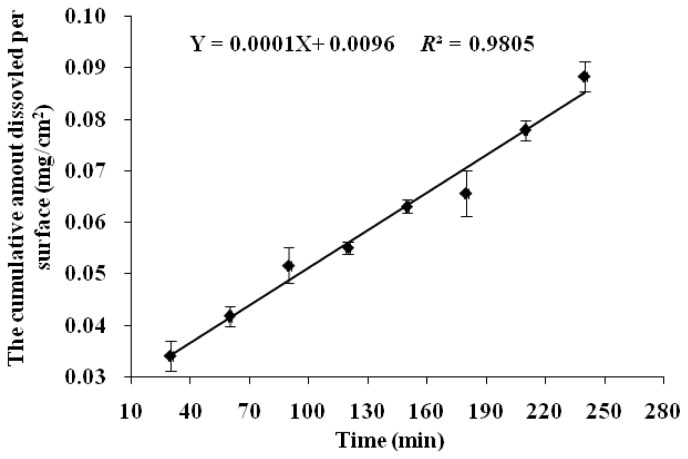
Specific biopharmaceutics classification investigation and study on phamacokinetic profile of a novel drug candidate (2-methylcarbamoyl-4-{4-[3- (trifluoromethyl) benzamido] phenoxy} pyridinium 4-methylbenzenesulfonate monohydrate, NCE) were carried out. Equilibrium solubility and intrinsic dissolution rate (IDR) of NCE were estimated in different phosphate buffers. Effective intestinal permeability (P(eff)) of NCE was determined using single-pass intestinal perfusion technique in rat duodenum, jejunum and ileum at three concentrations. Theophylline (high permeability) and ranitidine (low permeability) were also applied to access the permeability of NCE as reference compounds. The bioavailability after intragastrical and intravenous administration was measured in beagle dogs. The solubility of NCE in tested phosphate buffers was quite low with the maximum solubility of 81.73 μg/mL at pH 1.0. The intrinsic dissolution ratio of NCE was 1 × 10⁻⁴ mg·min⁻¹·cm⁻². The P(eff) value of NCE in all intestinal segments was more proximate to the high-permeability reference theophylline. Therefore, NCE was classified as class II drug according to Biopharmaceutics Classification System due to its low solubility and high intestinal permeability. In addition, concentration-dependent permeability was not observed in all the segments, indicating that there might be passive transportation for NCE. The absolute oral bioavailability of NCE in beagle dogs was 26.75%. Therefore, dissolution promotion will be crucial for oral formulation development and intravenous administration route will also be suggested for further NCE formulation development. All the data would provide a reference for biopharmaceutics classification research of other novel drug candidates.
对一种新型候选药物(2-甲基氨基甲酰基-4-{4-[3-(三氟甲基)苯甲酰胺基]苯氧基}吡啶𬭩 4-甲基苯磺酸盐一水合物,NCE)进行了特定的生物药剂学分类研究和药代动力学特征研究。在不同的磷酸盐缓冲液中评估了 NCE 的平衡溶解度和固有溶出速率(IDR)。采用大鼠十二指肠、空肠和回肠的单向肠灌流技术,在三个浓度下测定了 NCE 的有效肠道渗透性(P(eff))。还应用茶碱(高渗透性)和雷尼替丁(低渗透性)作为参考化合物来评估 NCE 的渗透性。在比格犬中测量了口服和静脉给药后的生物利用度。NCE 在测试的磷酸盐缓冲液中的溶解度相当低,在 pH 1.0 时最大溶解度为 81.73μg/mL。NCE 的固有溶出比为 1×10⁻⁴mg·min⁻¹·cm⁻²。NCE 在所有肠段的 P(eff)值都更接近高渗透性参考茶碱。因此,根据生物药剂学分类系统,由于其低溶解度和高肠道渗透性,NCE 被分类为 II 类药物。此外,在所有节段均未观察到浓度依赖性渗透性,表明 NCE 可能通过被动转运。NCE 在比格犬中的绝对口服生物利用度为 26.75%。因此,对于口服制剂的开发,促进溶解将是至关重要的,并且还将建议静脉给药途径用于进一步的 NCE 制剂开发。所有数据将为其他新型候选药物的生物药剂学分类研究提供参考。