Department of Pathology, University of Cambridge, Cambridge CB2 1QP, United Kingdom; Centre for Trophoblast Research, University of Cambridge, Cambridge CB2 1QP, United Kingdom;
Cancer and Inflammation Program, Laboratory of Experimental Immunology, Leidos Biomedical Research, Inc., Frederick National Laboratory, Frederick, MD 21702; Ragon Institute of Massachusetts General Hospital, Massachusetts Institute of Technology and Harvard University, Cambridge, MA 02139;
J Immunol. 2014 Jun 1;192(11):5069-73. doi: 10.4049/jimmunol.1400577. Epub 2014 Apr 28.
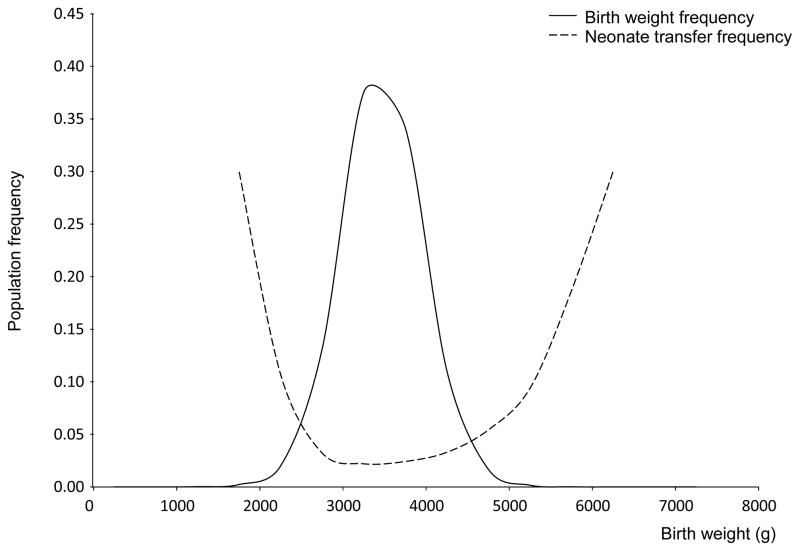
Human birth weight is subject to stabilizing selection; babies born too small or too large are less likely to survive. Particular combinations of maternal/fetal immune system genes are associated with pregnancies where the babies are ≤ 5th birth weight centile, specifically an inhibitory maternal KIR AA genotype with a paternally derived fetal HLA-C2 ligand. We have now analyzed maternal KIR and fetal HLA-C combinations at the opposite end of the birth weight spectrum. Mother/baby pairs (n = 1316) were genotyped for maternal KIR as well as fetal and maternal HLA-C. Presence of a maternal-activating KIR2DS1 gene was associated with increased birth weight in linear or logistic regression analyses of all pregnancies >5th centile (p = 0.005, n = 1316). Effect of KIR2DS1 was most significant in pregnancies where its ligand, HLA-C2, was paternally but not maternally inherited by a fetus (p = 0.005, odds ratio = 2.65). Thus, maternal KIR are more frequently inhibitory with small babies but activating with big babies. At both extremes of birth weight, the KIR associations occur when their HLA-C2 ligand is paternally inherited by a fetus. We conclude that the two polymorphic immune gene systems, KIR and HLA-C, contribute to successful reproduction by maintaining birth weight between two extremes with a clear role for paternal HLA.
人类的出生体重受到稳定选择的影响;出生体重过小或过大的婴儿存活的可能性较低。特定的母婴免疫系统基因组合与出生体重处于第 5 百分位数以下的妊娠有关,特别是具有抑制性母体 KIR AA 基因型和来自父本的胎儿 HLA-C2 配体。我们现在分析了出生体重谱另一端的母婴 KIR 和胎儿 HLA-C 组合。对 1316 对母婴进行了母婴 KIR 以及胎儿和母体 HLA-C 的基因分型。在所有大于第 5 百分位数的妊娠的线性或逻辑回归分析中,母体激活型 KIR2DS1 基因的存在与出生体重增加相关(p=0.005,n=1316)。在其配体 HLA-C2 由父亲而不是母亲遗传给胎儿的妊娠中,KIR2DS1 的作用最为显著(p=0.005,优势比=2.65)。因此,母婴 KIR 在婴儿较小时更常具有抑制作用,而在婴儿较大时具有激活作用。在出生体重的两个极端,当胎儿从父亲那里继承 HLA-C2 配体时,KIR 关联就会发生。我们得出结论,两种多态性免疫基因系统 KIR 和 HLA-C 通过在两个极端之间维持出生体重来促进成功繁殖,而父亲的 HLA 起着明确的作用。