Pazarbasi A, Demirhan O, Alptekin D, Ozgunen Ft, Ozpak L, Yilmaz Mb, Nazlican E, Tanriverdi N, Luleyap U, Gümürdülü D
Çukurova University, Faculty of Medicine, Department of Medical Biology and Genetics, Adana, Turkey.
Çukurova University, Faculty of Medicine, Department of Obstetrics and Gynecology, Adana, Turkey.
Balkan J Med Genet. 2013 Dec;16(2):91-6. doi: 10.2478/bjmg-2013-0039.
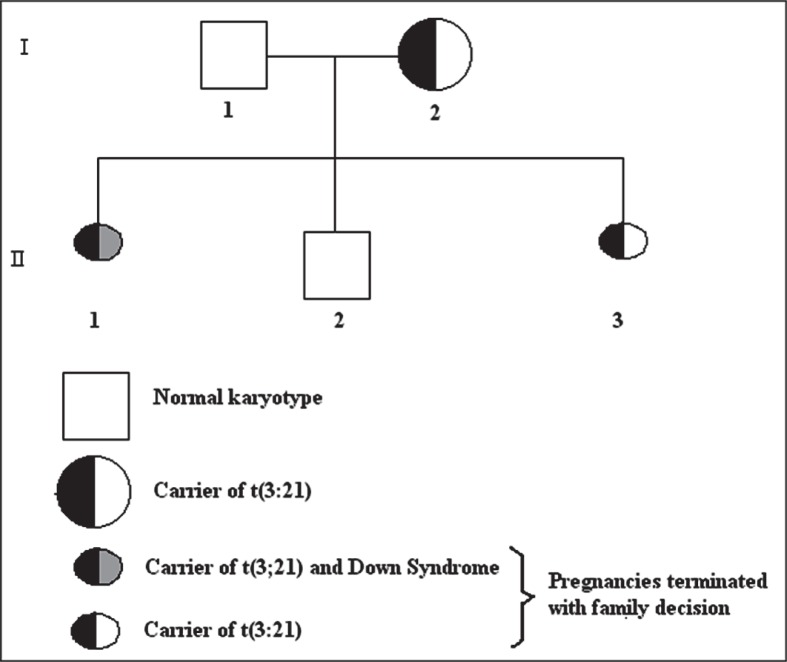
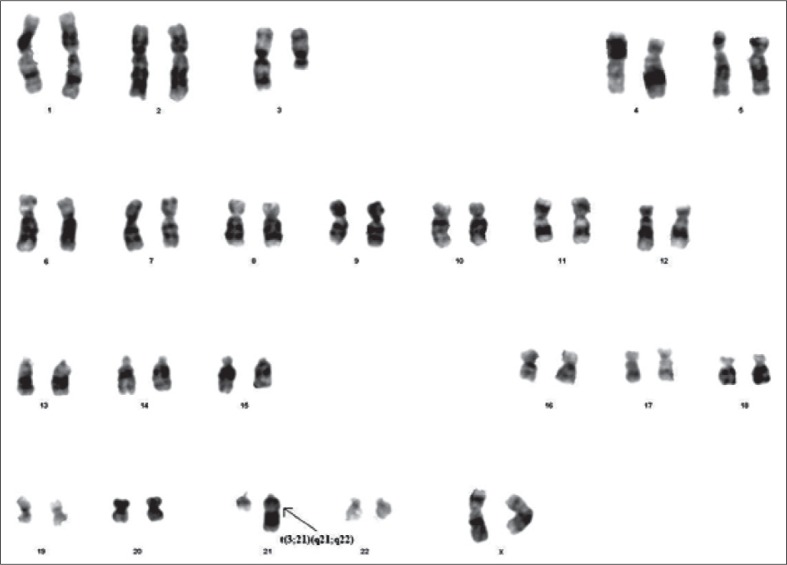
The majority of chromosome rearrangements are balanced reciprocal and Robertsonian translocations. It is now known that such abnormalities cause no phenotypic effect on the carrier but lead to increased risk of producing unbalanced gametes. Here, we report the inheritance of a translocation between chromosomes 3 and 21 in a family with one of two fetuses with Down Syndrome carrying the same translocation and the other also carrying the same translocation without the additional chromosome 21. Chromosomal analysis from fetal amniotic fluid and peripheral blood lymphocytes from the family were performed at the Çukurova University Hospital at Adana, Turkey. We assessed a family in which the translocation between chromosomes 3 and 21 segregates: one of the three progenies carried the 47,XX,+21,t(3;21)(q21;q22) karyotype and presented with Down Syndrome; another of the three progenies carried the 46,XX,t(3;21) (q21;q22) karyotype and the third had the 46,XY karyotype. Their mother is phenotypically normal. Apparently this rearrangement occurred due to an unbalanced chromosome segregation of the mother [t(3;21)(q21;q22)mat]. This family will enable us to explain the behavior of segregation patterns and the mechanism for each type of translocation from carrier to carrier and their effects on reproduction and numerical aberrations. These findings can be used in clinical genetics and may be used as an effective tool for reproductive guidance and genetic counseling.
大多数染色体重排是平衡易位和罗伯逊易位。现在已知此类异常对携带者没有表型影响,但会增加产生不平衡配子的风险。在此,我们报告一个家庭中3号和21号染色体之间易位的遗传情况,该家庭中有两个胎儿,其中一个患有唐氏综合征且携带相同的易位,另一个也携带相同的易位但没有额外的21号染色体。来自土耳其阿达纳的库库罗瓦大学医院对该家庭的胎儿羊水和外周血淋巴细胞进行了染色体分析。我们评估了一个3号和21号染色体之间易位发生分离的家庭:三个后代中的一个携带47,XX,+21,t(3;21)(q21;q22)核型并患有唐氏综合征;三个后代中的另一个携带46,XX,t(3;21)(q21;q22)核型,第三个具有46,XY核型。他们的母亲表型正常。显然,这种重排是由于母亲[t(3;21)(q21;q22)mat]的染色体分离不平衡所致。这个家庭将使我们能够解释分离模式的行为以及每种类型易位从携带者到携带者的机制及其对生殖和数目畸变的影响。这些发现可用于临床遗传学,并可作为生殖指导和遗传咨询的有效工具。