Zambello Renato, Teramo Antonella, Gattazzo Cristina, Semenzato Gianpietro
Padua University School of Medicine, Department of Medicine, Hematology and Clinical Immunology Branch , Padua, Italy ; Venetian Institute of Molecular Medicine (VIMM) , Padua, Italy.
Transl Med UniSa. 2014 Feb 4;8:4-11. eCollection 2014 Jan.
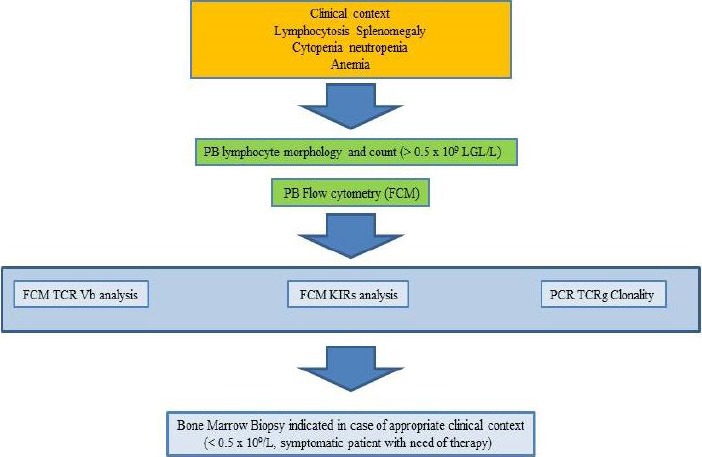
Mature Large Granular lymphocytes (LGL) disorders include a spectrum of conditions, ranging from polyclonal to clonal indolent and/or overt leukemic LGL proliferations. Most cases are represented by clonal expansions of TCRα/β+ LGL displaying a CD8+ phenotype with expression of cytotoxic T-cell antigens (CD57, CD16, TIA-1, perforin and granzyme B). Proliferations of CD3-CD16+ NK cells with a restricted patter of NK receptors are less common, usually comprising 15% of the cases. Main features are cytopenias, splenomegaly and autoimmune phenomena. Morphology, immunophenotyping and molecular analyses are crucial to establish a correct diagnosis of disease. According to the 2008 WHO classification, two separate entities account for the majority of cases, T-LGL leukemia and Chronic Lymphoproliferative Disease of NK cell (this latter still provisional). Although these disorders are characterized by the expansion of different cells types i.e. T and NK cells, with specific genetic features and abnormalities, compelling evidence supports the hypothesis that a common pathogenic mechanism would be involved in both disorders. As a matter of fact, a foreign antigen driven clonal selection is considered the initial step in the mechanism ultimately leading to generation of both conditions. In this chapter we will discuss recent advances on the pathogenesis of chronic T and NK disorders of granular lymphocytes, challenging the current WHO classification on the opportunity to separate T and NK disorders, which are likely to represent two sides of the same coin.
成熟大颗粒淋巴细胞(LGL)疾病包括一系列病症,范围从多克隆到克隆性惰性和/或明显的白血病性LGL增殖。大多数病例表现为TCRα/β+ LGL的克隆性扩增,呈现CD8+表型并表达细胞毒性T细胞抗原(CD57、CD16、TIA-1、穿孔素和颗粒酶B)。具有受限NK受体模式的CD3-CD16+ NK细胞增殖较少见,通常占病例的15%。主要特征是血细胞减少、脾肿大和自身免疫现象。形态学、免疫表型分析和分子分析对于正确诊断疾病至关重要。根据2008年世界卫生组织(WHO)分类,两个独立的实体占大多数病例,即T-LGL白血病和NK细胞慢性淋巴细胞增殖性疾病(后者仍为暂定)。尽管这些疾病的特征是不同细胞类型(即T细胞和NK细胞)的扩增,具有特定的遗传特征和异常,但有力的证据支持这两种疾病涉及共同致病机制的假说。事实上,外来抗原驱动的克隆选择被认为是最终导致这两种疾病产生的机制中的初始步骤。在本章中,我们将讨论颗粒淋巴细胞慢性T和NK疾病发病机制的最新进展,对当前WHO关于区分T和NK疾病的分类提出挑战,因为它们可能是同一枚硬币的两面。