
肿瘤坏死因子家族成员LIGHT(TNFSF14)对与支气管上皮细胞相互作用的嗜碱性粒细胞和嗜酸性粒细胞激活的影响。
Effect of tumor necrosis factor family member LIGHT (TNFSF14) on the activation of basophils and eosinophils interacting with bronchial epithelial cells.
作者信息
Qiu Huai Na, Wong Chun Kwok, Dong Jie, Lam Christopher Wai-Kei, Cai Zhe
机构信息
Department of Chemical Pathology, The Chinese University of Hong Kong, Prince of Wales Hospital, Shatin, New Territories, Hong Kong.
Department of Chemical Pathology, The Chinese University of Hong Kong, Prince of Wales Hospital, Shatin, New Territories, Hong Kong ; Institute of Chinese Medicine and State Key Laboratory of Phytochemistry and Plant Resources in West China, The Chinese University of Hong Kong, Hong Kong ; Shenzhen Research Institute, The Chinese University of Hong Kong, Shenzhen, China.
出版信息
Mediators Inflamm. 2014;2014:136463. doi: 10.1155/2014/136463. Epub 2014 Mar 25.
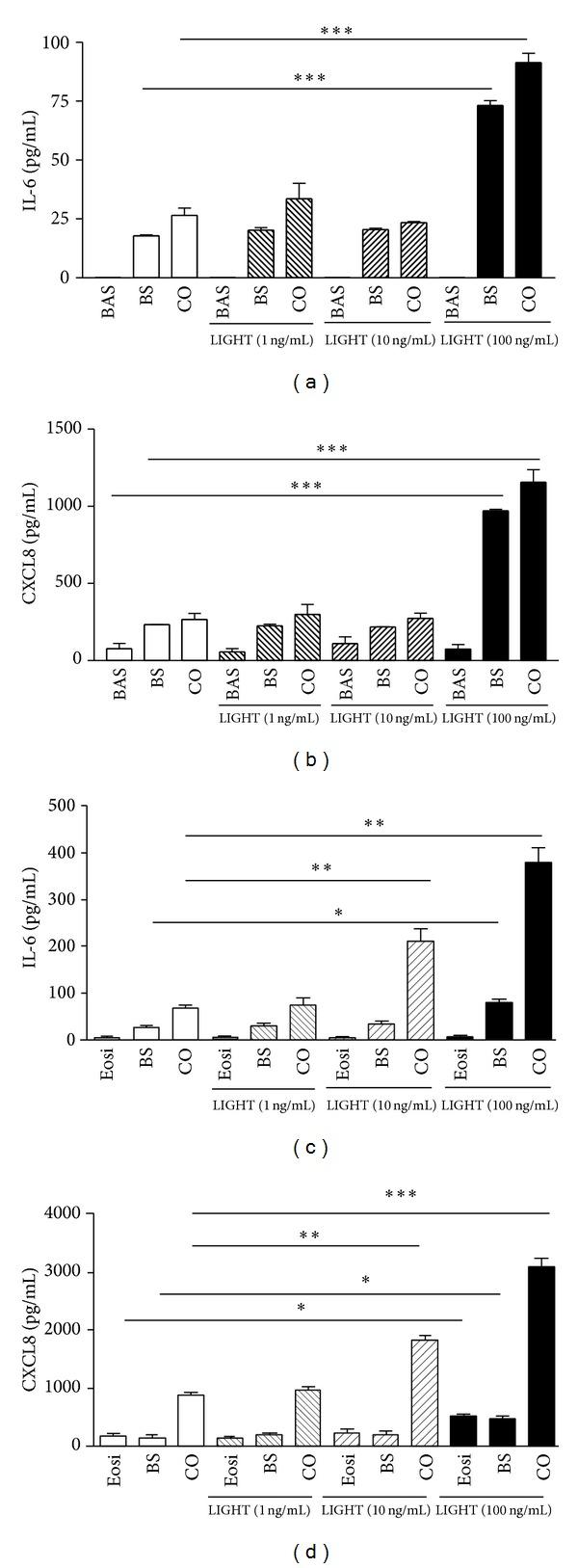
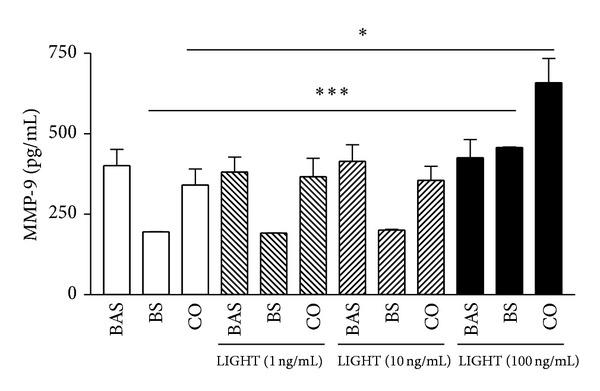
Allergic asthma can cause airway structural remodeling, involving the accumulation of extracellular matrix and thickening of smooth muscle. Tumor necrosis factor (TNF) family ligand LIGHT (TNFSF14) is a cytokine that binds herpesvirus entry mediator (HVEM)/TNFRSF14 and lymphotoxin β receptor (LTβR). LIGHT induces asthmatic cytokine IL-13 and fibrogenic cytokine transforming growth factor-β release from allergic asthma-related eosinophils expressing HVEM and alveolar macrophages expressing LTβR, respectively, thereby playing crucial roles in asthmatic airway remodeling. In this study, we investigated the effects of LIGHT on the coculture of human basophils/eosinophils and bronchial epithelial BEAS-2B cells. The expression of adhesion molecules, cytokines/chemokines, and matrix metalloproteinases (MMP) was measured by flow cytometry, multiplex, assay or ELISA. Results showed that LIGHT could significantly promote intercellular adhesion, cell surface expression of intercellular adhesion molecule-1, release of airway remodeling-related IL-6, CXCL8, and MMP-9 from BEAS-2B cells upon interaction with basophils/eosinophils, probably via the intercellular interaction, cell surface receptors HVEM and LTβR on BEAS-2B cells, and extracellular signal-regulated kinase, p38 mitogen activated protein kinase, and NF-κB signaling pathways. The above results, therefore, enhance our understanding of the immunopathological roles of LIGHT in allergic asthma and shed light on the potential therapeutic targets for airway remodeling.
过敏性哮喘可导致气道结构重塑,包括细胞外基质的积聚和平滑肌增厚。肿瘤坏死因子(TNF)家族配体LIGHT(TNFSF14)是一种细胞因子,可与疱疹病毒进入介质(HVEM)/TNFRSF14和淋巴毒素β受体(LTβR)结合。LIGHT分别诱导哮喘相关细胞因子IL-13和促纤维化细胞因子转化生长因子-β从表达HVEM的过敏性哮喘相关嗜酸性粒细胞和表达LTβR的肺泡巨噬细胞中释放,从而在哮喘气道重塑中发挥关键作用。在本研究中,我们研究了LIGHT对人嗜碱性粒细胞/嗜酸性粒细胞与支气管上皮BEAS-2B细胞共培养的影响。通过流式细胞术、多重分析或酶联免疫吸附测定法检测黏附分子、细胞因子/趋化因子和基质金属蛋白酶(MMP)的表达。结果表明,LIGHT可能通过细胞间相互作用、BEAS-2B细胞表面受体HVEM和LTβR以及细胞外信号调节激酶、p38丝裂原活化蛋白激酶和NF-κB信号通路,在与嗜碱性粒细胞/嗜酸性粒细胞相互作用时,显著促进BEAS-2B细胞的细胞间黏附、细胞间黏附分子-1的细胞表面表达、气道重塑相关IL-6、CXCL8和MMP-9的释放。因此,上述结果加深了我们对LIGHT在过敏性哮喘中免疫病理作用的理解,并为气道重塑的潜在治疗靶点提供了线索。




 Zotero 插件