Institute for Epidemiology and Pathogen Diagnostics, Julius Kühn-Institut Braunschweig, Germany ; Department of Plant Health, Leibniz Institute of Vegetable and Ornamental Crops Großbeeren/Erfurt e.V. Großbeeren, Germany.
Institute for Epidemiology and Pathogen Diagnostics, Julius Kühn-Institut Braunschweig, Germany ; College of Resources and Environmental Sciences, China Agricultural University Beijing, China.
Front Microbiol. 2014 Apr 8;5:144. doi: 10.3389/fmicb.2014.00144. eCollection 2014.
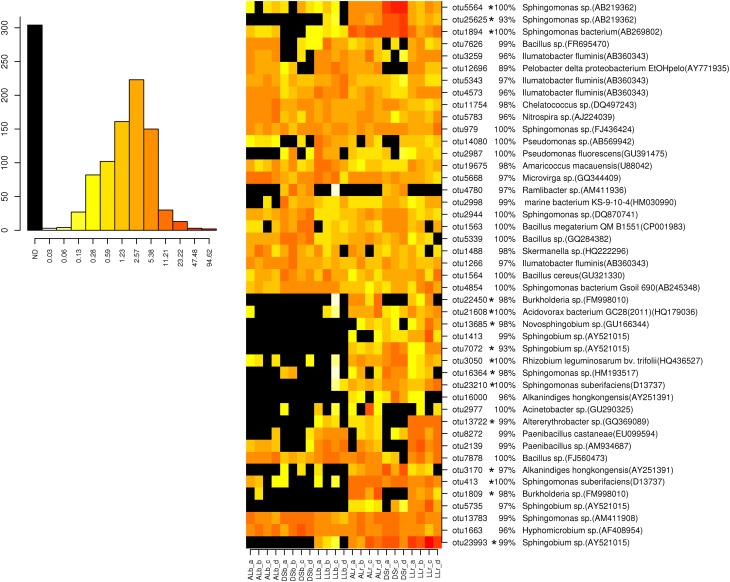
The complex and enormous diversity of microorganisms associated with plant roots is important for plant health and growth and is shaped by numerous factors. This study aimed to unravel the effects of the soil type on bacterial communities in the rhizosphere of field-grown lettuce. We used an experimental plot system with three different soil types that were stored at the same site for 10 years under the same agricultural management to reveal differences directly linked to the soil type and not influenced by other factors such as climate or cropping history. Bulk soil and rhizosphere samples were collected 3 and 7 weeks after planting. The analysis of 16S rRNA gene fragments amplified from total community DNA by denaturing gradient gel electrophoresis and pyrosequencing revealed soil type dependent differences in the bacterial community structure of the bulk soils and the corresponding rhizospheres. The rhizosphere effect differed depending on the soil type and the plant growth developmental stage. Despite the soil type dependent differences in the bacterial community composition several genera such as Sphingomonas, Rhizobium, Pseudomonas, and Variovorax were significantly increased in the rhizosphere of lettuce grown in all three soils. The number of rhizosphere responders was highest 3 weeks after planting. Interestingly, in the soil with the highest numbers of responders the highest shoot dry weights were observed. Heatmap analysis revealed that many dominant operational taxonomic units were shared among rhizosphere samples of lettuce grown in diluvial sand, alluvial loam, and loess loam and that only a subset was increased in relative abundance in the rhizosphere compared to the corresponding bulk soil. The findings of the study provide insights into the effect of soil types on the rhizosphere microbiome of lettuce.
与植物根系相关的微生物种类繁多且复杂,这对植物的健康和生长很重要,并且受到许多因素的影响。本研究旨在揭示土壤类型对田间生长生菜根际细菌群落的影响。我们使用了一个实验性的田间系统,该系统由三种不同的土壤类型组成,这些土壤在相同的农业管理下,在同一地点储存了 10 年,以直接揭示与土壤类型有关的差异,而不受气候或种植历史等其他因素的影响。在种植后 3 周和 7 周采集了原状土和根际样本。通过变性梯度凝胶电泳和焦磷酸测序对从总群落 DNA 扩增的 16S rRNA 基因片段的分析表明,土壤类型对原状土和相应根际的细菌群落结构有依赖性差异。根际效应取决于土壤类型和植物生长发育阶段。尽管细菌群落组成存在土壤类型依赖性差异,但在所有三种土壤中生长的生菜根际中, Sphingomonas 、 Rhizobium 、 Pseudomonas 和 Variovorax 等几个属的数量显著增加。种植后 3 周时,根际反应者的数量最多。有趣的是,在根际反应者数量最高的土壤中,地上部干重最高。热图分析表明,在由洪积沙、冲积壤土和黄土母质壤土生长的生菜根际样本中,许多优势操作分类单元是共享的,并且只有一部分在根际相对于相应的原状土中相对丰度增加。该研究的结果提供了对土壤类型对生菜根际微生物组影响的深入了解。