Chaldakov George Nikov, Fiore Marco, Ghenev Peter I, Beltowski Jerzy, Ranćić Gorana, Tunçel Neşe, Aloe Luigi
Laboratory of Cell Biology, Department of Anatomy and Histology, Medical University , Varna , Bulgaria.
Institute of Cellular Biology and Neurobiology, National Research Council , Rome , Italy.
Front Immunol. 2014 Apr 8;5:130. doi: 10.3389/fimmu.2014.00130. eCollection 2014.
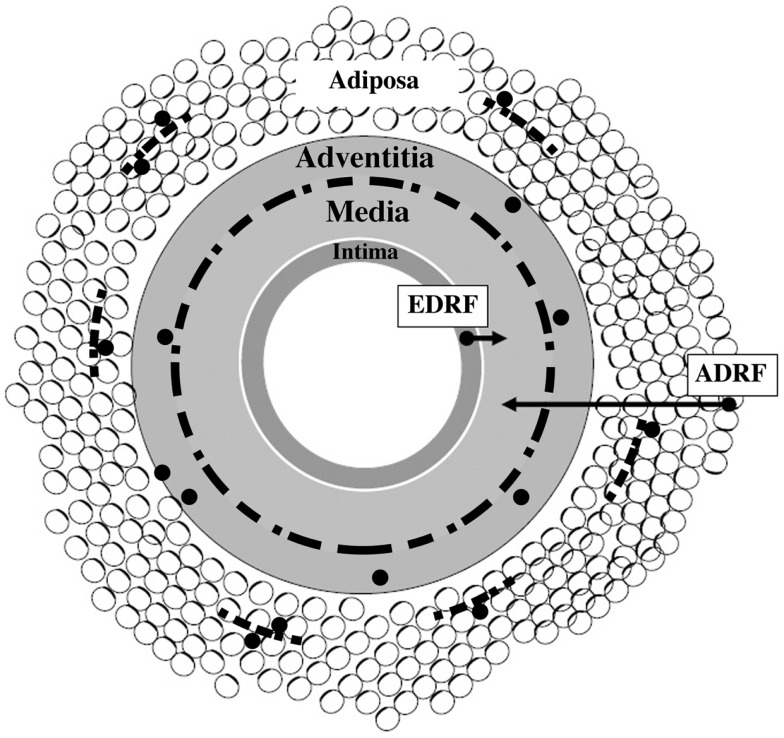
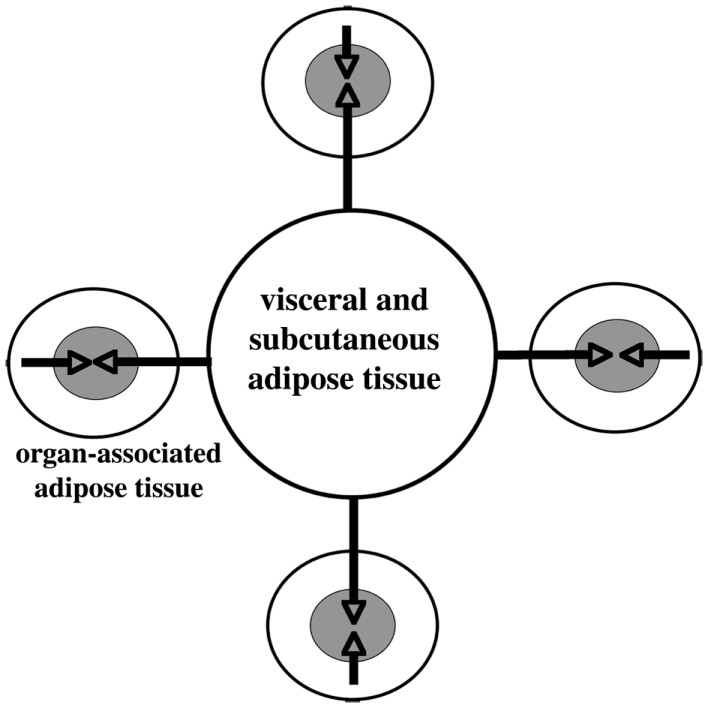
Understanding how the precise interactions of nerves, immune cells, and adipose tissue account for cardiovascular and metabolic biology is a central aim of biomedical research at present. A long standing paradigm holds that the vascular wall is composed of three concentric tissue coats (tunicae): intima, media, and adventitia. However, large- and medium-sized arteries, where usually atherosclerotic lesions develop, are consistently surrounded by periadventitial adipose tissue (PAAT), we recently designated tunica adiposa (in brief, adiposa like intima, media, and adventitia). Today, atherosclerosis is considered an immune-mediated inflammatory disease featured by endothelial dysfunction/intimal thickening, medial atrophy, and adventitial lesions associated with adipose dysfunction, whereas hypertension is characterized by hyperinnervation-associated medial thickening due to smooth muscle cell hypertrophy/hyperplasia. PAAT expansion is associated with increased infiltration of immune cells, both adipocytes and immunocytes secreting pro-inflammatory and anti-inflammatory (metabotrophic) signaling proteins collectively dubbed adipokines. However, the role of vascular nerves and their interactions with immune cells and paracrine adipose tissue is not yet evaluated in such an integrated way. The present review attempts to briefly highlight the findings in basic and translational sciences in this area focusing on neuro-immune-adipose interactions, herein referred to as triactome. Triactome-targeted pharmacology may provide a novel therapeutic approach in cardiovascular disease.
理解神经、免疫细胞和脂肪组织之间的精确相互作用如何影响心血管和代谢生物学,是当前生物医学研究的核心目标。长期以来的一种范式认为,血管壁由三层同心组织层(膜)组成:内膜、中膜和外膜。然而,通常发生动脉粥样硬化病变的大中型动脉,一直被外膜周围脂肪组织(PAAT)所包围,我们最近将其命名为脂肪膜(简而言之,类似内膜、中膜和外膜的脂肪膜)。如今,动脉粥样硬化被认为是一种免疫介导的炎症性疾病,其特征为内皮功能障碍/内膜增厚、中膜萎缩以及与脂肪功能障碍相关的外膜病变,而高血压的特征是由于平滑肌细胞肥大/增生导致的与神经支配过度相关的中膜增厚。PAAT的扩张与免疫细胞浸润增加有关,脂肪细胞和免疫细胞都会分泌统称为脂肪因子的促炎和抗炎(代谢营养型)信号蛋白。然而,血管神经及其与免疫细胞和旁分泌脂肪组织的相互作用尚未以这种综合方式进行评估。本综述试图简要强调该领域基础科学和转化科学的研究结果,重点关注神经 - 免疫 - 脂肪相互作用,在此称为三元组。针对三元组的药理学可能为心血管疾病提供一种新的治疗方法。