Environment and Ecology Research Group, Faculty of Life Sciences, University of Manchester Manchester, UK.
Front Genet. 2014 Apr 8;5:72. doi: 10.3389/fgene.2014.00072. eCollection 2014.
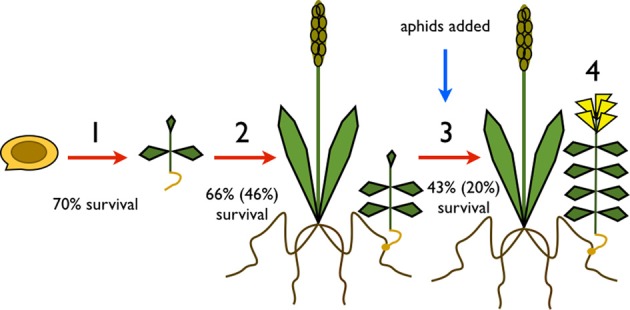
When parasitic plants and aphid herbivores share a host, both direct and indirect ecological effects (IEEs) can influence evolutionary processes. We used a hemiparasitic plant (Rhinanthus minor), a grass host (Hordeum vulgare) and a cereal aphid (Sitobion avenae) to investigate the genetics of IEEs between the aphid and the parasitic plant, and looked to see how these might affect or be influenced by the genetic diversity of the host plants. Survival of R. minor depended on the parasite's population of origin, the genotypes of the aphids sharing the host and the genetic diversity in the host plant community. Hence the indirect effects of the aphids on the parasitic plants depended on the genetic environment of the system. Here, we show that genetic variation can be important in determining the outcome of IEEs. Therefore, IEEs have the potential to influence evolutionary processes and the continuity of species interactions over time.
当寄生植物和蚜虫食草动物共享一个宿主时,直接和间接生态效应(IEEs)都会影响进化过程。我们使用半寄生植物(黄花棘豆)、一种禾本科植物(大麦)和一种谷类蚜虫(燕麦缢管蚜)来研究蚜虫和寄生植物之间的 IEEs 的遗传基础,并观察这些遗传基础如何影响或受宿主植物遗传多样性的影响。黄花棘豆的存活率取决于寄生虫的种群起源、共享宿主的蚜虫基因型以及宿主植物群落的遗传多样性。因此,蚜虫对寄生植物的间接影响取决于系统的遗传环境。在这里,我们表明遗传变异在确定 IEEs 的结果方面可能很重要。因此,IEEs 有可能影响进化过程和物种相互作用的连续性随时间的推移。