Lawrence Lauren, Sincan Murat, Markello Thomas, Adams David R, Gill Fred, Godfrey Rena, Golas Gretchen, Groden Catherine, Landis Dennis, Nehrebecky Michele, Park Grace, Soldatos Ariane, Tifft Cynthia, Toro Camilo, Wahl Colleen, Wolfe Lynne, Gahl William A, Boerkoel Cornelius F
1] National Institutes of Health (NIH) Undiagnosed Diseases Program, Common Fund, NIH Office of the Director and National Human Genome Research Institute, Bethesda, Maryland, USA [2] Keck School of Medicine, University of Southern California, Los Angeles, California, USA.
National Institutes of Health (NIH) Undiagnosed Diseases Program, Common Fund, NIH Office of the Director and National Human Genome Research Institute, Bethesda, Maryland, USA.
Genet Med. 2014 Oct;16(10):741-50. doi: 10.1038/gim.2014.29. Epub 2014 May 1.
Using exome sequence data from 159 families participating in the National Institutes of Health Undiagnosed Diseases Program, we evaluated the number and inheritance mode of reportable incidental sequence variants.
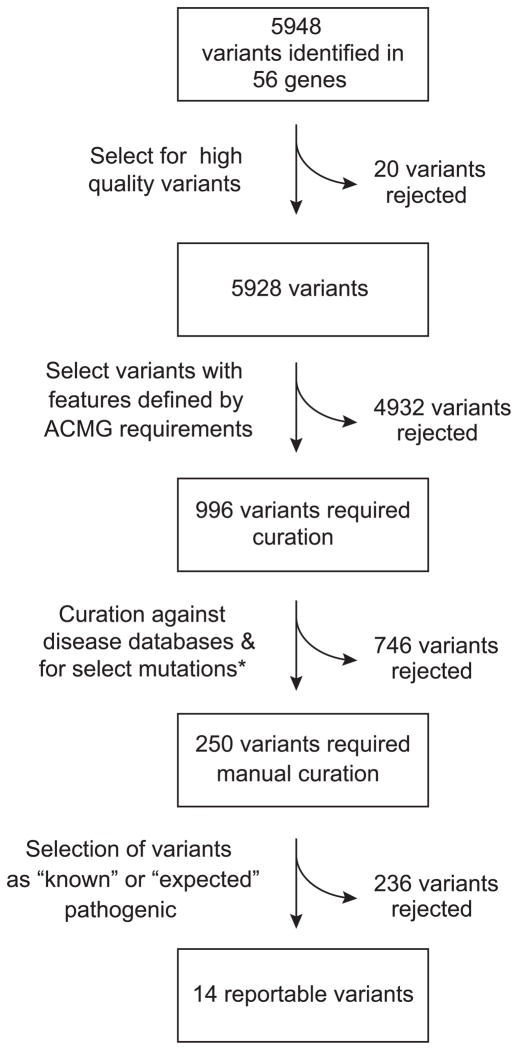
Following the American College of Medical Genetics and Genomics recommendations for reporting of incidental findings from next-generation sequencing, we extracted variants in 56 genes from the exome sequence data of 543 subjects and determined the reportable incidental findings for each participant. We also defined variant status as inherited or de novo for those with available parental sequence data.
We identified 14 independent reportable variants in 159 (8.8%) families. For nine families with parental sequence data in our cohort, a parent transmitted the variant to one or more children (nine minor children and four adult children). The remaining five variants occurred in adults for whom parental sequences were unavailable.
Our results are consistent with the expectation that a small percentage of exomes will result in identification of an incidental finding under the American College of Medical Genetics and Genomics recommendations. Additionally, our analysis of family sequence data highlights that genome and exome sequencing of families has unavoidable implications for immediate family members and therefore requires appropriate counseling for the family.
利用参与美国国立卫生研究院未确诊疾病项目的159个家庭的外显子组序列数据,我们评估了可报告的偶然序列变异的数量和遗传模式。
遵循美国医学遗传学与基因组学学会关于报告下一代测序偶然发现的建议,我们从543名受试者的外显子组序列数据中提取了56个基因中的变异,并确定了每位参与者可报告的偶然发现。对于有可用亲本序列数据的参与者,我们还将变异状态定义为遗传或新发。
我们在159个(8.8%)家庭中鉴定出14个独立的可报告变异。在我们队列中有亲本序列数据的9个家庭中,一位亲本将变异传递给了一个或多个孩子(9个未成年孩子和4个成年孩子)。其余5个变异发生在无法获得亲本序列的成年人中。
我们的结果与预期一致,即在按照美国医学遗传学与基因组学学会的建议进行检测时,一小部分外显子组会导致偶然发现的鉴定。此外,我们对家庭序列数据的分析强调,家庭的基因组和外显子组测序对直系家庭成员具有不可避免的影响,因此需要对家庭进行适当的咨询。