Lerner Research Institute Department of Immunology; Cleveland Clinic Foundation, Cleveland, OH.
Taussig Cancer Institute, Cleveland Clinic Foundation, Cleveland, OH.
Semin Oncol. 2014 Apr;41(2):174-84. doi: 10.1053/j.seminoncol.2014.02.003. Epub 2014 Feb 14.
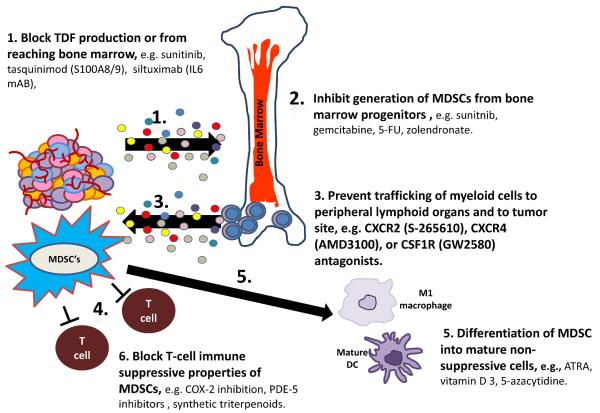
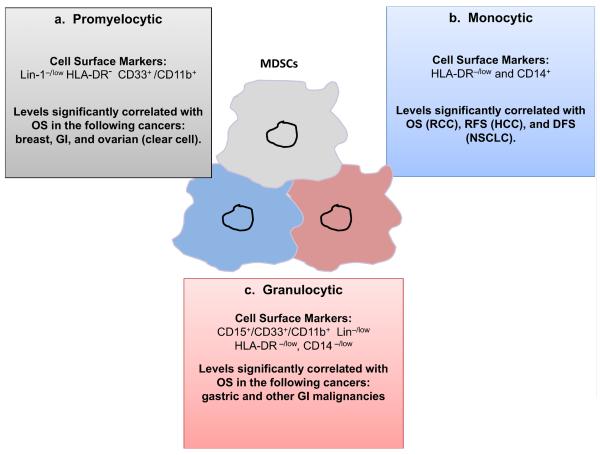
Immune evasion is a hallmark of cancer. While there are multiple different mechanisms that cancer cells employ, myeloid-derived suppressor cells (MDSCs) are one of the key drivers of tumor-mediated immune evasion. MDSCs begin as myeloid cells recruited to the tumor microenvironment, where they are transformed into potent immunosuppressive cells. However, our understanding of the clinical relevance of MDSCs in cancer patients has significantly lagged behind the preclinical literature in part due to the absence of a cognate molecule present in mice, as well as to the considerable heterogeneity of MDSCs. However, if one evaluates the clinical literature through the filter of clinically robust endpoints, such as overall survival, three important phenotypes emerge: promyelocytic, monocytic, and granulocytic. Based on these studies, MDSCs have clear prognostic importance in multiple solid tumors, and emerging data support the utility of circulating MDSCs as a predictive marker for cancer immunotherapy, and even as an early leading marker for predicting clinical response to systemic chemotherapy in patients with advanced solid tumors. More recent preclinical data in immunosuppressed murine models suggest that MDSCs play an important role in tumor progression and the metastatic process that is independent of their immunosuppressive properties. Consequently, targeting MDSCs either in combination with cancer immunotherapy or independently as part of an approach to inhibit the metastatic process appears to be a very clinically promising strategy. We review different approaches to target MDSCs that could potentially be tested in future clinical trials in cancer patients.
免疫逃避是癌症的一个标志。虽然癌细胞采用了多种不同的机制,但髓系来源的抑制细胞(MDSCs)是肿瘤介导的免疫逃避的关键驱动因素之一。MDSCs 最初是招募到肿瘤微环境中的髓系细胞,在那里它们被转化为强效的免疫抑制细胞。然而,我们对癌症患者中 MDSCs 的临床相关性的理解大大落后于临床前文献,部分原因是缺乏在小鼠中存在的同源分子,以及 MDSCs 的相当大的异质性。然而,如果通过临床稳健的终点(如总生存期)来评估临床文献,就会出现三种重要的表型:原始粒细胞、单核细胞和粒细胞。基于这些研究,MDSCs 在多种实体瘤中具有明确的预后意义,新兴数据支持循环 MDSCs 作为癌症免疫治疗的预测标志物的效用,甚至作为预测晚期实体瘤患者接受系统化疗临床反应的早期领先标志物。最近在免疫抑制的小鼠模型中的临床前数据表明,MDSCs 在肿瘤进展和转移过程中发挥重要作用,而与它们的免疫抑制特性无关。因此,靶向 MDSCs 与癌症免疫疗法联合使用或作为抑制转移过程的一种方法独立使用,似乎是一种非常有临床前景的策略。我们综述了针对 MDSCs 的不同方法,这些方法有可能在未来的癌症患者临床试验中进行测试。