Zhang Lijuan, Wang Lin, Liu Xiaoliang, Zheng Dongming, Liu Sishi, Liu Caixia
The Department of Gynecology and Obstetrics, Shengjing hospital affiliated to China Medical University, Shenyang, China.
PLoS One. 2014 May 2;9(5):e96204. doi: 10.1371/journal.pone.0096204. eCollection 2014.
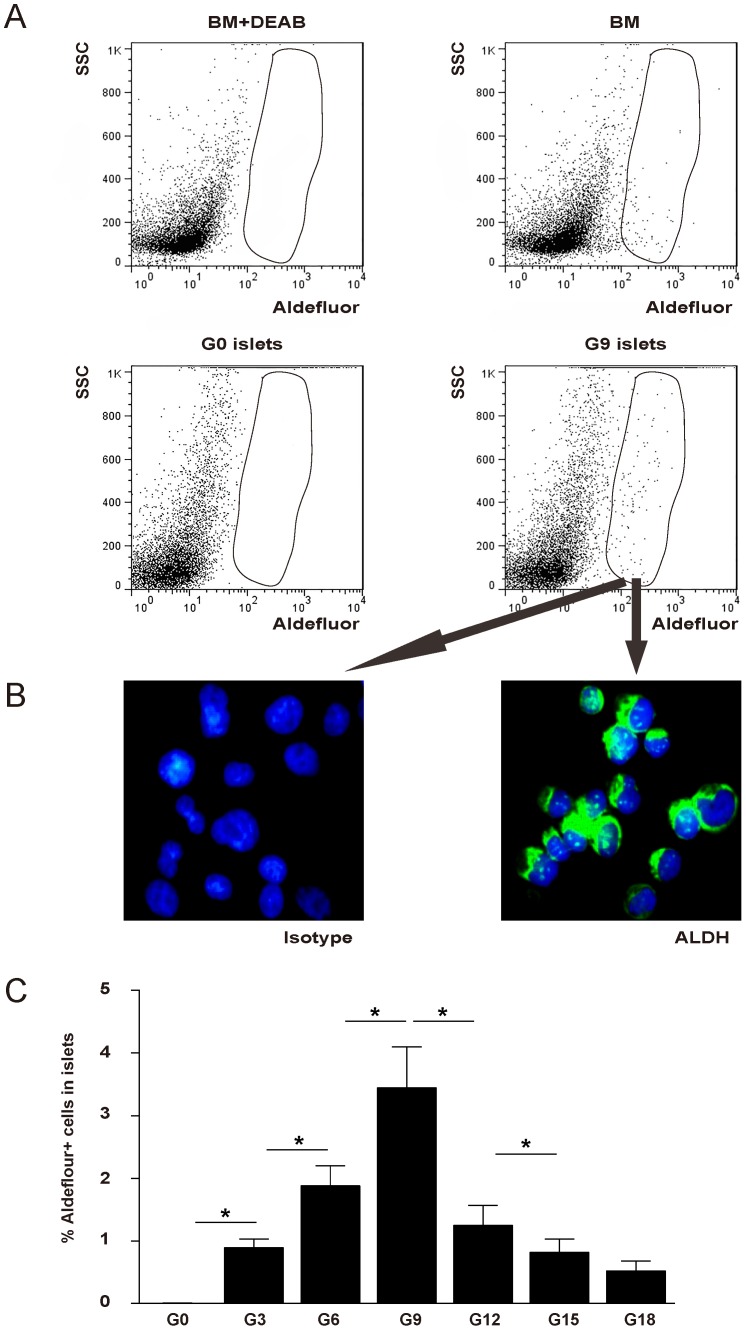
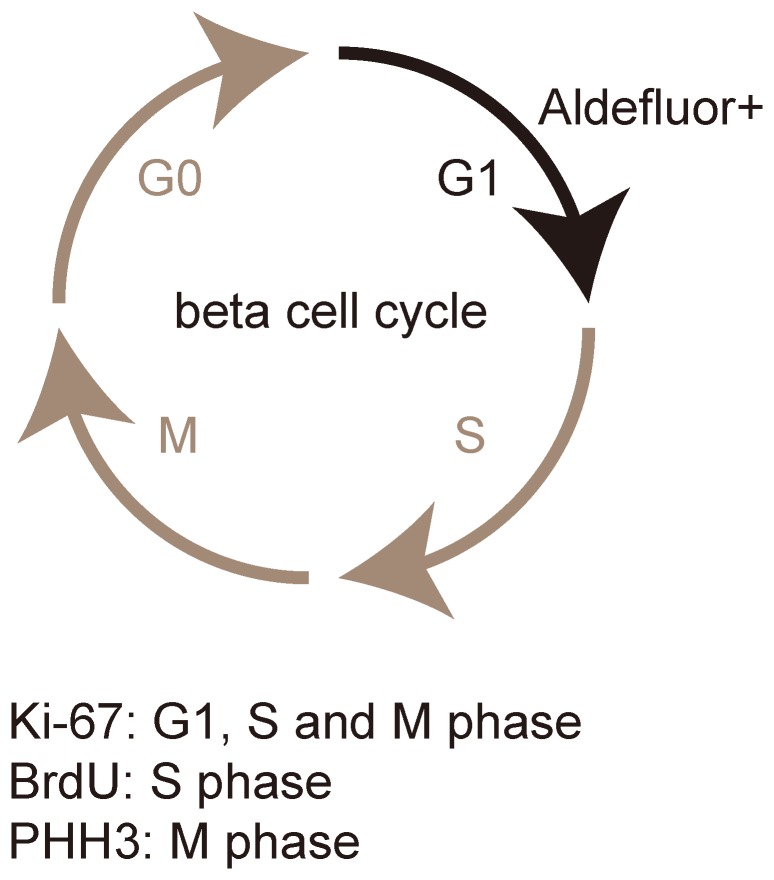
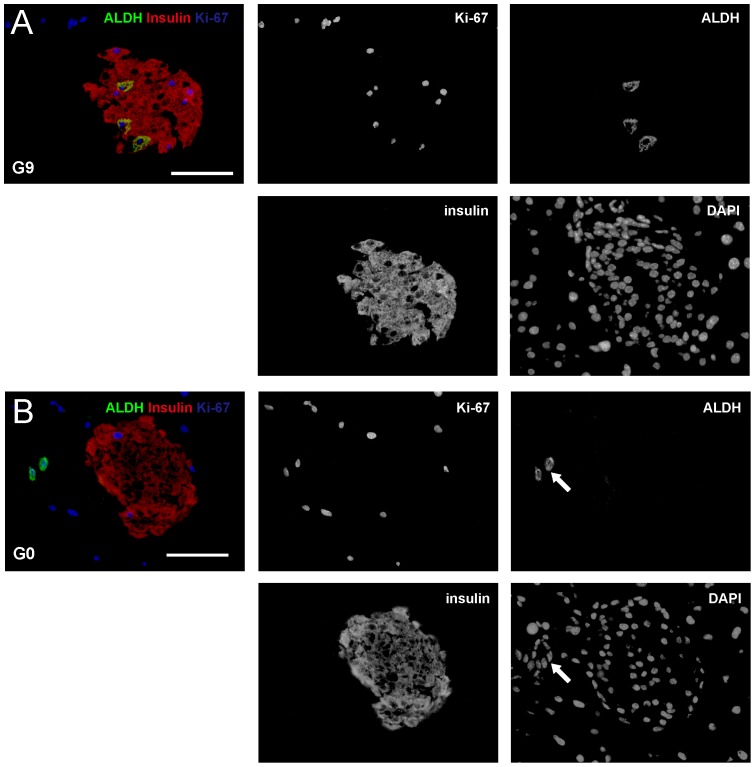
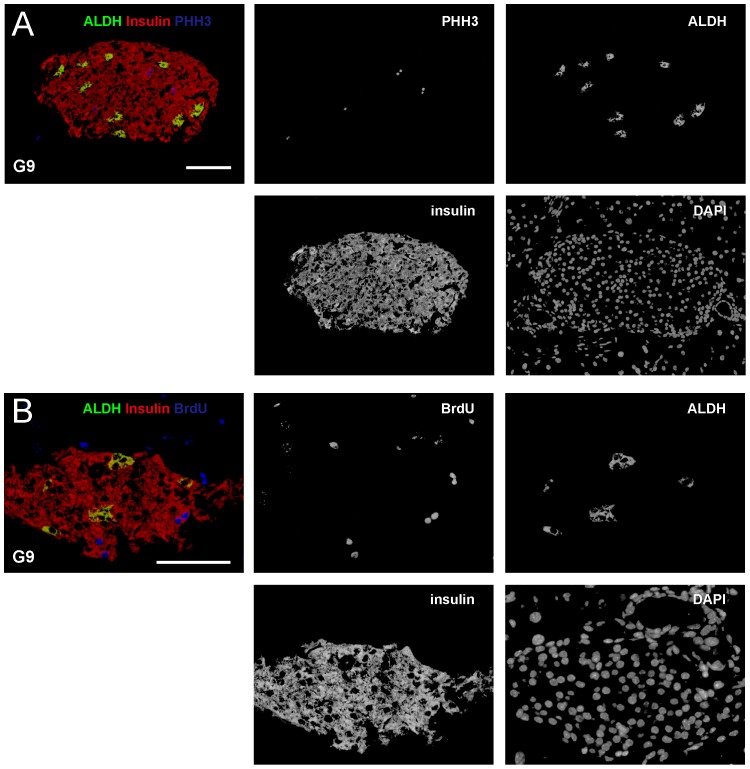
High levels of aldehyde dehydrogenase (ALDH) activity have been detected in various progenitor and stem cells. Thus, Aldefluor fluorescence, which represents precisely the ALDH activity, has been widely used for the identification, evaluation, and isolation of stem and progenitor cells. Recently, ALDH activity was detected in embryonic and adult mouse pancreas, specifically in adult centroacinar and terminal duct cells supposed to harbor endocrine and exocrine progenitor cells in the adult pancreas. Nevertheless, ALDH activity and aldeflour fluorescence have not been examined in beta cells. Here, we report a dynamic increase in the number of aldeflour+ beta cells during pregnancy. Interestingly, nearly all these aldeflour+ beta cells are positive for Ki-67, suggesting that they are in an active cell cycle (G1, S and M phases). To determine precisely at which phase beta cells activate ALDH activity and thus become aldeflour+, we co-stained insulin with additional proliferation markers, phosphohistone3 (PHH3, a marker for M-phase proliferating cells) and Bromodeoxyuridine (BrdU, a marker for S-phase proliferating cells). Our data show little aldeflour+ beta cells that were positive for either PHH3, or BrdU, suggesting that beta cells activate ALDH and become Aldefluor+ when they enter G1-phase of active cell cycle, but may downregulate ALDH when they leave G1-phase and enter S phase. Our data thus reveal a potential change in ALDH activity of proliferating beta cells during pregnancy, which provides a novel method for isolation and analysis of proliferating beta cells. Moreover, our data also suggest that caution needs to be taken on interpretation of Aldefluor lineage-tracing data in pancreas.
在各种祖细胞和干细胞中已检测到高水平的醛脱氢酶(ALDH)活性。因此,精确代表ALDH活性的AldeFluor荧光已被广泛用于干细胞和祖细胞的鉴定、评估及分离。最近,在胚胎和成年小鼠胰腺中检测到了ALDH活性,特别是在成年胰腺中被认为含有内分泌和外分泌祖细胞的腺泡中央细胞和终末导管细胞中。然而,尚未在β细胞中检测过ALDH活性和AldeFluor荧光。在此,我们报告孕期醛荧光阳性β细胞数量呈动态增加。有趣的是,几乎所有这些醛荧光阳性β细胞的Ki-67均呈阳性,表明它们处于活跃的细胞周期(G1、S和M期)。为了精确确定β细胞在哪个阶段激活ALDH活性并因此变为醛荧光阳性,我们将胰岛素与其他增殖标志物磷酸化组蛋白H3(PHH3,M期增殖细胞的标志物)和溴脱氧尿苷(BrdU,S期增殖细胞的标志物)进行了共染色。我们的数据显示,很少有醛荧光阳性β细胞对PHH3或BrdU呈阳性,这表明β细胞在进入活跃细胞周期的G1期时激活ALDH并变为AldeFluor阳性,但在离开G1期进入S期时可能会下调ALDH。因此,我们的数据揭示了孕期增殖β细胞ALDH活性的潜在变化,这为增殖β细胞的分离和分析提供了一种新方法。此外,我们的数据还表明,在解释胰腺中AldeFluor谱系追踪数据时需要谨慎。