Yao Yingbo, Cui Xiaoyan, Chen Qingshan, Huang Xinrong, Elmore Bradley, Pan Qing, Wang Shukun, Liu Jie
Center for Disease Control and Prevention of Yuxi City, Yuxi, Yunnan 653100, P.R. China.
Translational Center for Stem Cell Research, Tongji Hospital, Stem Cell Research Center, Tongji University School of Medicine, Shanghai 200065, P.R. China.
Mol Med Rep. 2014 Jul;10(1):68-74. doi: 10.3892/mmr.2014.2187. Epub 2014 Apr 24.
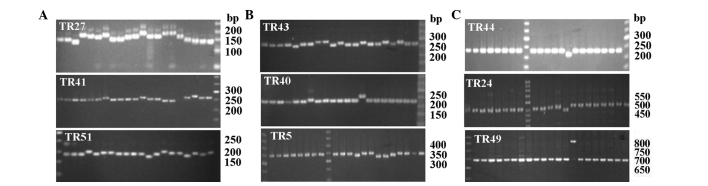
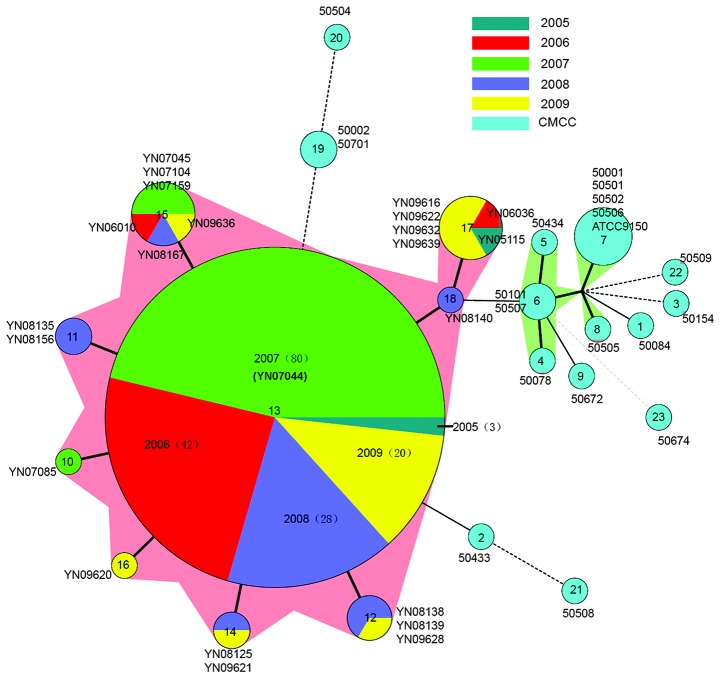
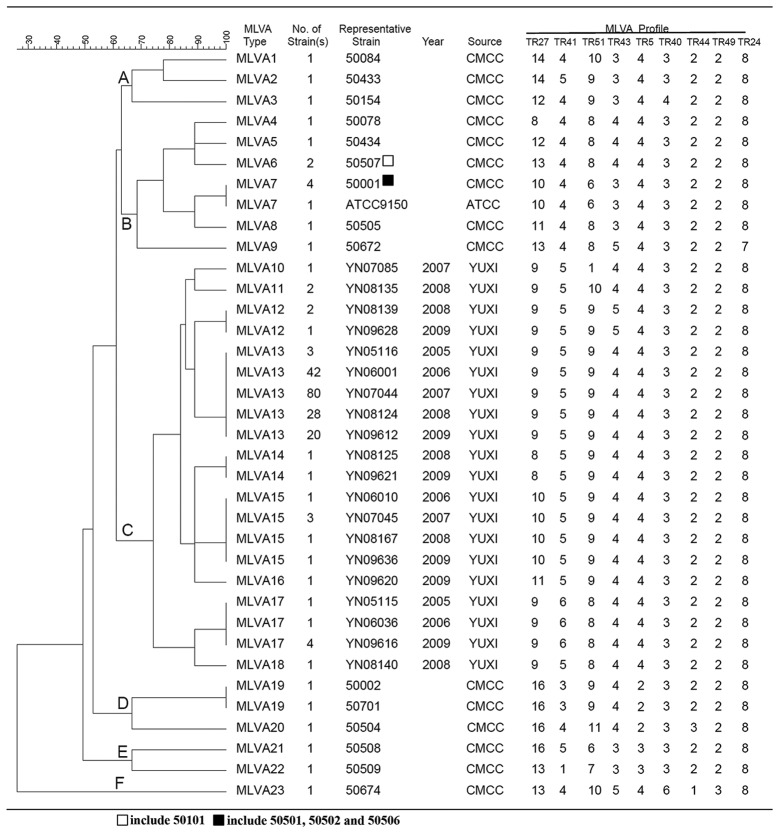
The aim of the present study was to genotype Salmonella enterica serotype paratyphi A (SPA) isolated from Yuxi, China, in a multiple-locus variable number of tandem repeats (VNTRs) analysis (MLVA) and to compare them with isolates from the Chinese Medical Culture Collection Center (CMCC). Potential VNTRs were screened from the genomes of ATCC9150 and AKU_12601 using the Tandem Repeats Finder program. Nine VNTRs were established for MLVA typing of 195 SPA isolates from Yuxi and 20 isolates from CMCC. The dendogram for MLVA profiles and minimum spanning tree (MST) were drawn using the categorical coefficient calculated by BioNumerics software. A total of 23 MLVA types were identified in 215 SPA isolates and were grouped into six distinct cluster groups A, B, C, D, E and F. A total of 195 Yuxi SPA isolates were exclusively grouped into cluster C with nine MLVA genotypes. A total of 20 CMCC isolates were grouped in clusters A B, D, E and F with the other 14 MLVA types. The MLVA with nine VNTR loci, which was exploited in the present study, represents a successful strategy for genotyping SPA. Furthermore, the 195 Yuxi isolates appear to be closely related to each other and distinct from the 20 CMCC strains.
本研究的目的是对从中国玉溪分离出的甲型副伤寒沙门氏菌(SPA)进行多位点可变数目串联重复序列(VNTR)分析(MLVA)基因分型,并将其与中国医学菌种保藏中心(CMCC)的分离株进行比较。使用串联重复序列查找程序从ATCC9150和AKU_12601的基因组中筛选潜在的VNTR。建立了9个VNTR用于对来自玉溪的195株SPA分离株和来自CMCC的20株分离株进行MLVA分型。使用BioNumerics软件计算的分类系数绘制MLVA图谱的树状图和最小生成树(MST)。在215株SPA分离株中总共鉴定出23种MLVA类型,并分为六个不同的聚类组A、B、C、D、E和F。总共195株玉溪SPA分离株仅分为聚类C,有9种MLVA基因型。总共20株CMCC分离株与其他14种MLVA类型一起分为聚类A、B、D、E和F。本研究中使用的具有9个VNTR位点的MLVA是一种成功的SPA基因分型策略。此外,195株玉溪分离株似乎彼此密切相关,与20株CMCC菌株不同。