Ahles Tim A, Li Yuelin, McDonald Brenna C, Schwartz Gary N, Kaufman Peter A, Tsongalis Gregory J, Moore Jason H, Saykin Andrew J
Department of Psychiatry and Behavioral Sciences, Memorial Sloan-Kettering Cancer Center, New York, NY, USA; Department of Psychiatry and Center for Psycho-Oncology Research, the Norris Cotton Cancer Center, Dartmouth-Hitchcock Medical Center, Lebanon, NH, USA.
Psychooncology. 2014 Dec;23(12):1382-90. doi: 10.1002/pon.3545. Epub 2014 Apr 30.
This study examined the association of post-treatment changes in cognitive performance, apolipoprotein E (APOE), and smoking in breast cancer patients treated with adjuvant therapy.
Breast cancer patients treated with chemotherapy (N = 55, age = 51.9 ± 7.1, education = 15.7 ± 2.6) were evaluated with a battery of neuropsychological tests prior to chemotherapy and at 1, 6, and 18 months post-chemotherapy. Matched groups of breast cancer patients not exposed to chemotherapy (N = 68, age = 56.8 ± 8.3, education = 14.8 ± 2.2) and healthy controls (N = 43, age = 53.0 ± 10.1, education = 15.2 ± 2.6) were evaluated at similar intervals. APOE epsilon 4 carrier status (APOE4+) and smoking history were also evaluated.
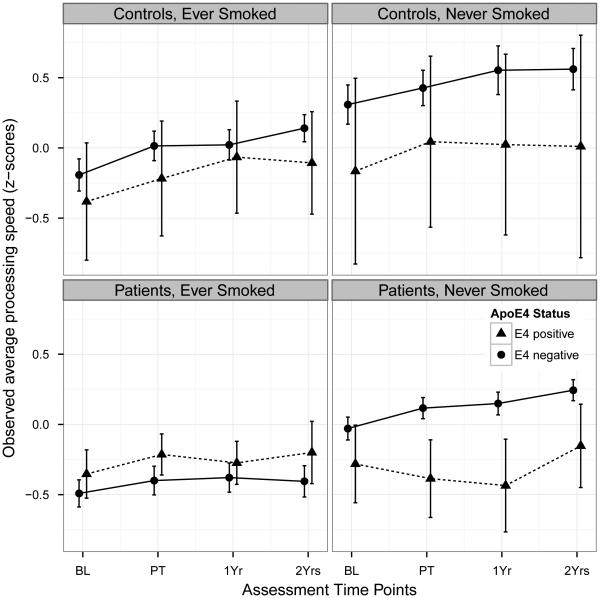
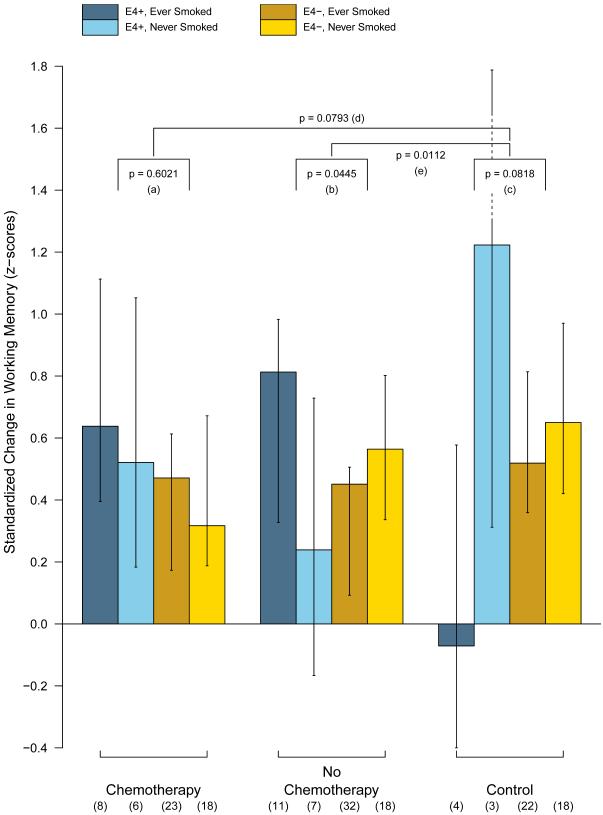
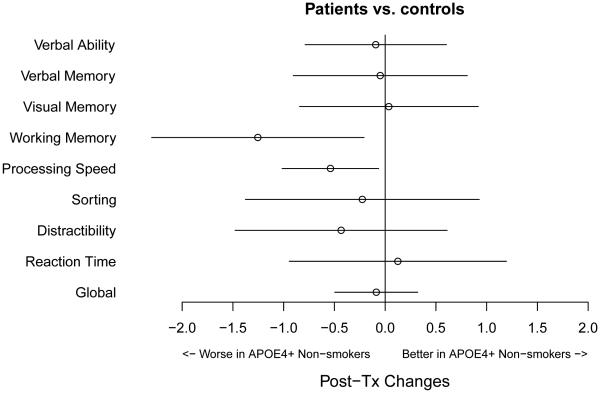
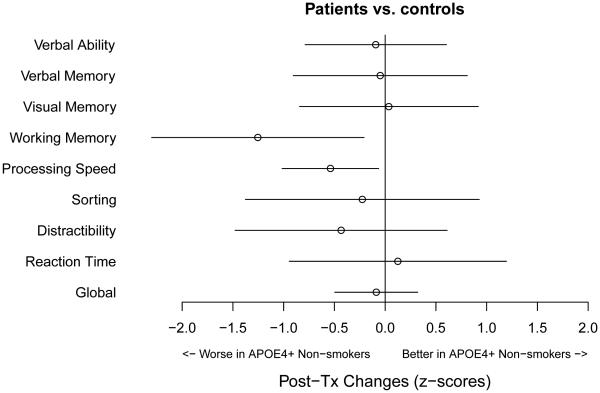
The detrimental effect of APOE4+ genotype on post-treatment cognitive functioning was moderated by smoking history, that is, patients without a smoking history had significantly lower performance on measures of processing speed and working memory compared with those with a smoking history and healthy controls. Exploratory analyses revealed that APOE4+ patients without a smoking history who were exposed to chemotherapy showed a decline in performance in processing speed, compared with patients with a smoking history. A similar but less pronounced pattern was seen in the no chemotherapy group (primarily endocrine treatment). For working memory, the APOE4+ by smoking interaction was observed in the no chemotherapy group only.
The association between APOE status, breast cancer treatment, and cognitive functioning was moderated by smoking history suggesting that both chemotherapy and endocrine therapy interact with APOE status and smoking to influence cognition. A putative mechanism is that smoking corrects a deficit in nicotinic receptor functioning and dopamine levels in APOE4+ individuals.
本研究探讨辅助治疗的乳腺癌患者治疗后认知功能变化、载脂蛋白E(APOE)和吸烟之间的关联。
对接受化疗的乳腺癌患者(N = 55,年龄 = 51.9 ± 7.1,受教育年限 = 15.7 ± 2.6)在化疗前以及化疗后1个月、6个月和18个月进行了一系列神经心理学测试评估。对未接受化疗的匹配乳腺癌患者组(N = 68,年龄 = 56.8 ± 8.3,受教育年限 = 14.8 ± 2.2)和健康对照组(N = 43,年龄 = 53.0 ± 10.1,受教育年限 = 15.2 ± 2.6)在相似的时间间隔进行评估。还评估了APOE ε4携带者状态(APOE4+)和吸烟史。
吸烟史调节了APOE4+基因型对治疗后认知功能的有害影响,即与有吸烟史的患者和健康对照组相比,无吸烟史的患者在处理速度和工作记忆测量指标上的表现显著更低。探索性分析显示,与有吸烟史的患者相比,接受化疗且无吸烟史的APOE4+患者在处理速度方面表现下降。在未化疗组(主要是内分泌治疗)中观察到类似但不太明显的模式。对于工作记忆,仅在未化疗组中观察到APOE4+与吸烟的交互作用。
吸烟史调节了APOE状态、乳腺癌治疗和认知功能之间的关联,表明化疗和内分泌治疗均与APOE状态及吸烟相互作用以影响认知。一种可能的机制是吸烟纠正了APOE4+个体中烟碱受体功能和多巴胺水平的缺陷。