Bilgrami Shumaila M, Qureshi Sohail A, Pervez Shahid, Abbas Farhat
Office of Research and Graduate Studies, Aga Khan University, Stadium Road, Karachi, 74800 Pakistan.
Department of Biology, Syed Babar Ali School of Science and Engineering, Lahore University of Management Sciences, Sector-U, D.H.A., Lahore, 54792 Pakistan.
Springerplus. 2014 Apr 5;3:178. doi: 10.1186/2193-1801-3-178. eCollection 2014.
To investigate the promoter methylation status at selected loci which encode for key proteins involved in apoptosis, DNA repair, cell cycle control and progression in urothelial cell carcinoma of bladder and compare the findings from tissue samples with that of plasma.
Total genomic DNA was isolated from 43 non-muscle invasive (low grade) and 33 muscle invasive (high grade) urothelial bladder cancer samples along with 10 control cases of normal bladder mucosa. Promoter methylation status was investigated for RASSF1A, APC, MGMT, CDKN2A and CDKN2B genes using real-time methylation-specific PCR with SYBR® green. Plasma samples from 16 patients with muscle invasive high grade bladder cancer were also subjected to similar analyses.
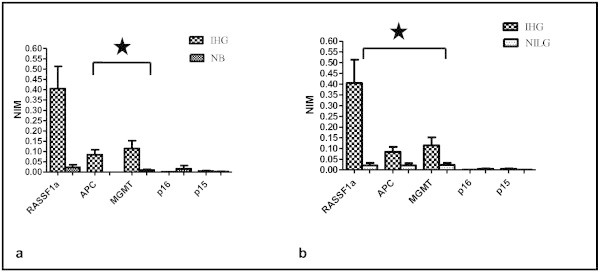
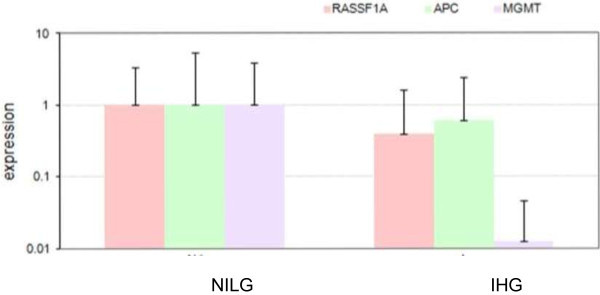
Promoter hypermethylation was frequently observed in RASSF1A, APC and MGMT gene promoters (p-value < 0.001). The methylation was more prominent in the muscle invasive high grade bladder cancer when compared to non-muscle invasive low grade group (p-value < 0.001) and normal bladder mucosa (p-value < 0.05). The RNA expression of RASSF1A, APC and MGMT was also found to be decreased in the muscle-invasive high grade bladder cancer when compared to the non muscle invasive low grade group (p-value < 0.05). RASSF1A, MGMT and CDKN2A showed comparable results when data from 16 plasma samples was compared to the corresponding tissue samples.
Our results suggest that epigenetic silencing of RASSF1A, APC and MGMT genes is strongly associated with invasive high grade urothelial bladder cancer. Thus, status of promoter methylation has the potential to serve as valuable tool for assessing aggressiveness of urothelial cell carcinoma of bladder.
研究编码参与膀胱尿路上皮细胞癌凋亡、DNA修复、细胞周期调控及进展的关键蛋白的特定基因座的启动子甲基化状态,并比较组织样本与血浆样本的研究结果。
从43例非肌层浸润性(低级别)和33例肌层浸润性(高级别)膀胱尿路上皮癌样本以及10例正常膀胱黏膜对照病例中分离出全基因组DNA。使用带有SYBR® green的实时甲基化特异性PCR研究RASSF1A、APC、MGMT、CDKN2A和CDKN2B基因的启动子甲基化状态。对16例肌层浸润性高级别膀胱癌患者的血浆样本也进行了类似分析。
在RASSF1A、APC和MGMT基因启动子中经常观察到启动子高甲基化(p值<0.001)。与非肌层浸润性低级别组(p值<0.001)和正常膀胱黏膜(p值<0.05)相比,甲基化在肌层浸润性高级别膀胱癌中更为明显。与非肌层浸润性低级别组相比,RASSF1A、APC和MGMT的RNA表达在肌层浸润性高级别膀胱癌中也降低(p值<0.05)。当将16份血浆样本的数据与相应的组织样本进行比较时,RASSF1A、MGMT和CDKN2A显示出可比的结果。
我们的结果表明,RASSF1A、APC和MGMT基因的表观遗传沉默与浸润性高级别膀胱尿路上皮癌密切相关。因此,启动子甲基化状态有可能作为评估膀胱尿路上皮细胞癌侵袭性的有价值工具。