
瑞典肥胖受试者(SOS)中减肥手术后白蛋白尿的发生率及常规护理:一项前瞻性对照干预试验。
The incidence of albuminuria after bariatric surgery and usual care in Swedish Obese Subjects (SOS): a prospective controlled intervention trial.
作者信息
Carlsson L M S, Romeo S, Jacobson P, Burza M A, Maglio C, Sjöholm K, Svensson P-A, Haraldsson B, Peltonen M, Sjöström L
机构信息
Department of Molecular and Clinical Medicine, Institute of Medicine, The Sahlgrenska Academy at University of Gothenburg, Gothenburg, Sweden.
Department of Chronic Disease Prevention, National Institute for Health and Welfare, Helsinki, Finland.
出版信息
Int J Obes (Lond). 2015 Jan;39(1):169-75. doi: 10.1038/ijo.2014.72. Epub 2014 May 6.
BACKGROUND
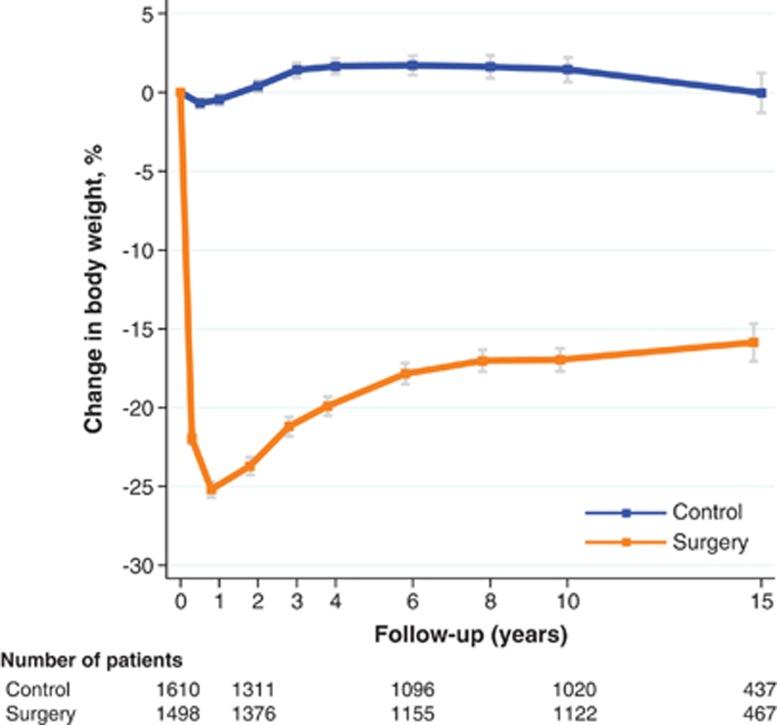
Obesity is associated with increased risk of chronic kidney disease and albuminuria is a predictor of renal impairment. Bariatric surgery reduces body weight in obese subjects, but it is not known whether surgery can prevent development of albuminuria. This study aims to determine the long-term effect of bariatric surgery on the incidence of albuminuria.
SUBJECTS
The Swedish Obese Subjects study is a non-randomized, prospective, controlled study conducted at 25 public surgical departments and 480 primary health care centers in Sweden. Between 1 September 1987 and 31 January 2001, 2010 participants who underwent bariatric surgery and 2037 controls were recruited. Inclusion criteria were age 37-60 years and BMI ⩾ 34 in men and BMI ⩾ 38 in women. In this analysis, we included 1498 patients in the surgery group and 1610 controls without albuminuria at baseline. Patients in the bariatric surgery group underwent banding (18%), vertical banded gastroplasty (69%) or gastric bypass (13%); controls received usual obesity care. Date of analysis was 1 January 2011. Median follow-up was 10 years, and the rates of follow-up were 87%, 74 and 52% at 2, 10 and 15 years, respectively. The main outcome of this report is incidence of albuminuria (defined as urinary albumin excretion >30 mg per 24 h) over up to 15 years.
RESULTS
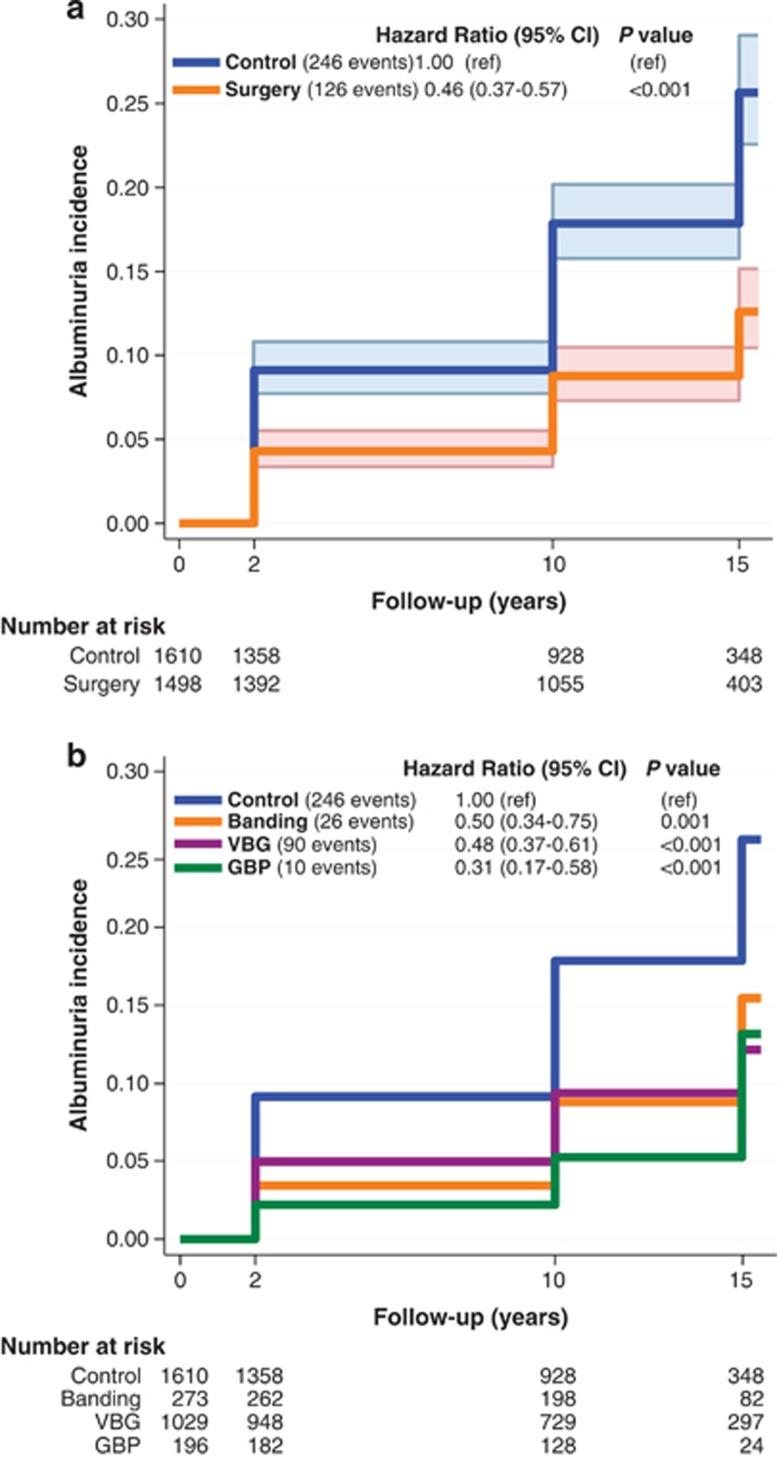
During the follow-up, albuminuria developed in 246 participants in the control group and in 126 in the bariatric surgery group, corresponding to incidence rates of 20.4 and 9.4 per 1000 person years, respectively (adjusted hazard ratio, 0.37; 95% confidence interval, 0.30-0.47; P < 0.001). The expected number of surgeries needed to prevent the development of albuminuria in one patient at 10 years was nine.
CONCLUSIONS
Bariatric surgery is associated with reduced incidence of albuminuria compared with usual obesity care.
背景
肥胖与慢性肾病风险增加相关,蛋白尿是肾功能损害的一个预测指标。减肥手术可降低肥胖受试者的体重,但尚不清楚手术能否预防蛋白尿的发生。本研究旨在确定减肥手术对蛋白尿发生率的长期影响。
研究对象
瑞典肥胖受试者研究是一项在瑞典25个公共外科科室和480个初级卫生保健中心进行的非随机、前瞻性、对照研究。在1987年9月1日至2001年1月31日期间,招募了2010名接受减肥手术的参与者和2037名对照者。纳入标准为年龄37 - 60岁,男性BMI⩾34,女性BMI⩾38。在本分析中,我们纳入了1498例手术组患者和1610例基线时无蛋白尿的对照者。减肥手术组患者接受束带术(18%)、垂直束带胃成形术(69%)或胃旁路术(13%);对照者接受常规肥胖护理。分析日期为2011年1月1日。中位随访时间为10年,2年、10年和15年的随访率分别为87%、74%和52%。本报告的主要结局是长达15年的蛋白尿发生率(定义为尿白蛋白排泄>30mg/24小时)。
结果
在随访期间,对照组有246名参与者出现蛋白尿,减肥手术组有126名,相应的发病率分别为每1000人年20.4例和9.4例(调整后的风险比为0.37;95%置信区间为0.30 - 0.47;P<0.001)。在10年时预防1例患者发生蛋白尿所需的预期手术例数为9例。
结论
与常规肥胖护理相比,减肥手术与蛋白尿发生率降低相关。
 Zotero 插件