Department of Epidemiology, School of Public Health, Johns Hopkins University, Baltimore, Maryland; Center on Aging and Health, Johns Hopkins University, Baltimore, Maryland.
J Am Geriatr Soc. 2014 May;62(5):843-9. doi: 10.1111/jgs.12801. Epub 2014 May 6.
To explore whether disparities in age and sex in access to kidney transplantation (KT) originate at the time of prereferral discussions about KT.
Cross-sectional survey.
Outpatient dialysis centers in Maryland (n = 26).
Individuals who had recently initiated hemodialysis treatment (N = 416).
Participants reported whether medical professionals (nephrologist, primary medical doctor, dialysis staff) and social group members (significant other, family member, friend) discussed KT with them and, when applicable, rated the tone of discussions. Relative risks were estimated using modified Poisson regression.
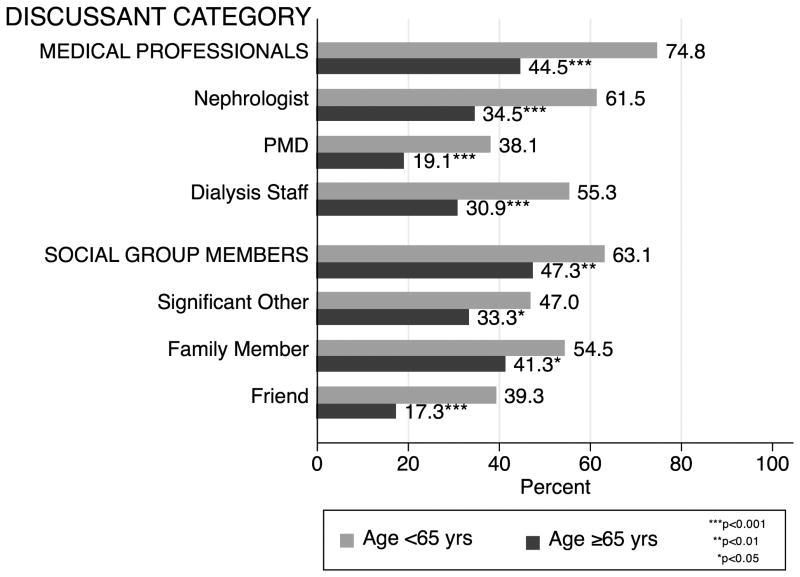
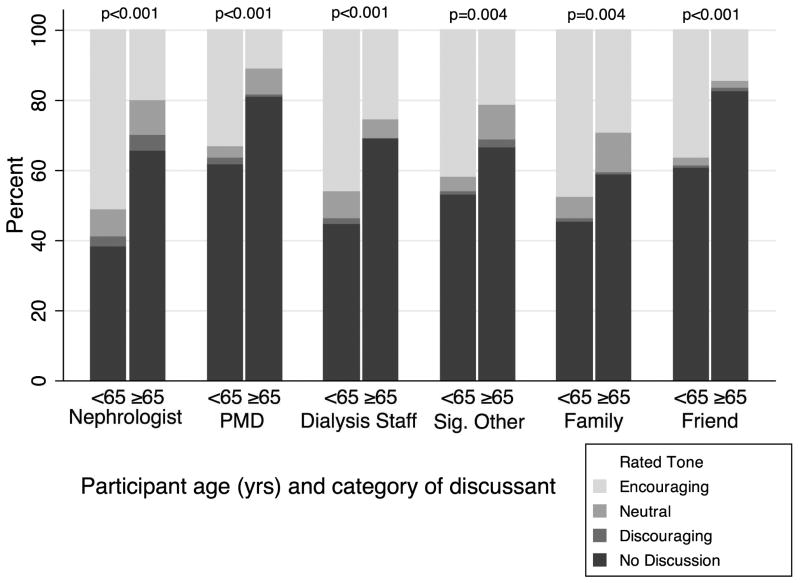
Participants aged 65 and older were much less likely than those who were younger to have had discussions with medical professionals (44.5% vs 74.8%, P < .001) or social group members (47.3% vs 63.1%, P = .005). Irrespective of sex and independent of race, health-related factors, and dialysis-related characteristics, older adults were more likely not to have had discussions with medical professionals (relative risk (RR) = 1.13, 95% confidence interval (CI) = 1.03-1.24, for each 5-year increase in age through 65; RR = 1.28, 95% CI = 1.14-1.42, for each 5-year increase in age beyond 65). Irrespective of age, women were more likely (RR = 1.45, 95% CI = 1.12-1.89) not to have had discussions with medical professionals. For each 5-year increase in age, men (RR = 1.04, 95% CI = 0.99-1.10) and women (RR = 1.17, 95% CI = 1.10-1.24) were more likely not to have discussions with social group members. Of those who had discussions with medical professionals or social group members, older participants described these discussions as less encouraging (all P < .01).
Older adults and women undergoing hemodialysis are less likely than younger adults and men to have discussions about KT as a treatment option, supporting a need for better clinical guidelines and education for these individuals, their social network, and their providers.
探讨在接受肾移植(KT)的预转诊讨论时,年龄和性别在获得 KT 方面的差异是否存在。
横断面调查。
马里兰州门诊透析中心(n=26)。
最近开始血液透析治疗的个体(N=416)。
参与者报告医疗专业人员(肾病专家、初级医生、透析工作人员)和社会群体成员(重要他人、家庭成员、朋友)是否与他们讨论过 KT,并在适用的情况下,对讨论的语气进行了评分。使用修正泊松回归估计相对风险。
65 岁及以上的参与者与年龄较小的参与者相比,与医疗专业人员(44.5% vs 74.8%,P<.001)或社会群体成员(47.3% vs 63.1%,P=.005)讨论 KT 的可能性要小得多。无论性别如何,且独立于种族、健康相关因素和透析相关特征,老年人与医疗专业人员进行讨论的可能性较小(每增加 5 岁,年龄通过 65 岁的相对风险(RR)为 1.13,95%置信区间(CI)为 1.03-1.24;年龄超过 65 岁的 RR 为 1.28,95% CI 为 1.14-1.42)。无论年龄大小,女性与医疗专业人员进行讨论的可能性更高(RR=1.45,95% CI=1.12-1.89)。对于每增加 5 岁,男性(RR=1.04,95% CI=0.99-1.10)和女性(RR=1.17,95% CI=1.10-1.24)与社会群体成员进行讨论的可能性更低。在与医疗专业人员或社会群体成员进行讨论的参与者中,年龄较大的参与者认为这些讨论的鼓励性较小(均 P<.01)。
与年轻成年人和男性相比,接受血液透析的老年人和女性更不可能讨论 KT 作为一种治疗选择,这支持了为这些人及其社交网络和提供者制定更好的临床指南和教育的必要性。