Authors' Affiliations:Massachusetts General Hospital Cancer Center, Harvard Medical School, Boston, Massachusetts; Howard Hughes Medical Institute, Chevy Chase; and Sidney Kimmel Comprehensive Cancer Center, Johns Hopkins University School of Medicine, Baltimore, MarylandAuthors' Affiliations:Massachusetts General Hospital Cancer Center, Harvard Medical School, Boston, Massachusetts; Howard Hughes Medical Institute, Chevy Chase; and Sidney Kimmel Comprehensive Cancer Center, Johns Hopkins University School of Medicine, Baltimore, Maryland.
Authors' Affiliations:Massachusetts General Hospital Cancer Center, Harvard Medical School, Boston, Massachusetts; Howard Hughes Medical Institute, Chevy Chase; and Sidney Kimmel Comprehensive Cancer Center, Johns Hopkins University School of Medicine, Baltimore, Maryland
Cancer Discov. 2014 Jun;4(6):650-61. doi: 10.1158/2159-8290.CD-13-1014. Epub 2014 May 6.
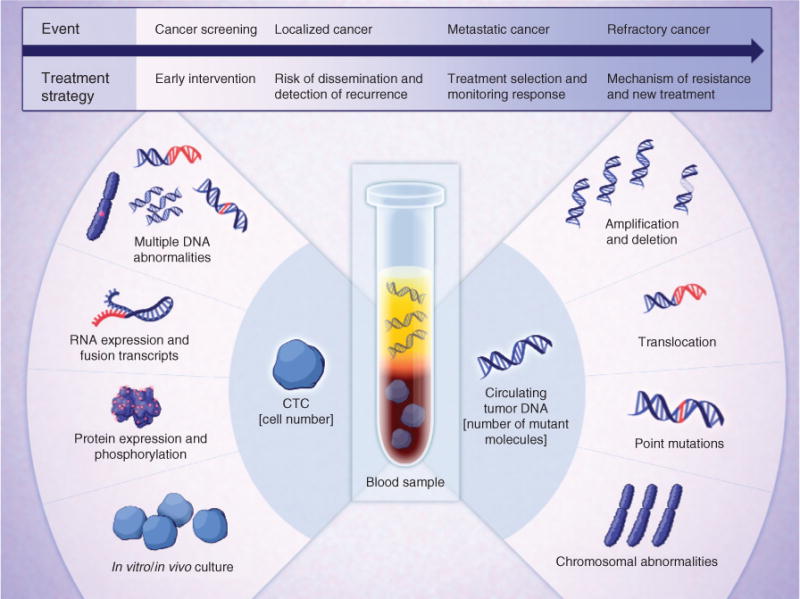
The ability to study nonhematologic cancers through noninvasive sampling of blood is one of the most exciting and rapidly advancing fields in cancer diagnostics. This has been driven both by major technologic advances, including the isolation of intact cancer cells and the analysis of cancer cell-derived DNA from blood samples, and by the increasing application of molecularly driven therapeutics, which rely on such accurate and timely measurements of critical biomarkers. Moreover, the dramatic efficacy of these potent cancer therapies drives the selection for additional genetic changes as tumors acquire drug resistance, necessitating repeated sampling of cancer cells to adjust therapy in response to tumor evolution. Together, these advanced noninvasive diagnostic capabilities and their applications in guiding precision cancer therapies are poised to change the ways in which we select and monitor cancer treatments.
Recent advances in technologies to analyze circulating tumor cells and circulating tumor DNA are setting the stage for real-time, noninvasive monitoring of cancer and providing novel insights into cancer evolution, invasion, and metastasis.
未注明:通过对血液进行非侵入性采样来研究非血液癌症,这是癌症诊断领域最令人兴奋和快速发展的领域之一。这既是由于包括完整癌细胞的分离和从血液样本中分析癌细胞衍生的 DNA 等重大技术进步的推动,也是由于分子驱动的治疗方法的日益应用,这些治疗方法依赖于对关键生物标志物的这种准确和及时的测量。此外,这些强效癌症疗法的显著疗效促使肿瘤获得耐药性时选择额外的遗传变化,这需要反复采样癌细胞以根据肿瘤进化来调整治疗。总之,这些先进的非侵入性诊断能力及其在指导精准癌症治疗中的应用有望改变我们选择和监测癌症治疗的方式。
意义:分析循环肿瘤细胞和循环肿瘤 DNA 的技术的最新进展正在为实时、非侵入性的癌症监测奠定基础,并为癌症的进化、侵袭和转移提供新的见解。