Nugent G, Yockney I J, Whitford E J, Cross M L
Landcare Research, P.O. Box 40, Lincoln 7640, New Zealand.
Vet Med Int. 2014;2014:361634. doi: 10.1155/2014/361634. Epub 2014 Apr 2.
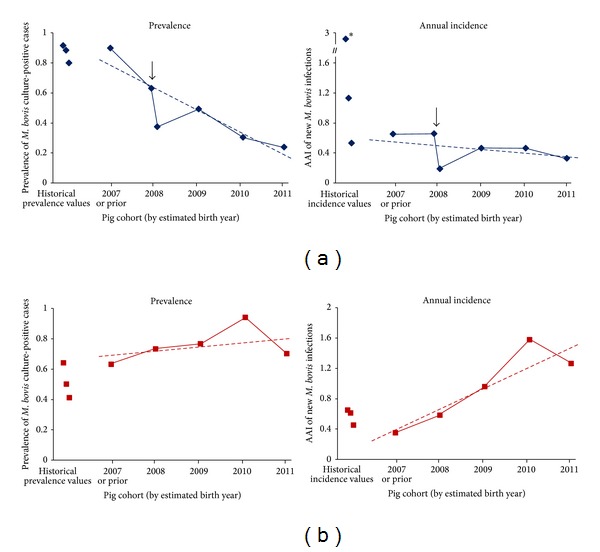
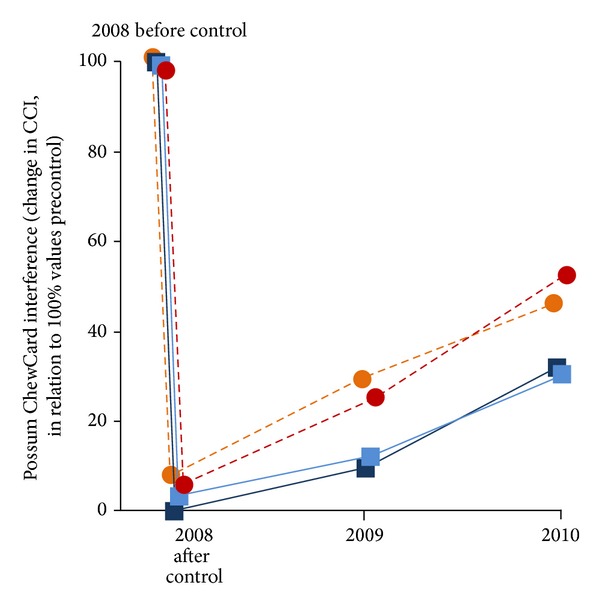
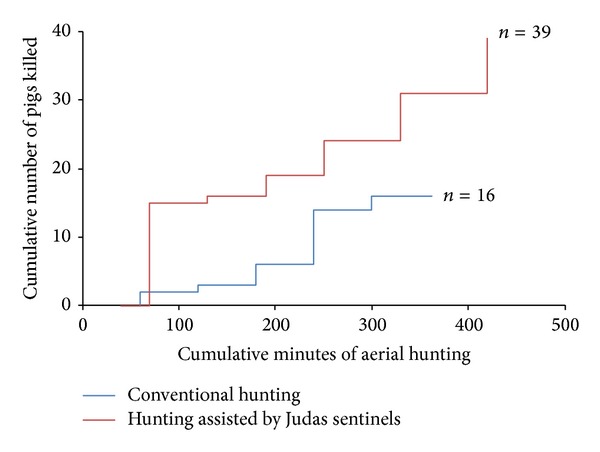
In New Zealand, wild pigs acquire Mycobacterium bovis infection by scavenging tuberculous carrion, primarily carcasses of the main disease maintenance host, the brushtail possum (Trichosurus vulpecula). We investigated the utility of captive-reared, purpose-released pigs as sentinels for tuberculosis (TB) following lethal possum control and subsequent population recovery. Within 2-3 years of possum control by intensive poisoning, TB prevalence and the incidence rate of M. bovis infection in released sentinel pigs were lower than in an adjacent area where possums had not been poisoned. Unexpectedly, TB did not decline to near zero levels among pigs in the poisoned area, a fact which reflected an unanticipated rapid increase in the apparent abundance of possums. Monitoring infection levels among resident wild pigs confirmed that TB prevalence, while reduced due to possum control, persisted in the poisoned area at >20% among pigs born 2-3 years after poisoning, while remaining >60% among resident wild pigs in the nonpoisoned area. When fitted with radio-tracking devices, purpose-released pigs provided precise spatial TB surveillance information and facilitated effective killing of wild pigs when employed as "Judas" animals to help locate residents. Sentinel pigs offer value for monitoring disease trends in New Zealand, as TB levels in possums decline nationally due to large-scale possum control.
在新西兰,野猪通过啃食患结核病的腐肉感染牛分枝杆菌,这些腐肉主要来自主要疾病宿主帚尾袋貂(Trichosurus vulpecula)的尸体。我们研究了在对袋貂进行致死性控制并随后种群恢复后,圈养繁殖、定向放归的猪作为结核病(TB)哨兵的效用。在通过密集投毒对袋貂进行控制后的2至3年内,放归的哨兵猪中牛分枝杆菌感染的患病率和发病率低于相邻未对袋貂投毒的区域。出乎意料的是,在投毒区域的猪中结核病并未降至接近零的水平,这一事实反映了袋貂明显数量的意外快速增加。对当地野猪感染水平的监测证实,虽然由于对袋貂的控制结核病患病率有所降低,但在投毒后2至3年出生的猪中,结核病患病率在投毒区域仍持续高于20%,而在未投毒区域的当地野猪中仍高于60%。当配备无线电追踪设备时,定向放归的猪提供了精确的结核病空间监测信息,并在用作“犹大”动物帮助定位当地野猪时便于有效捕杀野猪。随着全国范围内由于大规模袋貂控制导致袋貂结核病水平下降,哨兵猪对于监测新西兰的疾病趋势具有价值。