Kim Jae Su, Lee Se Jin, Lee Hyang Burm
Department of Agricultural Biology, College of Agriculture & Life Sciences, Chonbuk National University, Jeonju 561-756, Korea.
Department of Biological Chemistry, College of Agriculture & Life Sciences, Chonnam National University, Gwangju 500-757, Korea.
Mycobiology. 2014 Mar;42(1):59-65. doi: 10.5941/MYCO.2014.42.1.59. Epub 2014 Mar 31.
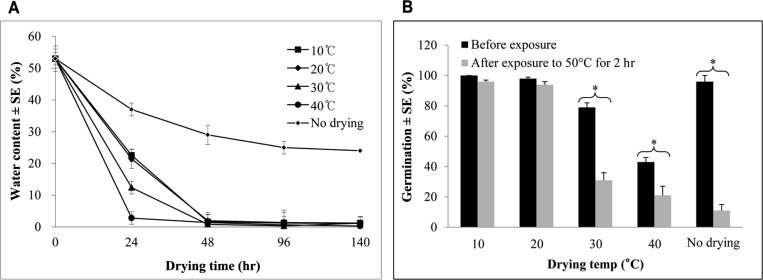
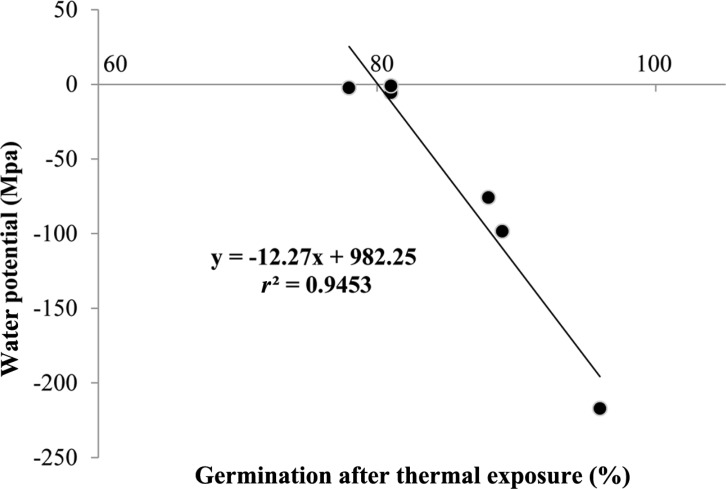
Entomopathogenic fungi are promising pest-control agents but their industrial applicability is limited by their thermosusceptibility. With an aim to increase the thermotolerance of Isaria fumosorosea SFP-198, moisture absorbents were added to dried conidial powder, and the relationship between its water potential and thermotolerance was investigated. Mycotized rice grains were dried at 10℃, 20℃, 30℃, and 40℃ and the drying effect of each temperature for 24, 48, 96, and 140 hr was determined. Drying for 48 hr at 10℃ and 20℃ reduced the moisture content to < 5% without any significant loss of conidial thermotolerance, but drying at 30℃ and 40℃ reduced both moisture content and conidial thermotolerance. To maintain thermotolerance during storage, moisture absorbents, such as calcium chloride, silica gel, magnesium sulfate, white carbon, and sodium sulfate were individually added to previously dried-conidial powder at 10% (w/w). These mixtures was then stored at room temperature for 30 days and subjected to 50℃ for 2 hr. The white carbon mixture had the highest conidial thermotolerance, followed by silica gel, magnesium sulfate, and then the other absorbents. A significant correlation between the water potential and conidial thermotolerance was observed in all conidia-absorbent mixtures tested in this study (r = -0.945). Conidial thermotolerance in wet conditions was evaluated by adding moisturized white carbon (0~20% H2O) to conidia to mimic wet conditions. Notably, the conidia still maintained their thermotolerance under these conditions. Thus, it is evident that conidial thermotolerance can be maintained by drying mycotized rice grains at low temperatures and adding a moisture absorbent, such as white carbon.
昆虫病原真菌是很有前景的害虫防治剂,但其工业适用性受到热敏感性的限制。为了提高玫烟色棒束孢SFP - 198的耐热性,将吸湿剂添加到干燥的分生孢子粉中,并研究其水势与耐热性之间的关系。将被真菌侵染的稻粒在10℃、20℃、30℃和40℃下干燥,并测定每个温度下24、48、96和140小时的干燥效果。在10℃和20℃下干燥48小时可使水分含量降至<5%,分生孢子耐热性无显著损失,但在30℃和40℃下干燥会降低水分含量和分生孢子耐热性。为了在储存期间保持耐热性,将氯化钙、硅胶、硫酸镁、白炭黑和硫酸钠等吸湿剂分别以10%(w/w)的比例添加到先前干燥的分生孢子粉中。然后将这些混合物在室温下储存30天,并在50℃下处理2小时。白炭黑混合物的分生孢子耐热性最高,其次是硅胶、硫酸镁,然后是其他吸湿剂。在本研究中测试的所有分生孢子 - 吸湿剂混合物中,观察到水势与分生孢子耐热性之间存在显著相关性(r = -0.945)。通过向分生孢子中添加保湿白炭黑(0~20% H2O)来模拟潮湿条件,评估潮湿条件下的分生孢子耐热性。值得注意的是,在这些条件下分生孢子仍保持其耐热性。因此,很明显,通过在低温下干燥被真菌侵染的稻粒并添加吸湿剂(如白炭黑)可以保持分生孢子的耐热性。