Eccard Jana A, Liesenjohann Thilo
Animal Ecology, University of Potsdam, Potsdam, Germany; Animal Behaviour, University of Bielefeld, Bielefeld, Germany.
Animal Ecology, University of Potsdam, Potsdam, Germany; Animal Behaviour, University of Bielefeld, Bielefeld, Germany; BioConsult, BioConsult SH GmbH, Husum, Germany.
PLoS One. 2014 May 8;9(5):e94107. doi: 10.1371/journal.pone.0094107. eCollection 2014.
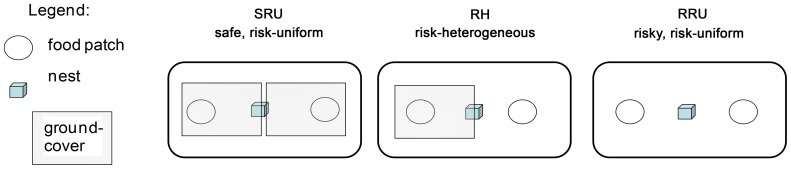
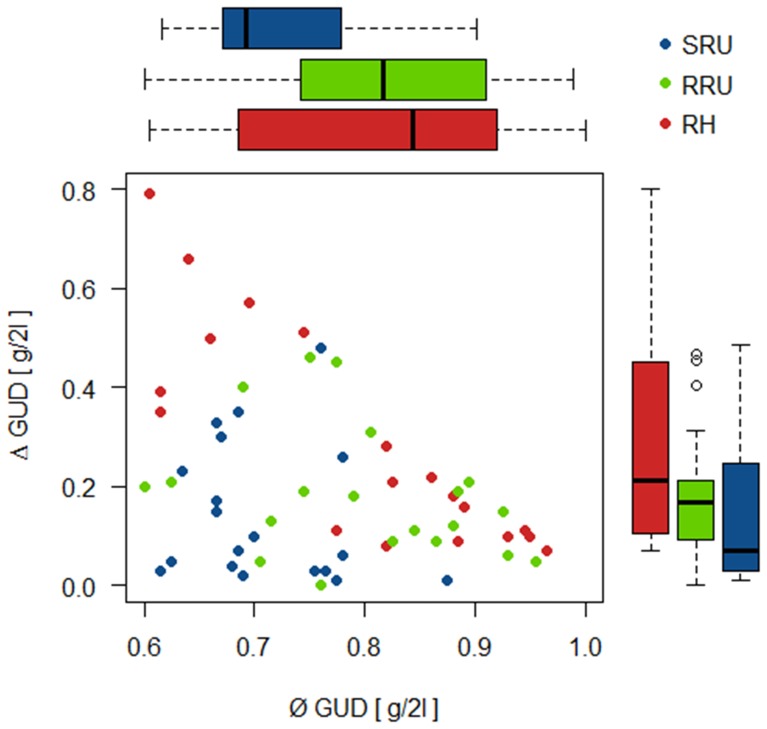
Correct assessment of risks and costs of foraging is vital for the fitness of foragers. Foragers should avoid predation risk and balance missed opportunities. In risk-heterogeneous landscapes animals prefer safer locations over riskier, constituting a landscape of fear. Risk-uniform landscapes do not offer this choice, all locations are equally risky. Here we investigate the effects of predation risk in patches, travelling risk between patches, and missed social opportunities on foraging decisions in risk-uniform and risk-heterogeous landscapes. We investigated patch leaving decisions of 20 common voles (M. arvalis) in three experimental landscapes: safe risk-uniform, risky risk-uniform and risk-heterogeneous. We varied both the predation risk level and the predation risk distribution between two patches experimentally and in steps, assuming that our manipulation consequently yield different distributions and levels of risk while foraging, risk while travelling, and costs of missed, social opportunities (MSOCs). We measured mean GUDs (giving-up density of food left in the patch) for both patches as a measure of foraging gain, and delta GUD, the differences among patches, as a measure of the spatial distribution of foraging effort over a period of six hours. Distribution of foraging effort was most even in the safe risk-uniform landscapes and least even in the risk-heterogeneous landscape, with risky risk-uniform landscapes in between. Foraging gain was higher in the safe than in the two riskier landscapes (both uniform and heterogeneous). Results supported predictions for the effects of risk in foraging patches and while travelling between patches, however predictions for the effects of missed social opportunities were not met in this short term experiment. Thus, both travelling and foraging risk contribute to distinct patterns observable high risk, risk-uniform landscapes.
正确评估觅食的风险和成本对于觅食者的适应性至关重要。觅食者应避免被捕食风险,并平衡错失的机会。在风险异质的景观中,动物更喜欢安全的地点而非风险更高的地点,从而构成了恐惧景观。风险均匀的景观则不提供这种选择,所有地点的风险均等。在此,我们研究斑块中的捕食风险、斑块间的移动风险以及错失的社交机会对风险均匀和风险异质景观中觅食决策的影响。我们在三种实验景观中研究了20只普通田鼠(M. arvalis)的斑块离开决策:安全风险均匀、高风险风险均匀和风险异质景观。我们通过实验逐步改变两个斑块之间的捕食风险水平和捕食风险分布,假设我们的操作会在觅食时产生不同的风险分布和水平、移动时的风险以及错失的社交机会成本(MSOCs)。我们测量了两个斑块的平均GUDs(斑块中剩余食物的放弃密度)作为觅食收益的指标,并测量了斑块间的GUD差异(delta GUD),作为六个小时内觅食努力空间分布的指标。觅食努力的分布在安全风险均匀景观中最为均匀,在风险异质景观中最不均匀,高风险风险均匀景观介于两者之间。安全景观中的觅食收益高于另外两个风险更高的景观(包括均匀和异质景观)。结果支持了关于觅食斑块和斑块间移动风险影响的预测,然而在这个短期实验中,关于错失社交机会影响的预测未得到满足。因此,移动和觅食风险都导致了在高风险、风险均匀景观中可观察到的不同模式。