Giagounidis Aristoteles, Mufti Ghulam J, Mittelman Moshe, Sanz Guillermo, Platzbecker Uwe, Muus Petra, Selleslag Dominik, Beyne-Rauzy Odile, te Boekhorst Peter, del Cañizo Consuelo, Guerci-Bresler Agnès, Nilsson Lars, Lübbert Michael, Quesnel Bruno, Ganser Arnold, Bowen David, Schlegelberger Brigitte, Göhring Gudrun, Fu Tommy, Benettaib Bouchra, Hellström-Lindberg Eva, Fenaux Pierre
Marien Hospital Düsseldorf, Düsseldorf, Germany.
Eur J Haematol. 2014 Nov;93(5):429-38. doi: 10.1111/ejh.12380. Epub 2014 Jun 9.
A subset analysis of the randomised, phase 3, MDS-004 study to evaluate outcomes in patients with International Prognostic Scoring System (IPSS)-defined Low-/Intermediate (Int)-1-risk myelodysplastic syndromes (MDS) with isolated del(5q).
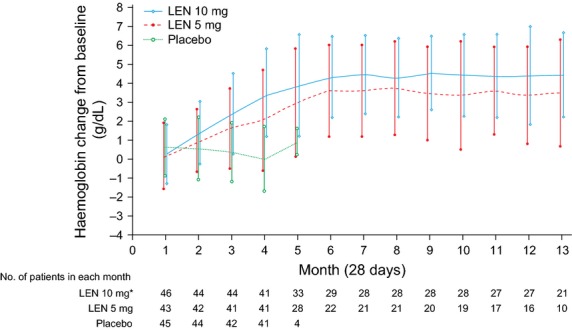
Patients received lenalidomide 10 mg/d (days 1-21; n = 47) or 5 mg/d (days 1-28; n = 43) on 28-d cycles or placebo (n = 45). From the placebo and lenalidomide 5 mg groups, 84% and 58% of patients, respectively, crossed over to lenalidomide 5 or 10 mg at 16 wk, respectively.
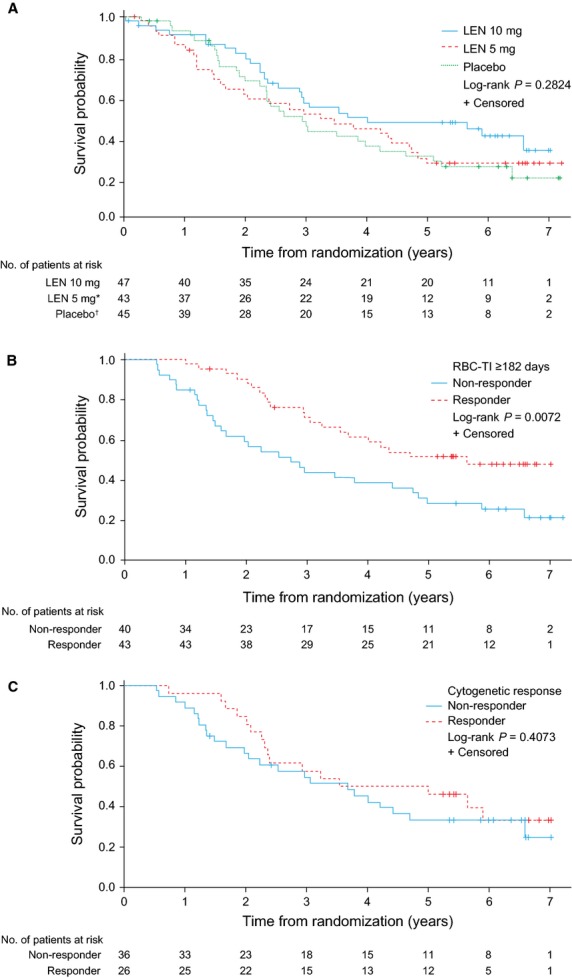
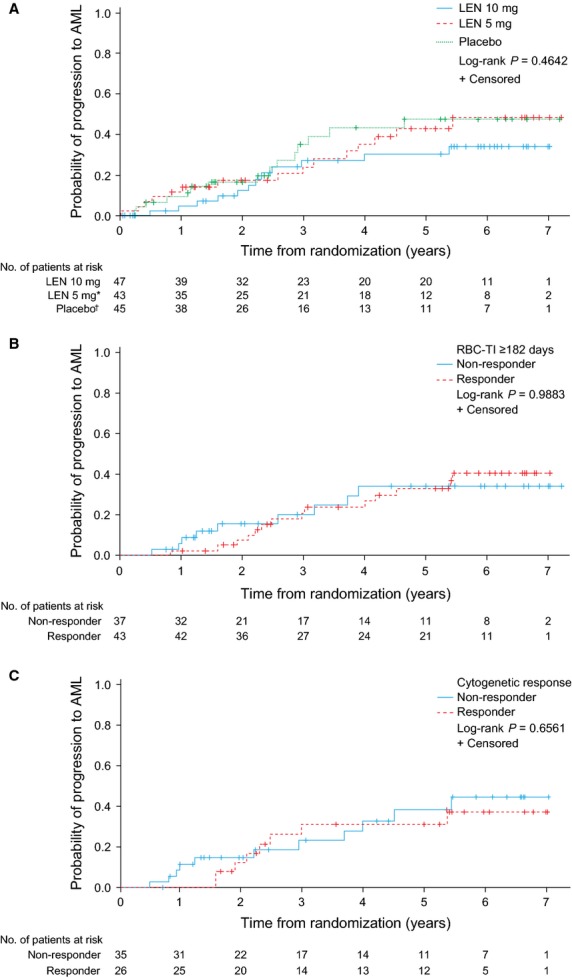
Rates of red blood cell-transfusion independence (RBC-TI) ≥182 d were higher in the lenalidomide 10 mg (57.4%; P < 0.0001) and 5 mg (37.2%; P = 0.0001) groups vs. placebo (2.2%). Cytogenetic response rates (major + minor responses) were 56.8% (P < 0.0001), 23.1% (P = 0.0299) and 0%, respectively. Two-year cumulative risk of acute myeloid leukaemia progression was 12.6%, 17.4% and 16.7% in the lenalidomide 10 mg, 5 mg, and placebo groups, respectively. In a 6-month landmark analysis, overall survival was longer in lenalidomide-treated patients with RBC-TI ≥182 d vs. non-responders (P = 0.0072). The most common grade 3-4 adverse event was myelosuppression.
These data support the clinical benefits and acceptable safety profile of lenalidomide in transfusion-dependent patients with IPSS-defined Low-/Int-1-risk MDS with isolated del(5q).
对随机3期MDS - 004研究进行亚组分析,以评估国际预后评分系统(IPSS)定义的低危/中危-1(Int-1)风险且伴有孤立性5号染色体长臂缺失(del(5q))的骨髓增生异常综合征(MDS)患者的预后。
患者接受来那度胺10mg/d(第1 - 21天;n = 47)或5mg/d(第1 - 28天;n = 43),每28天为一个周期,或接受安慰剂治疗(n = 45)。在安慰剂组和来那度胺5mg组中,分别有84%和58%的患者在16周时交叉接受来那度胺5mg或10mg治疗。
来那度胺10mg组(57.4%;P < 0.0001)和5mg组(37.2%;P = 0.0001)的红细胞输注独立(RBC - TI)≥182天的发生率高于安慰剂组(2.2%)。细胞遗传学缓解率(主要 + 次要缓解)分别为56.8%(P < 0.0001)、23.1%(P = 0.0299)和0%。来那度胺10mg组、5mg组和安慰剂组急性髓系白血病进展的两年累积风险分别为12.6%、17.4%和16.7%。在一项6个月的标志性分析中,RBC - TI≥182天的来那度胺治疗患者的总生存期长于无反应者(P = 0.0072)。最常见的3 - 4级不良事件是骨髓抑制。
这些数据支持来那度胺在IPSS定义的低危/中危-1风险且伴有孤立性del(5q)的输血依赖型MDS患者中的临床益处和可接受的安全性。