
潮间带溪流网络中多毛类次级生产力沿溪流等级梯度的变异性。
Variability of polychaete secondary production in intertidal creek networks along a stream-order gradient.
作者信息
Chu Tianjiang, Sheng Qiang, Wang Sikai, Wu Jihua
机构信息
Ministry of Education Key Laboratory for Biodiversity Science and Ecological Engineering, and Institute of Biodiversity Science, Fudan University, Shanghai, China.
出版信息
PLoS One. 2014 May 9;9(5):e97287. doi: 10.1371/journal.pone.0097287. eCollection 2014.
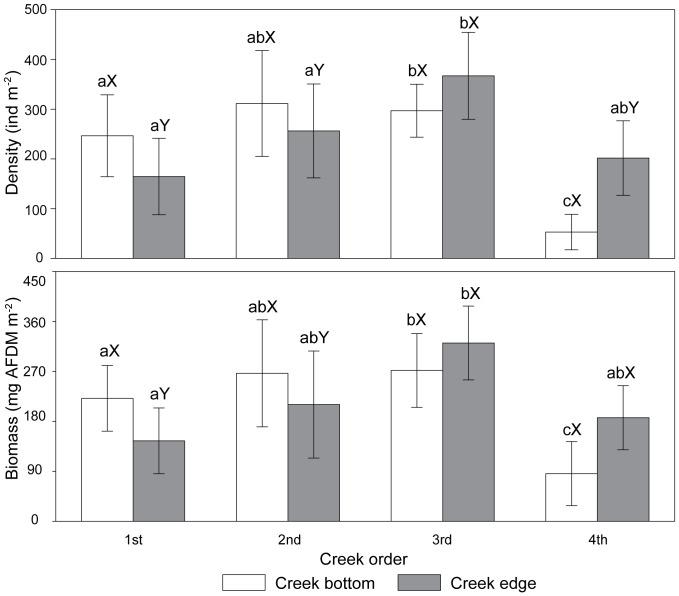
Dendritic tidal creek networks are important habitats for sustaining biodiversity and ecosystem functioning in salt marsh wetlands. To evaluate the importance of creek heterogeneity in supporting benthic secondary production, we assess the spatial distribution and secondary production of a representative polychaete species (Dentinephtys glabra) in creek networks along a stream-order gradient in a Yangtze River estuarine marsh. Density, biomass, and secondary production of polychaetes were found to be highest in intermediate order creeks. In high order (3rd and 4th) creeks, the density and biomass of D. glabra were higher in creek edge sites than in creek bottom sites, whereas the reverse was true for low order (1st and 2nd) creeks. Secondary production was highest in 2nd order creeks (559.7 mg AFDM m-2 year-1) and was ca. 2 folds higher than in 1st and 4th order creeks. Top fitting AIC models indicated that the secondary production of D. glabra was mainly associated with geomorphological characters including cross-sectional area and bank slope. This suggests that hydrodynamic forces are essential factors influencing secondary production of macrobenthos in salt marshes. This study emphasizes the importance of microhabitat variability when evaluating secondary production and ecosystem functions.
树枝状潮汐河网是盐沼湿地维持生物多样性和生态系统功能的重要栖息地。为评估河网异质性在支持底栖生物次级生产中的重要性,我们在长江河口湿地的河网中,沿着溪流等级梯度评估了一种代表性多毛类物种(光滑齿沙蚕)的空间分布和次级生产。多毛类的密度、生物量和次级生产在中等等级的溪流中最高。在高等级(第3级和第4级)溪流中,光滑齿沙蚕在溪流边缘位点的密度和生物量高于溪流底部位点,而在低等级(第1级和第2级)溪流中情况则相反。次级生产在第2级溪流中最高(559.7毫克无灰干重·平方米⁻¹·年⁻¹),约为第1级和第4级溪流的2倍。最优拟合AIC模型表明,光滑齿沙蚕的次级生产主要与包括横截面积和河岸坡度在内的地貌特征相关。这表明水动力是影响盐沼大型底栖生物次级生产的重要因素。本研究强调了在评估次级生产和生态系统功能时微生境变异性的重要性。


 Zotero 插件