McRae Ian, Butler James R G
Australian Primary Health Care Research Institute, Australian National University, Building 63, Cnr Mills and Eggleston Roads, Acton, Canberra, ACT , 0200, Australia,
Int J Health Care Finance Econ. 2014 Sep;14(3):269-87. doi: 10.1007/s10754-014-9148-7. Epub 2014 May 14.
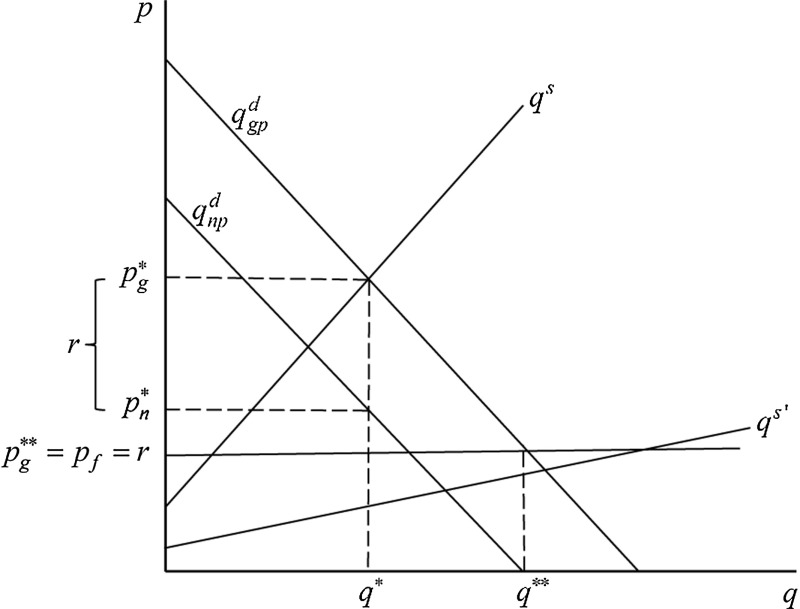
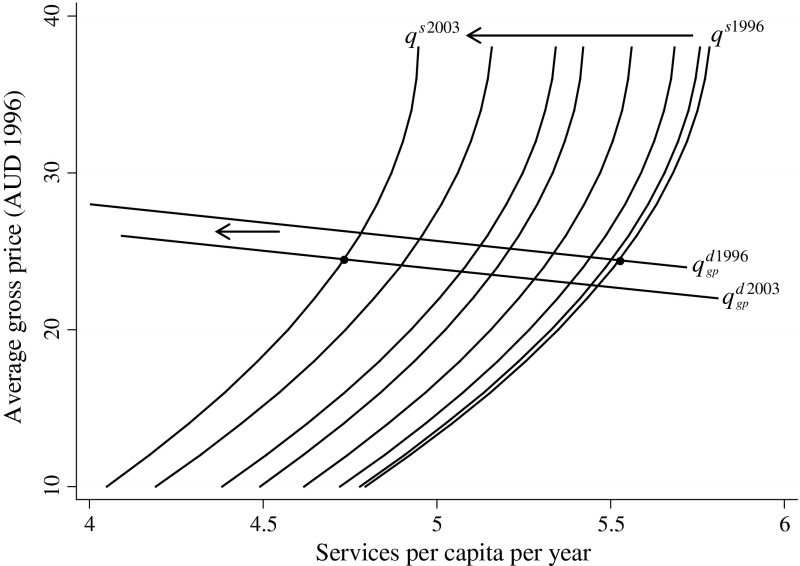
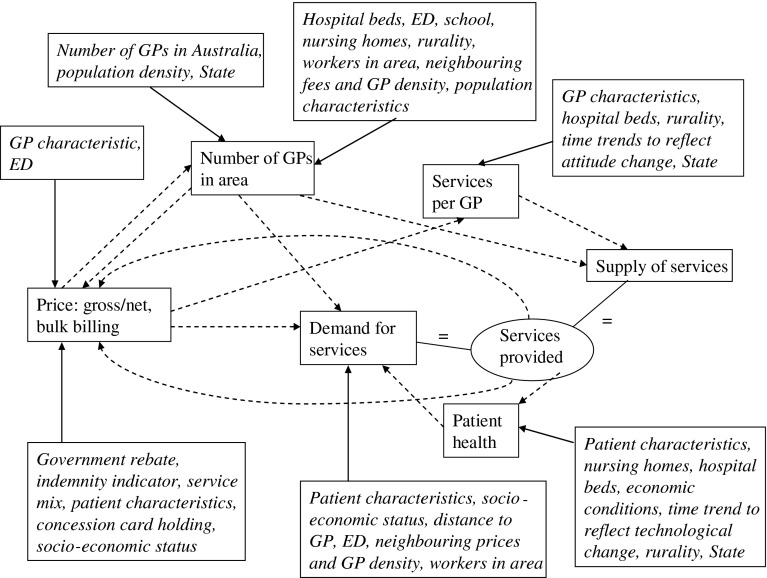
To understand the trends in any physician services market it is necessary to understand the nature of both supply and demand, but few studies have jointly examined supply and demand in these markets. This study uses aggregate panel data on general practitioner (GP) services at the Statistical Local Area level in Australia spanning eight years to estimate supply and demand equations for GP services. The structural equations of the model are estimated separately using population-weighted fixed effects panel modelling with the two stage least squares formulation of the generalised method of moments approach (GMM (2SLS)). The estimated price elasticity of demand of [Formula: see text] is comparable with other studies. The direct impact of GP density on demand, while significant, proves almost immaterial in the context of near vertical supply curves. Supply changes are therefore due to shifts in the position of the curves, partly determined by a time trend. The model is validated by comparing post-panel model predictions with actual market outcomes over a period of three years and is found to provide surprisingly accurate projections over a period of significant policy change. The study confirms the need to jointly consider supply and demand in exploring the behaviour of physician services markets.
要了解任何医生服务市场的趋势,有必要了解供给和需求的本质,但很少有研究同时考察这些市场的供给和需求。本研究使用澳大利亚统计局部地区层面八年的全科医生(GP)服务总量面板数据,来估计GP服务的供给和需求方程。该模型的结构方程使用人口加权固定效应面板模型,并采用广义矩量法(GMM(2SLS))的两阶段最小二乘法进行单独估计。估计出的需求价格弹性为[公式:见原文],与其他研究结果相当。全科医生密度对需求的直接影响虽然显著,但在供给曲线近乎垂直的情况下几乎无关紧要。因此,供给变化是由于曲线位置的移动,部分由时间趋势决定。通过将面板模型后的预测结果与三年期间的实际市场结果进行比较,对该模型进行了验证,结果发现该模型在重大政策变化期间能提供令人惊讶的准确预测。该研究证实,在探索医生服务市场行为时,有必要同时考虑供给和需求。