Pluskal Tomáš, Ueno Masaru, Yanagida Mitsuhiro
G0 Cell Unit, Okinawa Institute of Science and Technology Graduate University (OIST), Onna-son, Okinawa, Japan; Department of Molecular Biotechnology, Graduate School of Advanced Sciences of Matter, Hiroshima University, Higashihiroshima-shi, Hiroshima, Japan.
Department of Molecular Biotechnology, Graduate School of Advanced Sciences of Matter, Hiroshima University, Higashihiroshima-shi, Hiroshima, Japan.
PLoS One. 2014 May 14;9(5):e97774. doi: 10.1371/journal.pone.0097774. eCollection 2014.
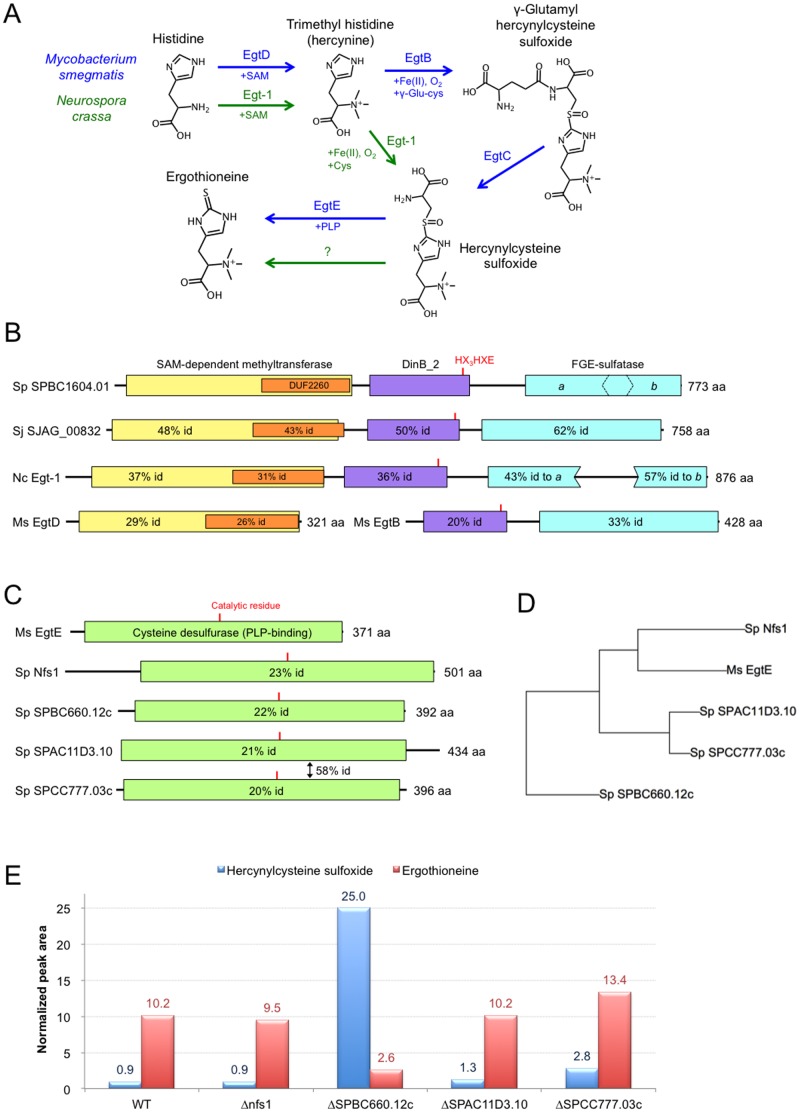
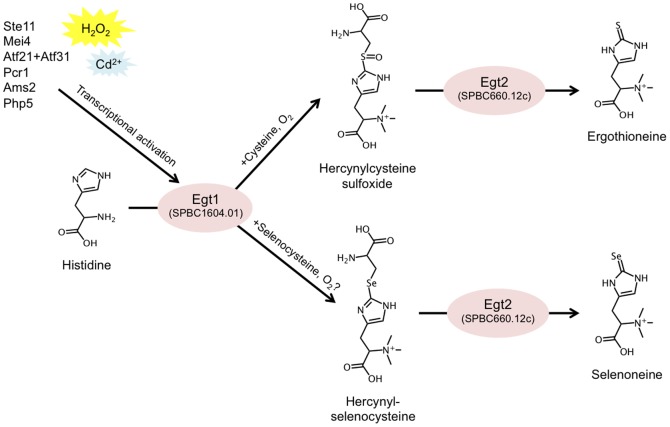
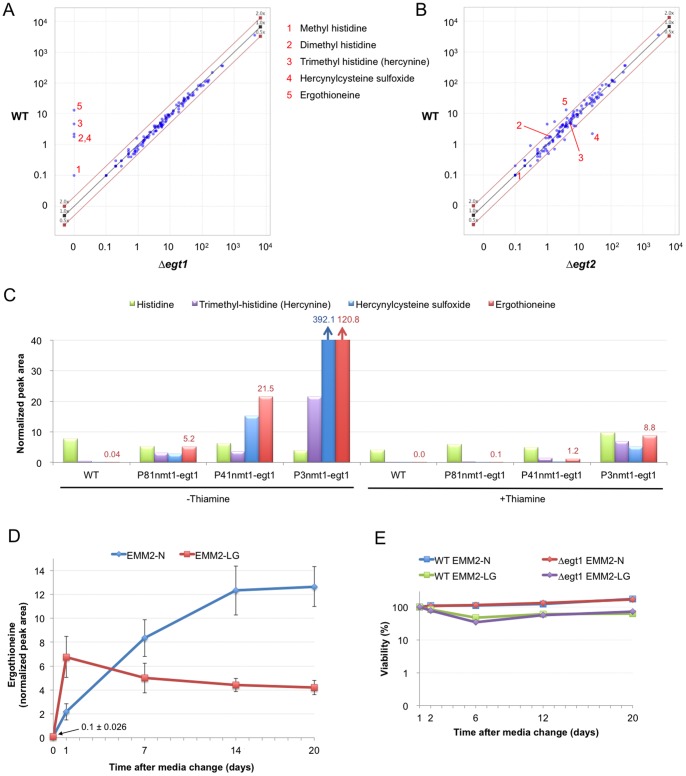
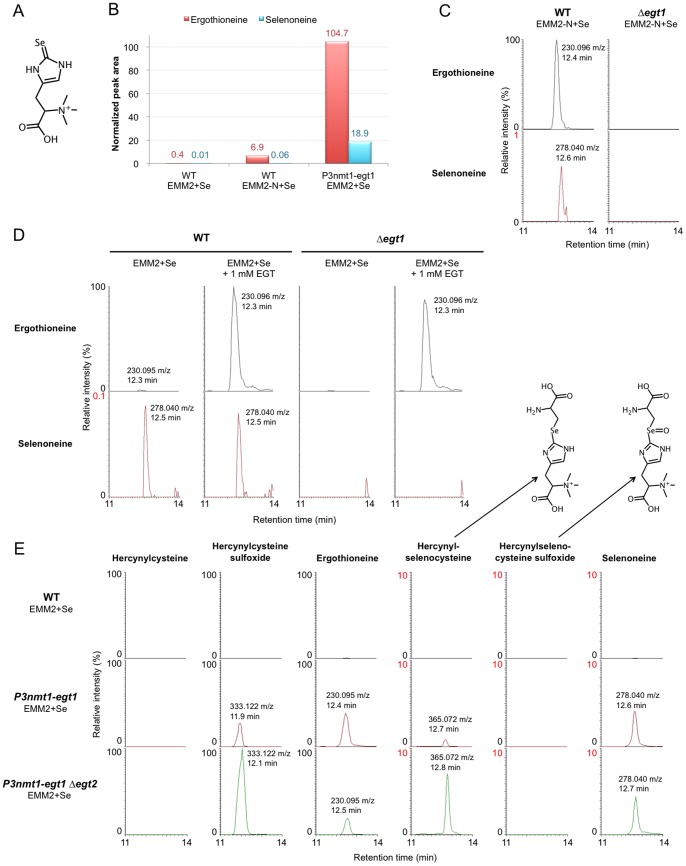
Ergothioneine is a small, sulfur-containing metabolite (229 Da) synthesized by various species of bacteria and fungi, which can accumulate to millimolar levels in tissues or cells (e.g. erythrocytes) of higher eukaryotes. It is commonly marketed as a dietary supplement due to its proposed protective and antioxidative functions. In this study we report the genes forming the two-step ergothioneine biosynthetic pathway in the fission yeast, Schizosaccharomyces pombe. We identified the first gene, egt1+ (SPBC1604.01), by sequence homology to previously published genes from Neurospora crassa and Mycobacterium smegmatis. We showed, using metabolomic analysis, that the Δegt1 deletion mutant completely lacked ergothioneine and its precursors (trimethyl histidine/hercynine and hercynylcysteine sulfoxide). Since the second step of ergothioneine biosynthesis has not been characterized in eukaryotes, we examined four putative homologs (Nfs1/SPBC21D10.11c, SPAC11D3.10, SPCC777.03c, and SPBC660.12c) of the corresponding mycobacterial enzyme EgtE. Among deletion mutants of these genes, only one (ΔSPBC660.12c, designated Δegt2) showed a substantial decrease in ergothioneine, accompanied by accumulation of its immediate precursor, hercynylcysteine sulfoxide. Ergothioneine-deficient strains exhibited no phenotypic defects during vegetative growth or quiescence. To effectively study the role of ergothioneine, we constructed an egt1+ overexpression system by replacing its native promoter with the nmt1+ promoter, which is inducible in the absence of thiamine. We employed three versions of the nmt1 promoter with increasing strength of expression and confirmed corresponding accumulations of ergothioneine. We quantified the intracellular concentration of ergothioneine in S. pombe (0.3, 157.4, 41.6, and up to 1606.3 µM in vegetative, nitrogen-starved, glucose-starved, and egt1+-overexpressing cells, respectively) and described its gradual accumulation under long-term quiescence. Finally, we demonstrated that the ergothioneine pathway can also synthesize selenoneine, a selenium-containing derivative of ergothioneine, when the culture medium is supplemented with selenium. We further found that selenoneine biosynthesis involves a novel intermediate compound, hercynylselenocysteine.
麦角硫因是一种由多种细菌和真菌合成的含硫小分子代谢物(229道尔顿),它可以在高等真核生物的组织或细胞(如红细胞)中积累至毫摩尔水平。由于其具有推测的保护和抗氧化功能,它通常作为膳食补充剂销售。在本研究中,我们报道了裂殖酵母(Schizosaccharomyces pombe)中形成两步麦角硫因生物合成途径的基因。我们通过与先前发表的来自粗糙脉孢菌和耻垢分枝杆菌的基因进行序列同源性分析,鉴定出了第一个基因egt1 +(SPBC1604.01)。我们使用代谢组学分析表明,Δegt1缺失突变体完全缺乏麦角硫因及其前体(三甲基组氨酸/肌肽和肌肽半胱氨酸亚砜)。由于麦角硫因生物合成的第二步在真核生物中尚未得到表征,我们研究了相应分枝杆菌酶EgtE的四个推定同源物(Nfs1 / SPBC21D10.11c、SPAC11D3.10、SPCC777.03c和SPBC660.12c)。在这些基因的缺失突变体中,只有一个(ΔSPBC660.12c,命名为Δegt2)显示麦角硫因大幅减少,并伴有其直接前体肌肽半胱氨酸亚砜的积累。缺乏麦角硫因的菌株在营养生长或静止期没有表现出表型缺陷。为了有效地研究麦角硫因的作用,我们通过用在缺乏硫胺素时可诱导的nmt1 +启动子替换其天然启动子,构建了一个egt1 +过表达系统。我们使用了三种表达强度递增的nmt1启动子版本,并证实了麦角硫因的相应积累。我们对粟酒裂殖酵母中麦角硫因的细胞内浓度进行了定量(在营养细胞、氮饥饿细胞、葡萄糖饥饿细胞和egt1 +过表达细胞中分别为0.3、157.4、41.6和高达1606.3 μM),并描述了其在长期静止期的逐渐积累。最后,我们证明当培养基中添加硒时,麦角硫因途径也可以合成麦角硫因的含硒衍生物硒代麦角硫因。我们进一步发现,硒代麦角硫因的生物合成涉及一种新型中间化合物肌肽硒代半胱氨酸。