Mooranian Armin, Negrulj Rebecca, Mathavan Sangeetha, Martinez Jorge, Sciarretta Jessica, Chen-Tan Nigel, Mukkur Tk, Mikov Momir, Lalic-Popovic Mladena, Stojančević Maja, Golocorbin-Kon Svetlana, Al-Salami Hani
Biotechnology and Drug Development Research Laboratory, Curtin Health Innovation Research Institute, Biosciences Research Precinct, Curtin University, Perth, WA Australia.
Curtin Health Innovation Research Institute, Biosciences Research Precinct, School of Biomedical Science, Curtin University, Perth, WA Australia.
J Pharm Innov. 2014;9(2):150-157. doi: 10.1007/s12247-014-9182-5.
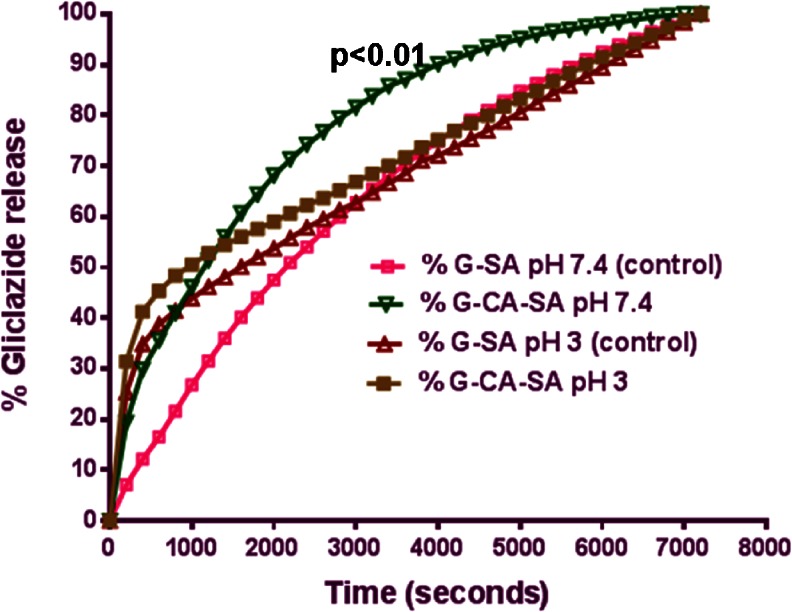
In previous studies carried out in our laboratory, a bile acid (BA) formulation exerted a hypoglycaemic effect in a rat model of type-1 diabetes (T1D). When the antidiabetic drug gliclazide (G) was added to the bile acid, it augmented the hypoglycaemic effect. In a recent study, we designed a new formulation of gliclazide-cholic acid (G-CA), with good structural properties, excipient compatibility and exhibits pseudoplastic-thixotropic characteristics. The aim of this study is to test the slow release and pH-controlled properties of this new formulation. The aim is also to examine the effect of CA on G release kinetics at various pH values and different temperatures.
Microencapsulation was carried out using our Buchi-based microencapsulating system developed in our laboratory. Using sodium alginate (SA) polymer, both formulations were prepared: G-SA (control) and G-CA-SA (test) at a constant ratio (1:3:30), respectively. Microcapsules were examined for efficiency, size, release kinetics, stability and swelling studies at pH 1.5, pH 3, pH 7.4 and pH 7.8 and temperatures of 20 and 30 °C.
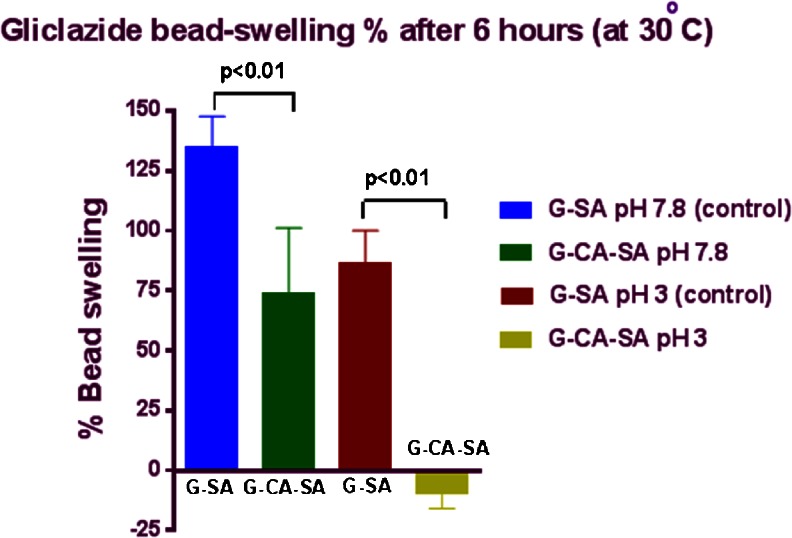
The new formulation is further optimised by the addition of CA. CA reduced microcapsule swelling of the microcapsules at pH 7.8 and pH 3 at 30 °C and pH 3 at 20 °C, and, even though microcapsule size remains similar after CA addition, percent G release was enhanced at high pH values (pH 7.4 and pH 7.8, < 0.01).
The new formulation exhibits colon-targeted delivery and the addition of CA prolonged G release suggesting its suitability for the sustained and targeted delivery of G and CA to the lower intestine.
在我们实验室之前进行的研究中,一种胆汁酸(BA)制剂在1型糖尿病(T1D)大鼠模型中发挥了降血糖作用。当将抗糖尿病药物格列齐特(G)添加到胆汁酸中时,增强了降血糖效果。在最近的一项研究中,我们设计了一种新的格列齐特 - 胆酸(G - CA)制剂,它具有良好的结构特性、辅料相容性并呈现假塑性 - 触变性特征。本研究的目的是测试这种新制剂的缓释和pH控制特性。目的还在于研究胆酸(CA)在不同pH值和不同温度下对格列齐特(G)释放动力学的影响。
使用我们实验室开发的基于Buchi的微囊化系统进行微囊化。使用海藻酸钠(SA)聚合物,分别以恒定比例(1:3:30)制备两种制剂:G - SA(对照)和G - CA - SA(测试)。在pH 1.5、pH 3、pH 7.4和pH 7.8以及20和30°C的温度下,对微囊进行效率、尺寸、释放动力学、稳定性和溶胀研究。
通过添加CA进一步优化了新制剂。CA降低了微囊在30°C时pH 7.8和pH 3以及20°C时pH 3下的微囊溶胀,并且,尽管添加CA后微囊尺寸保持相似,但在高pH值(pH 7.4和pH 7.8,P < 0.01)下G的释放百分比增加。
新制剂表现出结肠靶向递送,并且CA的添加延长了G的释放,表明其适用于将G和CA持续且靶向递送至下肠道。