Takeda Atsuya, Oku Yohei, Sanuki Naoko, Eriguchi Takahisa, Aoki Yousuke, Enomoto Tatsuji, Kaneko Takeshi, Nishimura Shuichi, Kunieda Etsuo
Radiation Oncology Center, Ofuna Chuo Hospital, 6-2-24 Ofuna, Kamakura, Kanagawa 247-0056, Japan
Radiation Oncology Center, Ofuna Chuo Hospital, 6-2-24 Ofuna, Kamakura, Kanagawa 247-0056, Japan.
J Radiat Res. 2014 Sep;55(5):988-95. doi: 10.1093/jrr/rru037. Epub 2014 May 15.
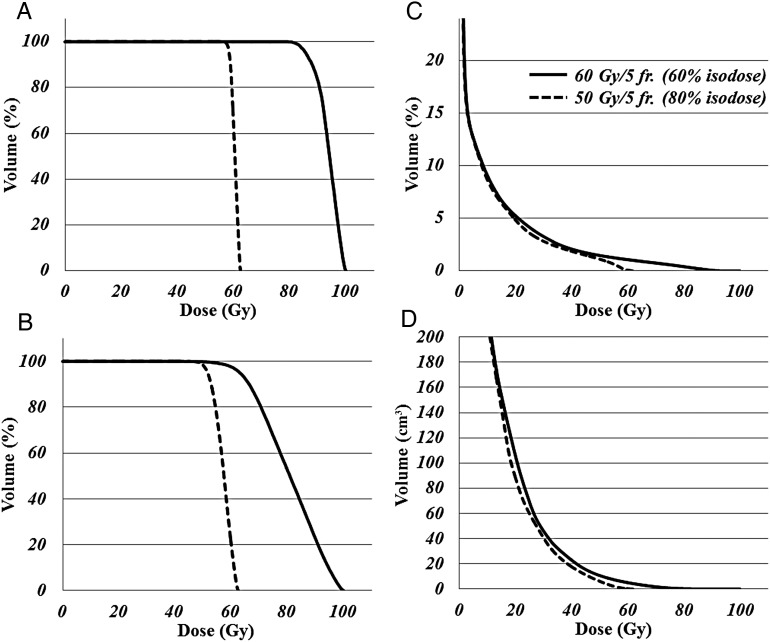
We evaluated toxicity and outcomes for patients with peripheral lung tumors treated with stereotactic body radiation therapy (SBRT) in a dose-escalation and dose-convergence study. A total of 15 patients were enrolled. SBRT was performed with 60 Gy in 5 fractions (fr.) prescribed to the 60% isodose line of maximum dose, which was 100 Gy in 5 fr., covering the planning target volume (PTV) surface (60 Gy/5 fr. - (60%-isodose)) using dynamic conformal multiple arc therapy (DCMAT). The primary endpoint was radiation pneumonitis (RP) ≥ Grade 2 within 6 months. Toxicities were graded according to the Common Terminology Criteria for Adverse Events, version 4.0. Using dose-volumetric analysis, the trial regimen of 60 Gy/5 fr. - (60%-isodose) was compared with our institutional conventional regimen of 50 Gy/5 fr. - (80%-isodose). The enrolled consecutive patients had either a solitary peripheral tumor or two ipsilateral tumors. The median follow-up duration was 22.0 (12.0-27.0) months. After 6 months post-SBRT, the respective number of RP Grade 0, 1 and 2 cases was 5, 9 and 1. In the Grade 2 RP patient, the image showed an organizing pneumonia pattern at 6.0 months post-SBRT. No other toxicity was found. At last follow-up, there was no evidence of recurrence of the treated tumors. The target volumes of 60 Gy/ 5 fr. - (60%-isodose) were irradiated with a significantly higher dose than those of 50 Gy/5 fr. - (80%-isodose), while the former dosimetric parameters of normal lung were almost equivalent to the latter. SBRT with 60 Gy/5 fr. - (60%-isodose) using DCMAT allowed the delivery of very high and convergent doses to peripheral lung tumors with feasibility in the acute and subacute phases. Further follow-up is required to assess for late toxicity.
在一项剂量递增和剂量汇聚研究中,我们评估了接受立体定向体部放射治疗(SBRT)的周围型肺肿瘤患者的毒性反应和治疗结果。共纳入15例患者。SBRT采用分5次给予60 Gy,处方剂量为最大剂量的60%等剂量线,即100 Gy分5次,覆盖计划靶体积(PTV)表面(60 Gy/5次 - (60%等剂量线)),采用动态适形多弧治疗(DCMAT)。主要终点为6个月内放射性肺炎(RP)≥2级。毒性反应根据《不良事件通用术语标准》第4.0版进行分级。采用剂量体积分析,将60 Gy/5次 - (60%等剂量线)的试验方案与我们机构50 Gy/5次 - (80%等剂量线)的传统方案进行比较。纳入的连续患者有孤立的周围型肿瘤或两个同侧肿瘤。中位随访时间为22.0(12.0 - 27.0)个月。SBRT后6个月,RP 0级、1级和2级的病例数分别为5例、9例和1例。在2级RP患者中,影像显示SBRT后6.0个月为机化性肺炎模式。未发现其他毒性反应。在最后一次随访时,未发现治疗的肿瘤有复发迹象。60 Gy/5次 - (60%等剂量线)的靶体积接受的照射剂量明显高于50 Gy/5次 - (80%等剂量线),而前者正常肺的剂量学参数与后者几乎相当。采用DCMAT的60 Gy/5次 - (60%等剂量线)SBRT能够在急性期和亚急性期将非常高且汇聚的剂量输送至周围型肺肿瘤,且具有可行性。需要进一步随访以评估晚期毒性反应。