Raimondi Lavinia, Amodio Nicola, Di Martino Maria Teresa, Altomare Emanuela, Leotta Marzia, Caracciolo Daniele, Gullà Annamaria, Neri Antonino, Taverna Simona, D'Aquila Patrizia, Alessandro Riccardo, Giordano Antonio, Tagliaferri Pierosandro, Tassone Pierfrancesco
Department of Experimental and Clinical Medicine, Magna Graecia University and Medical Oncology Unit, T. Campanella Cancer Center, Salvatore Venuta University Campus, Catanzaro, Italy.
Oncotarget. 2014 May 30;5(10):3039-54. doi: 10.18632/oncotarget.1747.
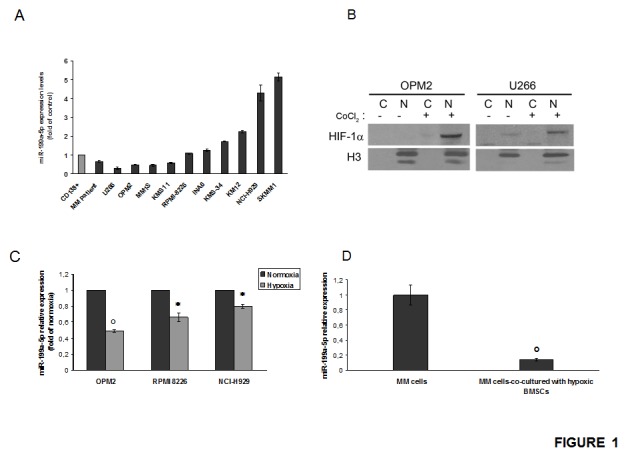
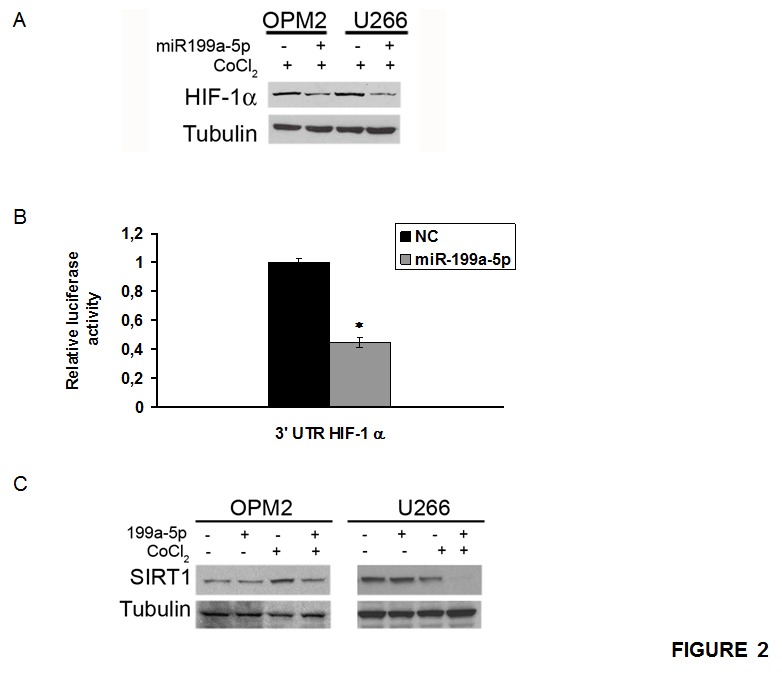
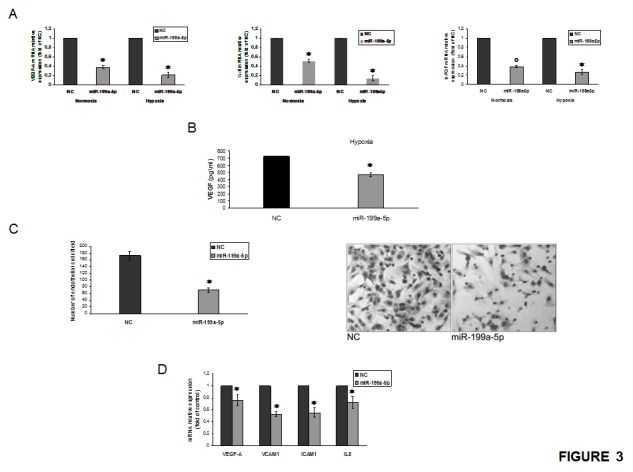
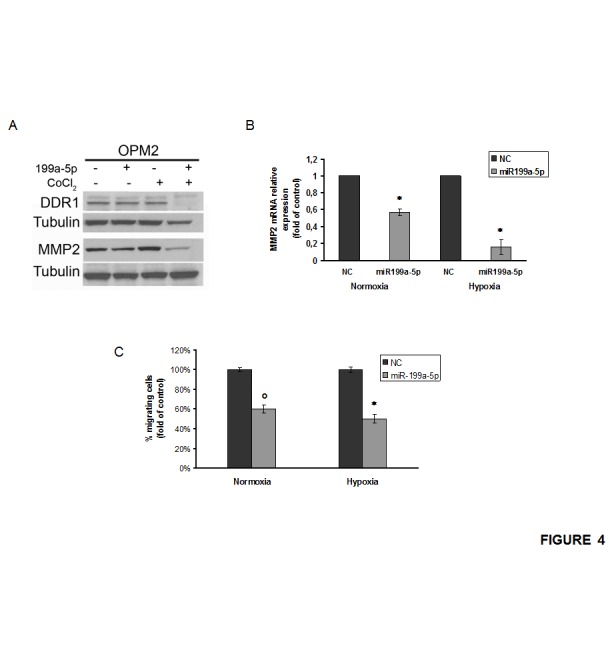
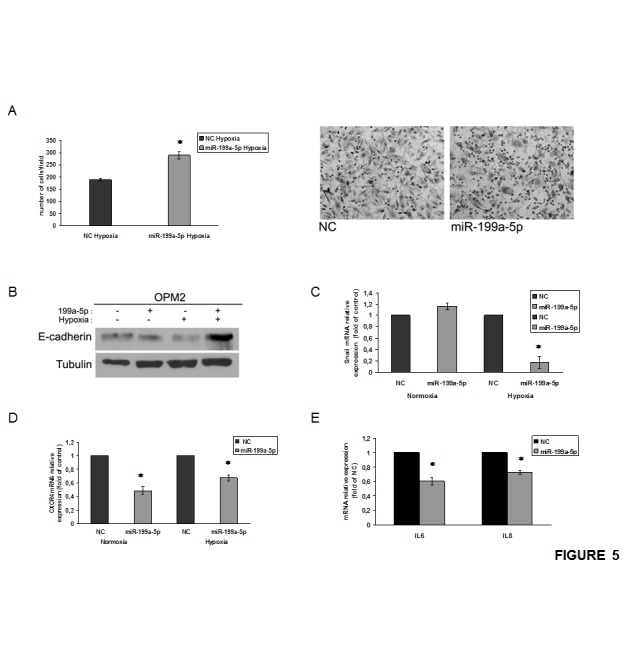
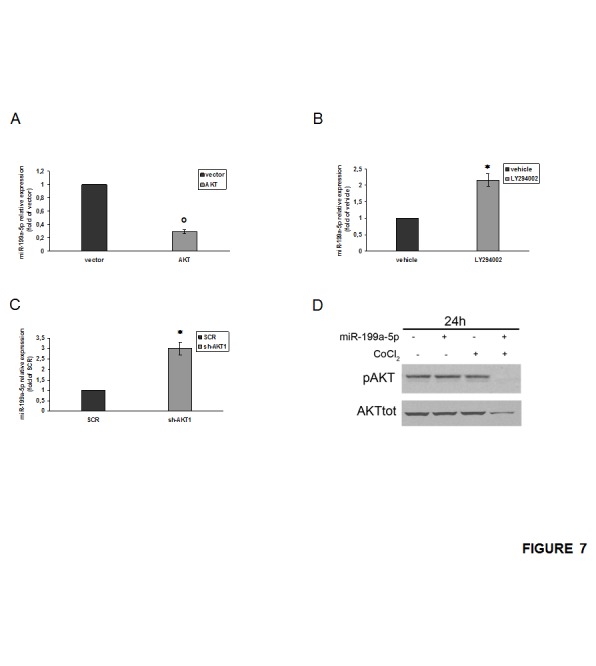
Multiple myeloma (MM) cells induce relevant angiogenic effects within the human bone marrow milieu (huBMM) by the aberrant expression of angiogenic factors. Hypoxia triggers angiogenic events within the huBMM and the transcription factor hypoxia-inducible factor-1α (HIF-1α) is over-expressed by MM cells. Since synthetic miR-199a-5p mimics negatively regulates HIF-1α, we here investigated a miRNA-based therapeutic strategy against hypoxic MM cells. We indeed found that enforced expression of miR-199a-5p led to down-modulated expression of HIF-1α as well as of other pro-angiogenic factors such as VEGF-A, IL-8, and FGFb in hypoxic MM cells in vitro. Moreover, miR-199a-5p negatively affected MM cells migration, while it increased the adhesion of MM cells to bone marrow stromal cells (BMSCs) in hypoxic conditions. Furthermore, transfection of MM cells with miR-199a-5p significantly impaired also endothelial cells migration and down-regulated the expression of endothelial adhesion molecules such as VCAM-1 and ICAM-1. Finally, we identified a hypoxia\AKT/miR-199a-5p loop as a potential molecular mechanism responsible of miR-199a-5p down-regulation in hypoxic MM cells. Taken together our results indicate that miR-199a-5p has an important role for the pathogenesis of MM and support the hypothesis that targeting angiogenesis via a miRNA/HIF-1α pathway may represent a novel potential therapeutical approach for this still lethal disease.
多发性骨髓瘤(MM)细胞通过血管生成因子的异常表达在人骨髓微环境(huBMM)中诱导相关的血管生成效应。缺氧触发huBMM内的血管生成事件,并且MM细胞过表达转录因子缺氧诱导因子-1α(HIF-1α)。由于合成的miR-199a-5p模拟物负向调节HIF-1α,我们在此研究了一种针对缺氧MM细胞的基于miRNA的治疗策略。我们确实发现,在体外缺氧的MM细胞中,miR-199a-5p的强制表达导致HIF-1α以及其他促血管生成因子如VEGF-A、IL-8和FGFb的表达下调。此外,miR-199a-5p对MM细胞迁移产生负面影响,而在缺氧条件下它增加了MM细胞与骨髓基质细胞(BMSC)的黏附。此外,用miR-199a-5p转染MM细胞也显著损害内皮细胞迁移,并下调内皮黏附分子如VCAM-1和ICAM-1的表达。最后,我们确定了一个缺氧\AKT/miR-199a-5p环作为缺氧MM细胞中miR-199a-5p下调的潜在分子机制。综上所述,我们的结果表明miR-199a-5p在MM发病机制中起重要作用,并支持通过miRNA/HIF-1α途径靶向血管生成可能代表这种仍然致命疾病的一种新型潜在治疗方法的假设。