
外周血涂片图像分析:全面综述。
Peripheral blood smear image analysis: A comprehensive review.
作者信息
Mohammed Emad A, Mohamed Mostafa M A, Far Behrouz H, Naugler Christopher
机构信息
Department of Electrical and Computer Engineering, Schulich School of Engineering, University of Calgary, Calgary, Alberta, Canada.
Department of Biomedical Engineering, Faculty of Engineering, Helwan University, Cairo, Egypt.
出版信息
J Pathol Inform. 2014 Mar 28;5(1):9. doi: 10.4103/2153-3539.129442. eCollection 2014.
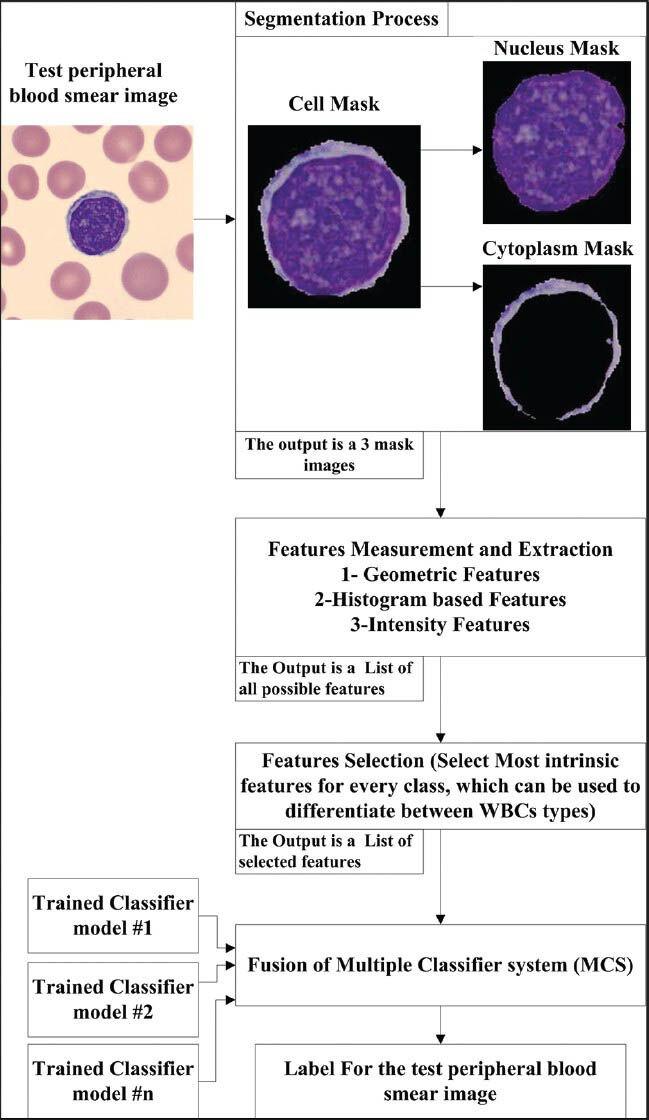
Peripheral blood smear image examination is a part of the routine work of every laboratory. The manual examination of these images is tedious, time-consuming and suffers from interobserver variation. This has motivated researchers to develop different algorithms and methods to automate peripheral blood smear image analysis. Image analysis itself consists of a sequence of steps consisting of image segmentation, features extraction and selection and pattern classification. The image segmentation step addresses the problem of extraction of the object or region of interest from the complicated peripheral blood smear image. Support vector machine (SVM) and artificial neural networks (ANNs) are two common approaches to image segmentation. Features extraction and selection aims to derive descriptive characteristics of the extracted object, which are similar within the same object class and different between different objects. This will facilitate the last step of the image analysis process: pattern classification. The goal of pattern classification is to assign a class to the selected features from a group of known classes. There are two types of classifier learning algorithms: supervised and unsupervised. Supervised learning algorithms predict the class of the object under test using training data of known classes. The training data have a predefined label for every class and the learning algorithm can utilize this data to predict the class of a test object. Unsupervised learning algorithms use unlabeled training data and divide them into groups using similarity measurements. Unsupervised learning algorithms predict the group to which a new test object belong to, based on the training data without giving an explicit class to that object. ANN, SVM, decision tree and K-nearest neighbor are possible approaches to classification algorithms. Increased discrimination may be obtained by combining several classifiers together.
外周血涂片图像检查是每个实验室日常工作的一部分。对这些图像进行人工检查既繁琐又耗时,而且存在观察者间差异。这促使研究人员开发不同的算法和方法来实现外周血涂片图像分析的自动化。图像分析本身由一系列步骤组成,包括图像分割、特征提取与选择以及模式分类。图像分割步骤解决了从复杂的外周血涂片图像中提取目标或感兴趣区域的问题。支持向量机(SVM)和人工神经网络(ANN)是图像分割的两种常见方法。特征提取与选择旨在获取所提取对象的描述性特征,同一对象类内的特征相似,不同对象间的特征不同。这将有助于图像分析过程的最后一步:模式分类。模式分类的目标是从一组已知类别中为所选特征分配一个类别。有两种类型的分类器学习算法:监督式和非监督式。监督式学习算法使用已知类别的训练数据来预测测试对象的类别。训练数据为每个类别都有一个预定义的标签,学习算法可以利用这些数据来预测测试对象的类别。非监督式学习算法使用无标签的训练数据,并通过相似性度量将它们分成组。非监督式学习算法根据训练数据预测新测试对象所属的组,而不给该对象明确的类别。人工神经网络、支持向量机、决策树和K近邻是分类算法的可能方法。通过将多个分类器组合在一起,可以提高辨别能力。



 Zotero 插件