Li Hongyan, Chuang Alice Z, O'Brien John
The Richard S. Ruiz M.D., Department of Ophthalmology and Visual Science,The University of Texas Medical School,Houston,Texas.
Vis Neurosci. 2014 May;31(3):237-43. doi: 10.1017/S095252381300062X.
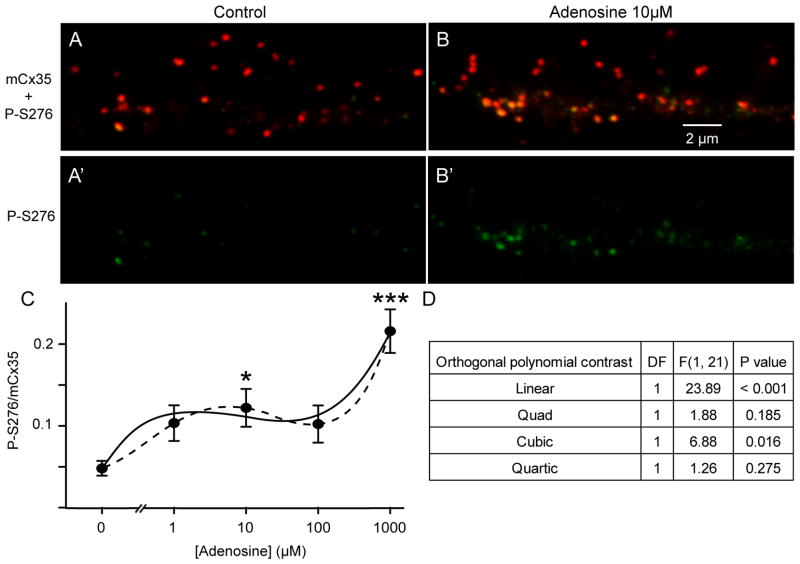
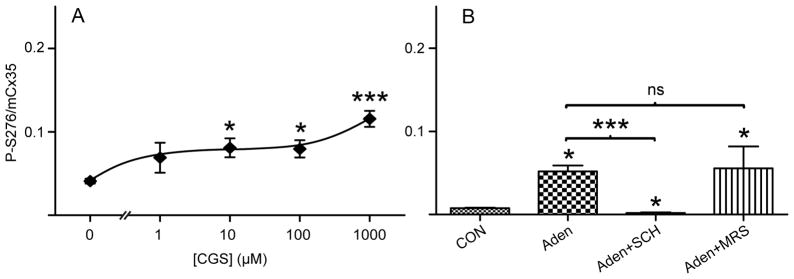
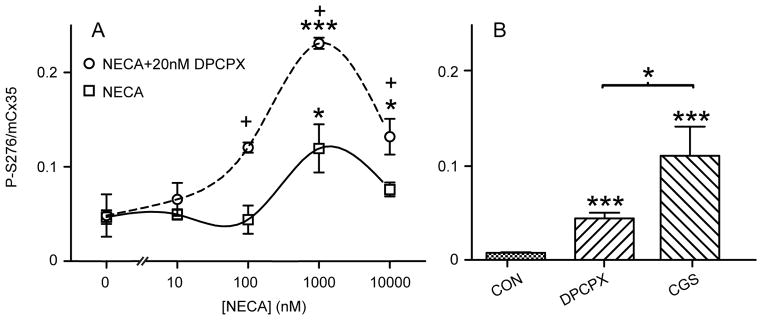
Electrical coupling of photoreceptors through gap junctions suppresses voltage noise, routes rod signals into cone pathways, expands the dynamic range of rod photoreceptors in high scotopic and mesopic illumination, and improves detection of contrast and small stimuli. In essentially all vertebrates, connexin 35/36 (gene homologs Cx36 in mammals, Cx35 in other vertebrates) is the major gap junction protein observed in photoreceptors, mediating rod-cone, cone-cone, and possibly rod-rod communication. Photoreceptor coupling is dynamically controlled by the day/night cycle and light/dark adaptation, and is directly correlated with phosphorylation of Cx35/36 at two sites, serine110 and serine 276/293 (homologous sites in teleost fish and mammals, respectively). Activity of protein kinase A (PKA) plays a key role during this process. Previous studies have shown that activation of dopamine D4 receptors on photoreceptors inhibits adenylyl cyclase, down-regulates cAMP and PKA activity, and leads to photoreceptor uncoupling, imposing the daytime/light condition. In this study, we explored the role of adenosine, a nighttime signal with a high extracellular concentration at night and a low concentration in the day, in regulating photoreceptor coupling by examining photoreceptor Cx35 phosphorylation in zebrafish retina. Adenosine enhanced photoreceptor Cx35 phosphorylation in daytime, but with a complex dose-response curve. Selective pharmacological manipulations revealed that adenosine A2a receptors provide a potent positive drive to phosphorylate photoreceptor Cx35 under the influence of endogenous adenosine at night. A2a receptors can be activated in the daytime as well by micromolar exogenous adenosine. However, the higher affinity adenosine A1 receptors are also present and have an antagonistic though less potent effect. Thus, the nighttime/darkness signal adenosine provides a net positive drive on Cx35 phosphorylation at night, working in opposition to dopamine to regulate photoreceptor coupling via a push-pull mechanism. However, the lower concentration of adenosine present in the daytime actually reinforces the dopamine signal through action on the A1 receptor.
通过缝隙连接实现的光感受器电耦合可抑制电压噪声,将视杆信号导入视锥通路,在高暗视和明视照明条件下扩展视杆光感受器的动态范围,并改善对比度和小刺激的检测。在基本上所有的脊椎动物中,连接蛋白35/36(哺乳动物中的基因同源物Cx36,其他脊椎动物中的Cx35)是在光感受器中观察到的主要缝隙连接蛋白,介导视杆 - 视锥、视锥 - 视锥以及可能的视杆 - 视杆之间的通讯。光感受器耦合受昼夜循环和光/暗适应动态控制,并且与Cx35/36在两个位点(丝氨酸110和丝氨酸276/293,分别为硬骨鱼和哺乳动物中的同源位点)的磷酸化直接相关。蛋白激酶A(PKA)的活性在此过程中起关键作用。先前的研究表明,光感受器上多巴胺D4受体的激活会抑制腺苷酸环化酶,下调cAMP和PKA活性,并导致光感受器解耦合,呈现白天/光照条件。在本研究中,我们通过检测斑马鱼视网膜中光感受器Cx35的磷酸化,探讨了腺苷(一种夜间细胞外浓度高而白天浓度低的夜间信号)在调节光感受器耦合中的作用。腺苷在白天增强了光感受器Cx35的磷酸化,但具有复杂的剂量反应曲线。选择性药理学操作表明,腺苷A2a受体在夜间内源性腺苷的影响下为磷酸化光感受器Cx35提供了强大的正向驱动。A2a受体在白天也可被微摩尔浓度的外源性腺苷激活。然而,亲和力更高的腺苷A1受体也存在,并且具有拮抗作用,尽管作用较弱。因此,夜间/黑暗信号腺苷在夜间对Cx35磷酸化提供净正向驱动,通过推挽机制与多巴胺相反作用来调节光感受器耦合。然而,白天存在的较低浓度腺苷实际上通过作用于A1受体增强了多巴胺信号。