Chan Ta-Chien, Chiang Po-Huang, Su Ming-Daw, Wang Hsuan-Wen, Liu Michael Shi-yung
Research Center for Humanities and Social Sciences, Academia Sinica, Taipei, Taiwan, Republic of China (R.O.C.).
Institute of Population Health Sciences, National Health Research Institutes, Zhunan, Taiwan, Republic of China (R.O.C.).
PLoS One. 2014 May 20;9(5):e98170. doi: 10.1371/journal.pone.0098170. eCollection 2014.
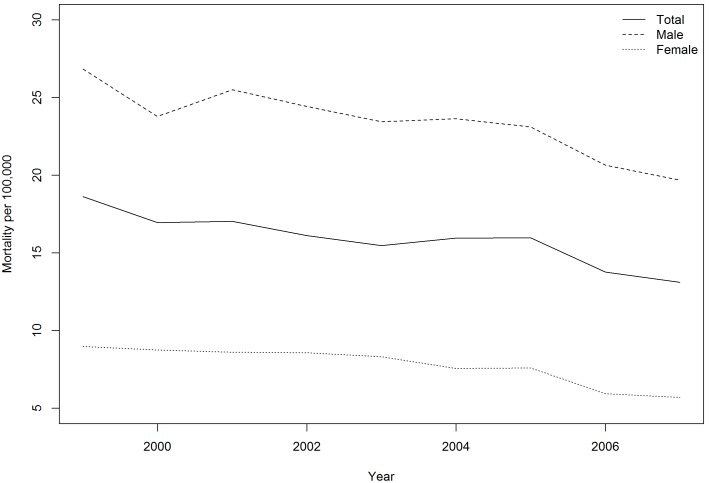
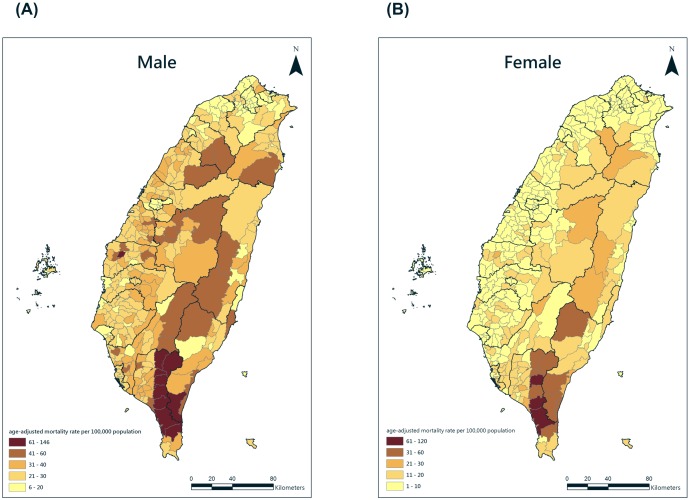
Chronic obstructive pulmonary disease (COPD) causes a high disease burden among the elderly worldwide. In Taiwan, the long-term temporal trend of COPD mortality is declining, but the geographical disparity of the disease is not yet known. Nationwide COPD age-adjusted mortality at the township level during 1999-2007 is used for elucidating the geographical distribution of the disease. With an ordinary least squares (OLS) model and geographically weighted regression (GWR), the ecologic risk factors such as smoking rate, area deprivation index, tuberculosis exposure, percentage of aborigines, density of health care facilities, air pollution and altitude are all considered in both models to evaluate their effects on mortality. Global and local Moran's I are used for examining their spatial autocorrelation and identifying clusters. During the study period, the COPD age-adjusted mortality rates in males declined from 26.83 to 19.67 per 100,000 population, and those in females declined from 8.98 to 5.70 per 100,000 population. Overall, males' COPD mortality rate was around three times higher than females'. In the results of GWR, the median coefficients of smoking rate, the percentage of aborigines, PM10 and the altitude are positively correlated with COPD mortality in males and females. The median value of density of health care facilities is negatively correlated with COPD mortality. The overall adjusted R-squares are about 20% higher in the GWR model than in the OLS model. The local Moran's I of the GWR's residuals reflected the consistent high-high cluster in southern Taiwan. The findings indicate that geographical disparities in COPD mortality exist. Future epidemiological investigation is required to understand the specific risk factors within the clustering areas.
慢性阻塞性肺疾病(COPD)在全球老年人中造成了很高的疾病负担。在台湾,COPD死亡率的长期时间趋势呈下降态势,但该疾病的地理差异尚不清楚。本研究采用1999 - 2007年乡镇层面的全国COPD年龄调整死亡率来阐明该疾病的地理分布情况。在普通最小二乘法(OLS)模型和地理加权回归(GWR)模型中,均考虑了吸烟率、地区贫困指数、结核病暴露情况、原住民百分比、医疗保健设施密度、空气污染和海拔高度等生态风险因素,以评估它们对死亡率的影响。使用全局和局部莫兰指数I来检验其空间自相关性并识别聚类。在研究期间,男性的COPD年龄调整死亡率从每10万人中的26.83例降至19.67例,女性则从每10万人中的8.98例降至5.70例。总体而言,男性的COPD死亡率约为女性的三倍。在GWR结果中,吸烟率、原住民百分比、PM10和海拔高度的中位数系数与男性和女性的COPD死亡率呈正相关。医疗保健设施密度的中位数与COPD死亡率呈负相关。GWR模型的总体调整R平方比OLS模型高约20%。GWR残差的局部莫兰指数I反映了台湾南部持续存在的高高聚类情况。研究结果表明,COPD死亡率存在地理差异。未来需要进行流行病学调查,以了解聚类区域内的具体风险因素。