Kauhl Boris, Maier Werner, Schweikart Jürgen, Keste Andrea, Moskwyn Marita
AOK Nordost-Die Gesundheitskasse, Department of Medical Care, Berlin, Germany.
Beuth University of Applied Sciences, Department III, Civil Engineering and Geoinformatics, Berlin, Germany.
PLoS One. 2018 Feb 7;13(2):e0190865. doi: 10.1371/journal.pone.0190865. eCollection 2018.
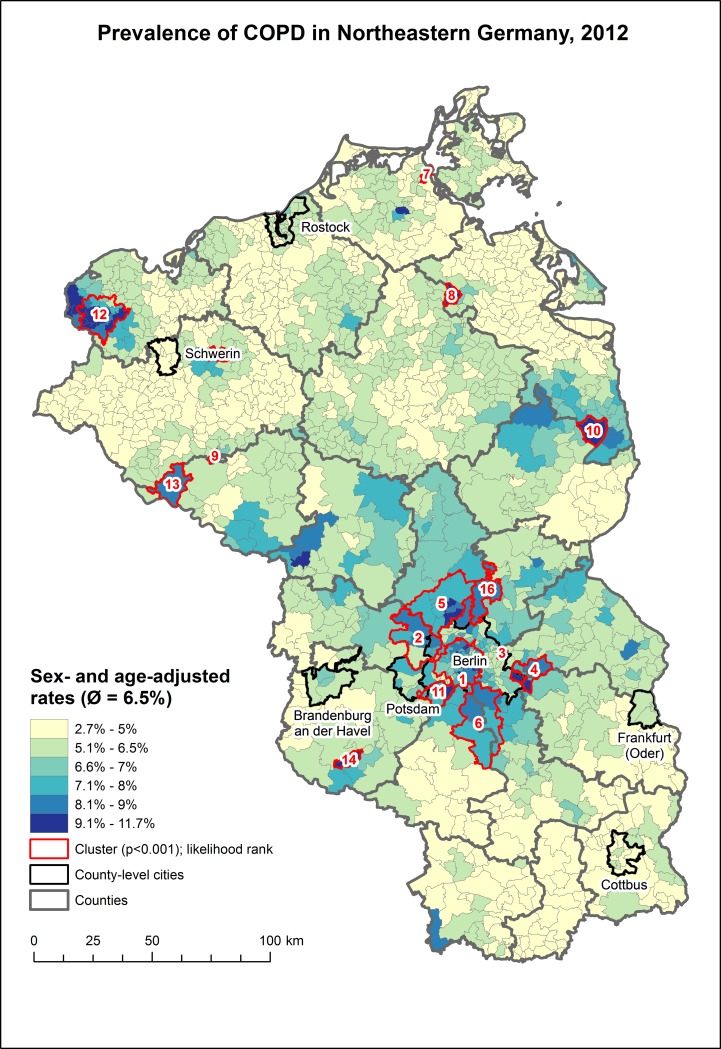
Chronic obstructive pulmonary disease (COPD) has a high prevalence rate in Germany and a further increase is expected within the next years. Although risk factors on an individual level are widely understood, only little is known about the spatial heterogeneity and population-based risk factors of COPD. Background knowledge about broader, population-based processes could help to plan the future provision of healthcare and prevention strategies more aligned to the expected demand. The aim of this study is to analyze how the prevalence of COPD varies across northeastern Germany on the smallest spatial-scale possible and to identify the location-specific population-based risk factors using health insurance claims of the AOK Nordost.
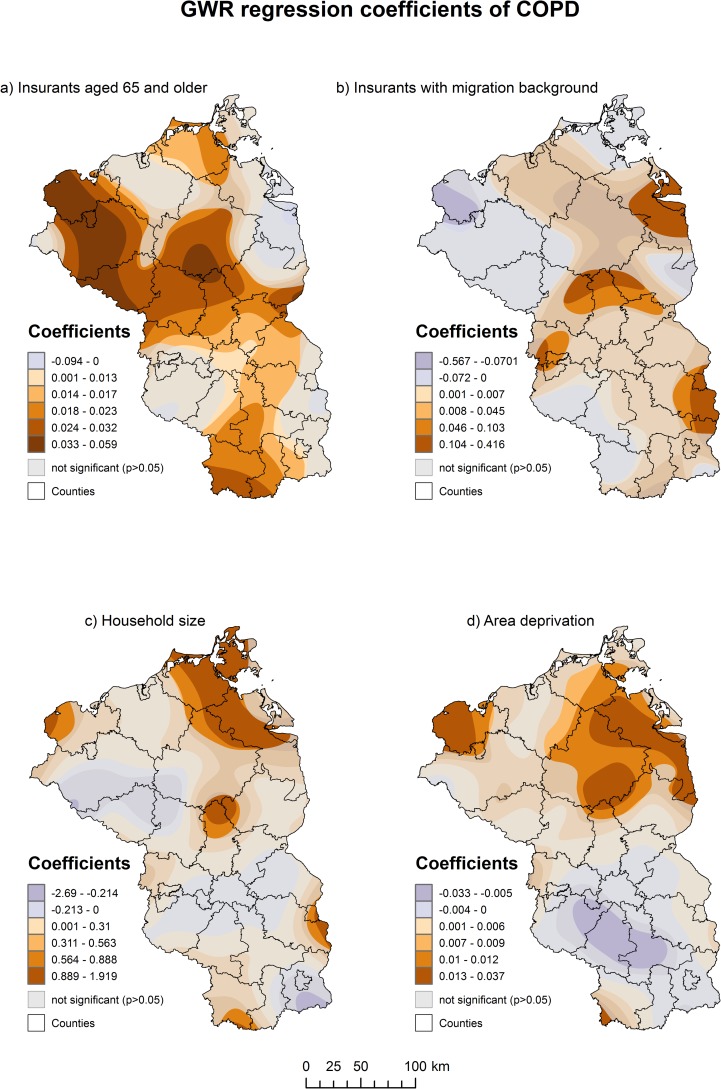
To visualize the spatial distribution of COPD prevalence at the level of municipalities and urban districts, we used the conditional autoregressive Besag-York-Mollié (BYM) model. Geographically weighted regression modelling (GWR) was applied to analyze the location-specific ecological risk factors for COPD.
The sex- and age-adjusted prevalence of COPD was 6.5% in 2012 and varied widely across northeastern Germany. Population-based risk factors consist of the proportions of insurants aged 65 and older, insurants with migration background, household size and area deprivation. The results of the GWR model revealed that the population at risk for COPD varies considerably across northeastern Germany.
Area deprivation has a direct and an indirect influence on the prevalence of COPD. Persons ageing in socially disadvantaged areas have a higher chance of developing COPD, even when they are not necessarily directly affected by deprivation on an individual level. This underlines the importance of considering the impact of area deprivation on health for planning of healthcare. Additionally, our results reveal that in some parts of the study area, insurants with migration background and persons living in multi-persons households are at elevated risk of COPD.
慢性阻塞性肺疾病(COPD)在德国的患病率很高,预计在未来几年还会进一步上升。尽管个体层面的风险因素已广为人知,但关于COPD的空间异质性和基于人群的风险因素却知之甚少。关于更广泛的基于人群的过程的背景知识有助于规划未来与预期需求更匹配的医疗保健和预防策略。本研究的目的是分析德国东北部COPD患病率在尽可能小的空间尺度上如何变化,并利用东北健康保险(AOK Nordost)的保险理赔数据确定特定地点基于人群的风险因素。
为了在市和市区层面可视化COPD患病率的空间分布,我们使用了条件自回归贝萨格-约克-莫利(BYM)模型。应用地理加权回归建模(GWR)分析COPD的特定地点生态风险因素。
2012年经性别和年龄调整的COPD患病率为6.5%,在德国东北部差异很大。基于人群的风险因素包括65岁及以上参保者的比例、有移民背景的参保者、家庭规模和地区贫困程度。GWR模型的结果显示,德国东北部COPD的风险人群差异很大。
地区贫困对COPD患病率有直接和间接影响。在社会弱势地区老龄化的人群患COPD的几率更高,即使他们不一定在个体层面直接受到贫困影响。这凸显了在规划医疗保健时考虑地区贫困对健康影响的重要性。此外,我们的结果显示,在研究区域的某些部分,有移民背景的参保者和居住在多人家庭中的人患COPD的风险较高。