Harms Ulf, Andreou Alexandra Zoi, Gubaev Airat, Klostermeier Dagmar
University of Muenster, Institute for Physical Chemistry, Corrensstrasse 30, D-48149 Muenster, Germany.
University of Muenster, Institute for Physical Chemistry, Corrensstrasse 30, D-48149 Muenster, Germany
Nucleic Acids Res. 2014 Jul;42(12):7911-22. doi: 10.1093/nar/gku440. Epub 2014 May 21.
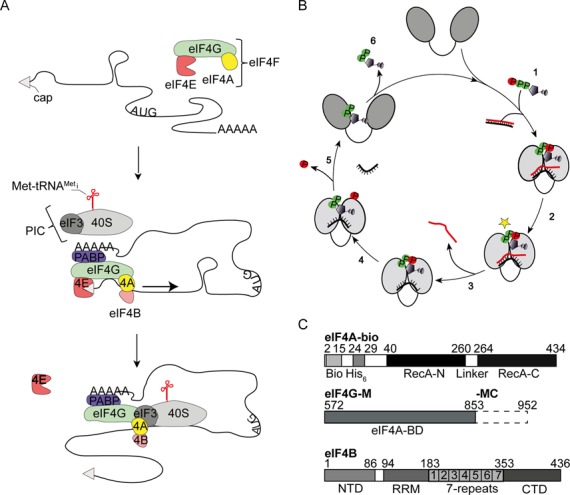
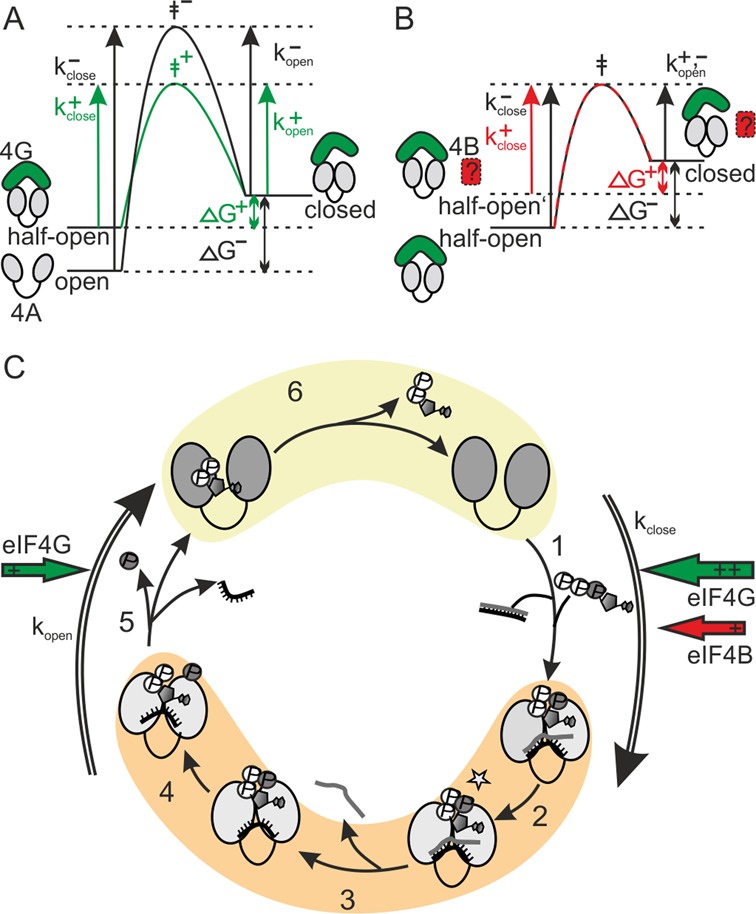
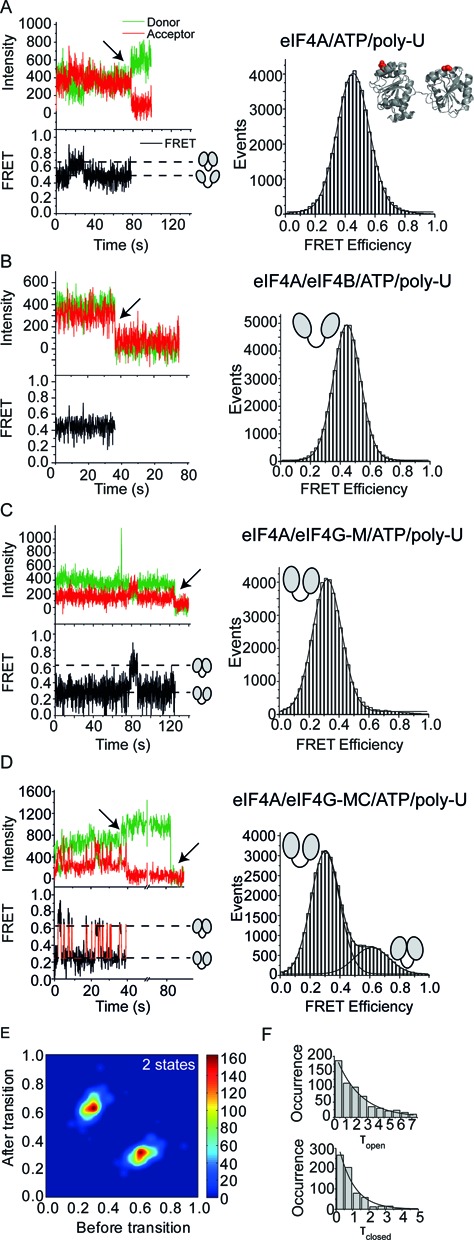
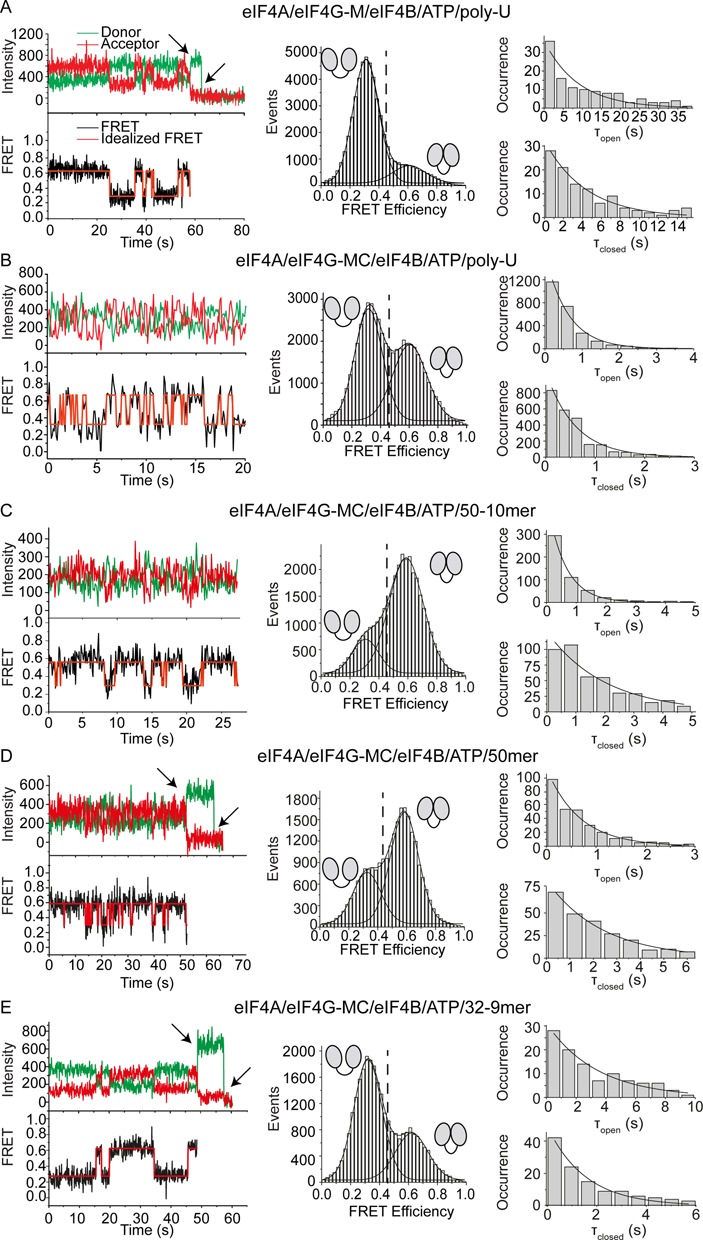
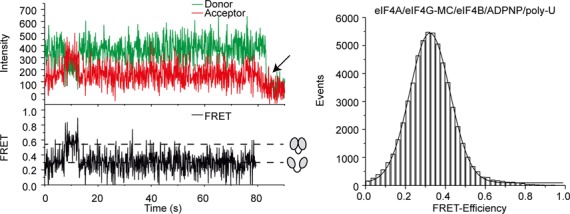
Eukaryotic translation initiation factor eIF4A is a DEAD-box helicase that resolves secondary structure elements in the 5'-UTR of mRNAs during ribosome scanning. Its RNA-stimulated ATPase and ATP-dependent helicase activities are enhanced by other translation initiation factors, but the underlying mechanisms are unclear. DEAD-box proteins alternate between open and closed conformations during RNA unwinding. The transition to the closed conformation is linked to duplex destabilization. eIF4A is a special DEAD-box protein that can adopt three different conformations, an open state in the absence of ligands, a half-open state stabilized by the translation initiation factor eIF4G and a closed state in the presence of eIF4G and eIF4B. We show here that eIF4A alone does not measurably sample the closed conformation. The translation initiation factors eIF4B and eIF4G accelerate the eIF4A conformational cycle. eIF4G increases the rate of closing more than the opening rate, and eIF4B selectively increases the closing rate. Strikingly, the rate constants and the effect of eIF4B are different for different RNAs, and are related to the presence of single-stranded regions. Modulating the kinetics of the eIF4A conformational cycle is thus central for the multi-layered regulation of its activity, and for its role as a regulatory hub in translation initiation.
真核生物翻译起始因子eIF4A是一种DEAD盒解旋酶,在核糖体扫描过程中可解开mRNA 5'-UTR中的二级结构元件。其RNA刺激的ATP酶和ATP依赖的解旋酶活性会被其他翻译起始因子增强,但其潜在机制尚不清楚。在RNA解旋过程中,DEAD盒蛋白会在开放和闭合构象之间交替。向闭合构象的转变与双链体不稳定有关。eIF4A是一种特殊的DEAD盒蛋白,可呈现三种不同的构象:在没有配体时为开放状态,由翻译起始因子eIF4G稳定的半开放状态,以及在存在eIF4G和eIF4B时的闭合状态。我们在此表明,单独的eIF4A无法检测到其闭合构象。翻译起始因子eIF4B和eIF4G加速了eIF4A的构象循环。eIF4G增加闭合速率的程度超过开放速率,而eIF4B选择性地增加闭合速率。引人注目的是,eIF4B的速率常数以及对不同RNA的影响是不同的,并且与单链区域的存在有关。因此,调节eIF4A构象循环的动力学对于其活性的多层调节以及其在翻译起始中作为调节枢纽的作用至关重要。