Chasman Daniel I, Anttila Verneri, Buring Julie E, Ridker Paul M, Schürks Markus, Kurth Tobias
Division of Preventive Medicine, Brigham and Women's Hospital, Boston, Massachusetts, United States of America; Harvard Medical School, Boston, Massachusetts, United States of America.
Harvard Medical School, Boston, Massachusetts, United States of America; Analytical and Translational Genetics Unit, Department of Medicine, Massachusetts General Hospital, Boston, Massachusetts, United States of America; Program in Medical and Population Genetics, Broad Institute of MIT and Harvard, Cambridge, Massachusetts, United States of America; Institute for Molecular Medicine Finland (FIMM), University of Helsinki, Helsinki, Finland.
PLoS Genet. 2014 May 22;10(5):e1004366. doi: 10.1371/journal.pgen.1004366. eCollection 2014 May.
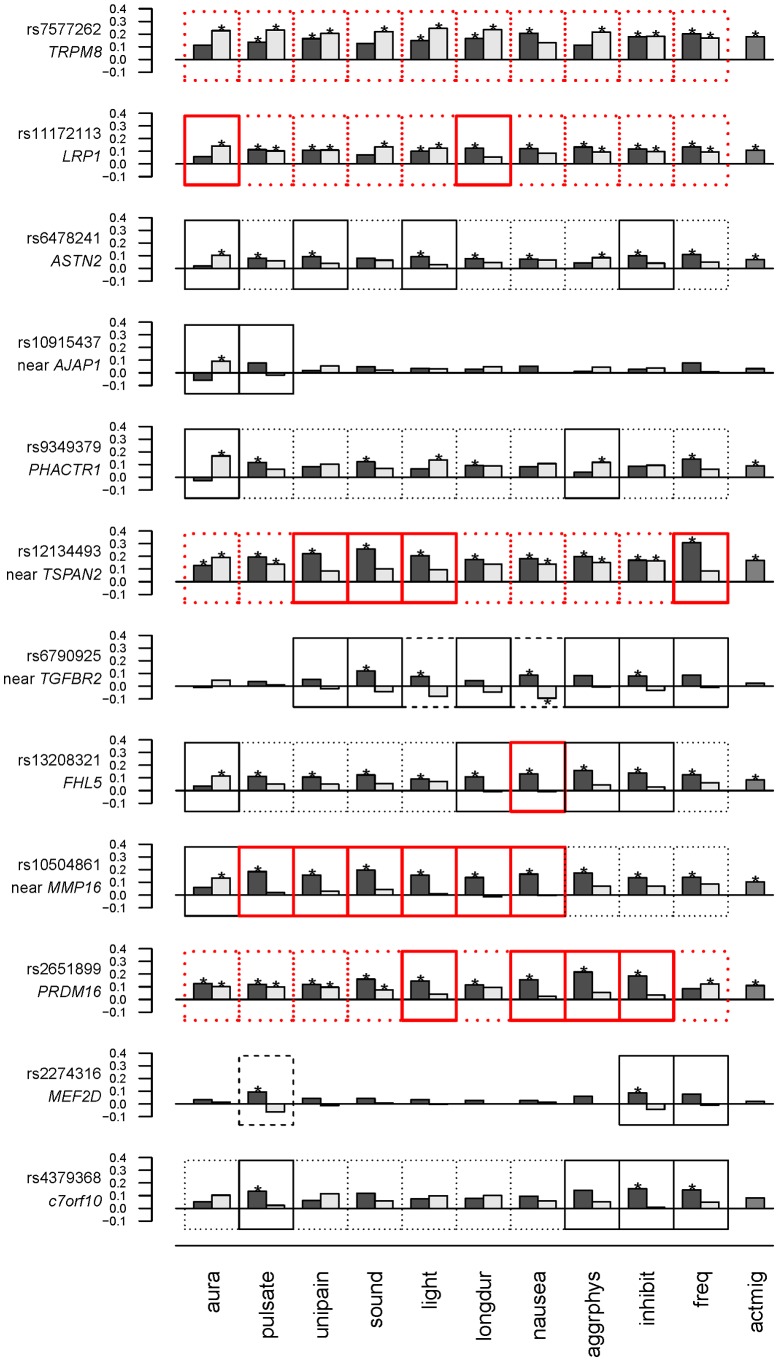
Migraine can be sub-classified not only according to presence of migraine aura (MA) or absence of migraine aura (MO), but also by additional features accompanying migraine attacks, e.g. photophobia, phonophobia, nausea, etc. all of which are formally recognized by the International Classification of Headache Disorders. It remains unclear how aura status and the other migraine features may be related to underlying migraine pathophysiology. Recent genome-wide association studies (GWAS) have identified 12 independent loci at which single nucleotide polymorphisms (SNPs) are associated with migraine. Using a likelihood framework, we explored the selective association of these SNPs with migraine, sub-classified according to aura status and the other features in a large population-based cohort of women including 3,003 active migraineurs and 18,108 free of migraine. Five loci met stringent significance for association with migraine, among which four were selective for sub-classified migraine, including rs11172113 (LRP1) for MO. The number of loci associated with migraine increased to 11 at suggestive significance thresholds, including five additional selective associations for MO but none for MA. No two SNPs showed similar patterns of selective association with migraine characteristics. At one extreme, SNPs rs6790925 (near TGFBR2) and rs2274316 (MEF2D) were not associated with migraine overall, MA, or MO but were selective for migraine sub-classified by the presence of one or more of the additional migraine features. In contrast, SNP rs7577262 (TRPM8) was associated with migraine overall and showed little or no selectivity for any of the migraine characteristics. The results emphasize the multivalent nature of migraine pathophysiology and suggest that a complete understanding of the genetic influence on migraine may benefit from analyses that stratify migraine according to both aura status and the additional diagnostic features used for clinical characterization of migraine.
偏头痛不仅可以根据有无偏头痛先兆(MA)进行亚分类,还可以根据偏头痛发作时伴随的其他特征进行分类,例如畏光、畏声、恶心等,所有这些特征都被《国际头痛疾病分类》正式认可。目前尚不清楚先兆状态和其他偏头痛特征如何与潜在的偏头痛病理生理学相关。最近的全基因组关联研究(GWAS)已经确定了12个独立位点,在这些位点上,单核苷酸多态性(SNP)与偏头痛相关。我们使用似然框架,在一个基于人群的大型女性队列中,探讨了这些SNP与根据先兆状态和其他特征进行亚分类的偏头痛之间的选择性关联,该队列包括3003名活动性偏头痛患者和18108名无偏头痛者。五个位点与偏头痛的关联达到了严格的显著性水平,其中四个位点对亚分类偏头痛具有选择性,包括与无先兆偏头痛(MO)相关的rs11172113(LRP1)。在提示性显著性阈值下,与偏头痛相关的位点数量增加到11个,包括另外五个与无先兆偏头痛相关的选择性关联,但与有先兆偏头痛(MA)无关。没有两个SNP与偏头痛特征显示出相似的选择性关联模式。在一个极端情况下,SNP rs6790925(靠近TGFBR2)和rs2274316(MEF2D)总体上与偏头痛、有先兆偏头痛或无先兆偏头痛均无关联,但对由一种或多种其他偏头痛特征定义的亚分类偏头痛具有选择性。相比之下,SNP rs7577262(TRPM8)总体上与偏头痛相关,并且对任何偏头痛特征几乎没有或没有选择性。这些结果强调了偏头痛病理生理学的多价性质,并表明,根据先兆状态和用于偏头痛临床特征描述的其他诊断特征对偏头痛进行分层分析,可能有助于全面了解遗传因素对偏头痛的影响。