School of Psychology, University of Plymouth, Drake Circus Devon, UK.
Front Hum Neurosci. 2014 May 12;8:254. doi: 10.3389/fnhum.2014.00254. eCollection 2014.
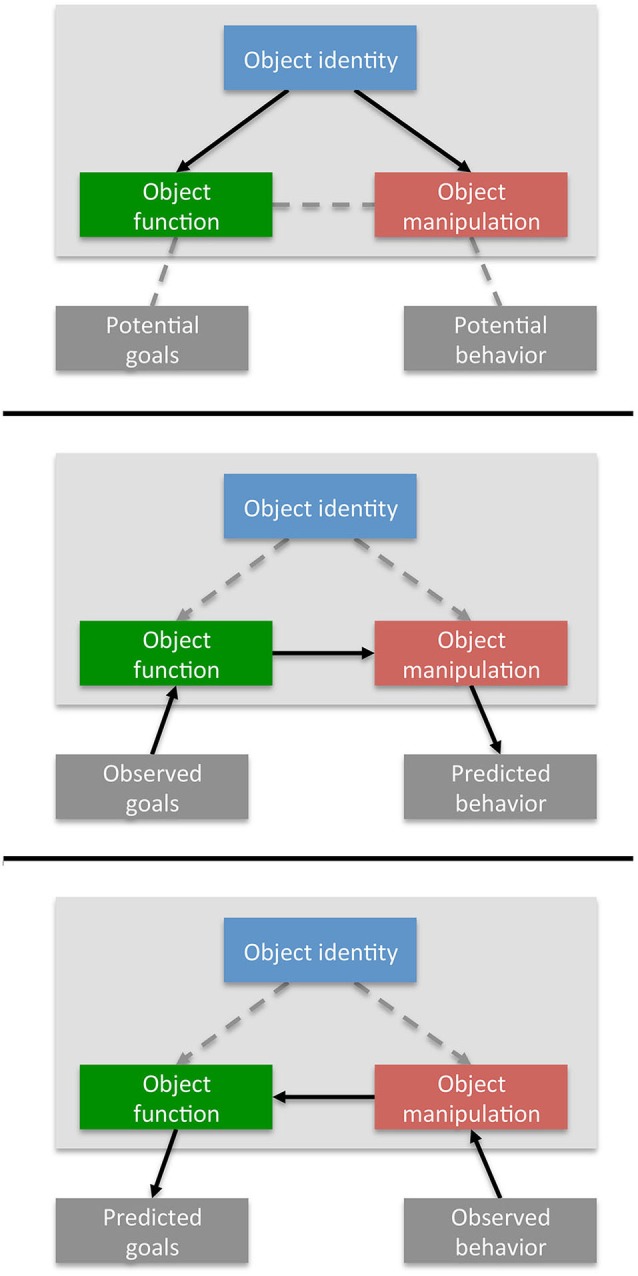
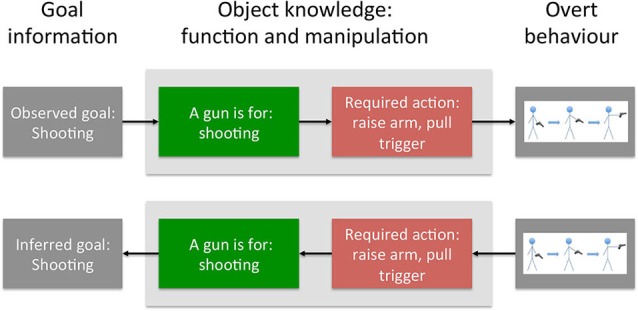
Action understanding lies at the heart of social interaction. Prior research has often conceptualized this capacity in terms of a motoric matching of observed actions to an action in one's motor repertoire, but has ignored the role of object information. In this manuscript, we set out an alternative conception of intention understanding, which places the role of objects as central to our observation and comprehension of the actions of others. We outline the current understanding of the interconnectedness of action and object knowledge, demonstrating how both rely heavily on the other. We then propose a novel framework, the affordance-matching hypothesis, which incorporates these findings into a simple model of action understanding, in which object knowledge-what an object is for and how it is used-can inform and constrain both action interpretation and prediction. We will review recent empirical evidence that supports such an object-based view of action understanding and we relate the affordance matching hypothesis to recent proposals that have re-conceptualized the role of mirror neurons in action understanding.
动作理解是社会互动的核心。先前的研究通常将这种能力概念化为将观察到的动作与自身动作库中的动作进行动作匹配,但忽略了物体信息的作用。在本文中,我们提出了一种理解意图的替代概念,将物体的作用作为我们观察和理解他人动作的核心。我们概述了当前对动作和物体知识的相互联系的理解,展示了两者如何相互依赖。然后,我们提出了一个新的框架,即顺应匹配假说,该假说将这些发现纳入一个简单的动作理解模型中,其中物体知识——物体的用途以及如何使用它——可以为动作解释和预测提供信息并加以限制。我们将回顾支持这种基于物体的动作理解观点的最新实证证据,并将顺应匹配假说与最近重新概念化镜像神经元在动作理解中的作用的提议联系起来。