Ho Chin Yee, Jaalouk Diana E, Lammerding Jan
Weill Institute for Cell and Molecular Biology/Department of Biomedical Engineering; Cornell University; Ithaca, NY USA ; Department of Medicine; Brigham and Women's Hospital; Boston, MA USA.
Weill Institute for Cell and Molecular Biology/Department of Biomedical Engineering; Cornell University; Ithaca, NY USA ; Department of Medicine; Brigham and Women's Hospital; Boston, MA USA ; Department of Biology; American University of Beirut; Beirut, Lebanon.
Rare Dis. 2013 Jan 1;1(1):e27002. doi: 10.4161/rdis.27002. Epub 2013 Nov 6.
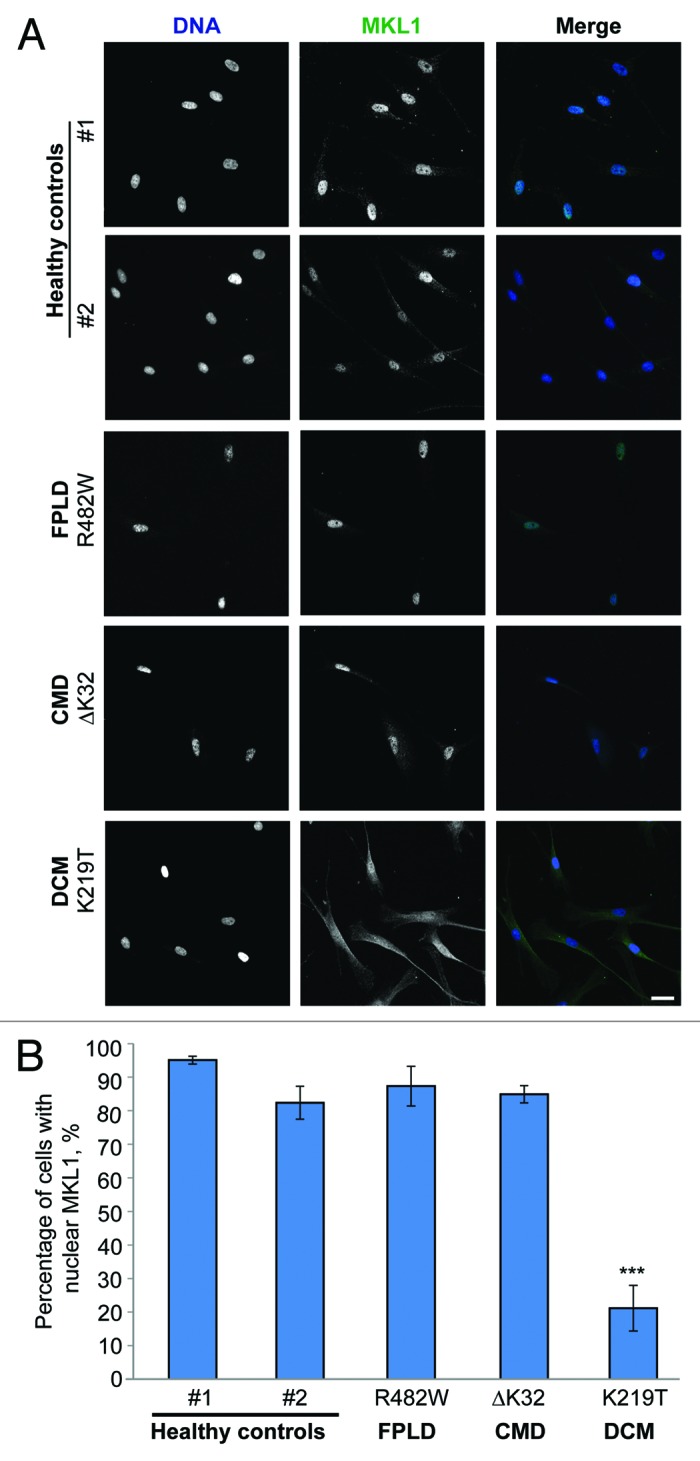
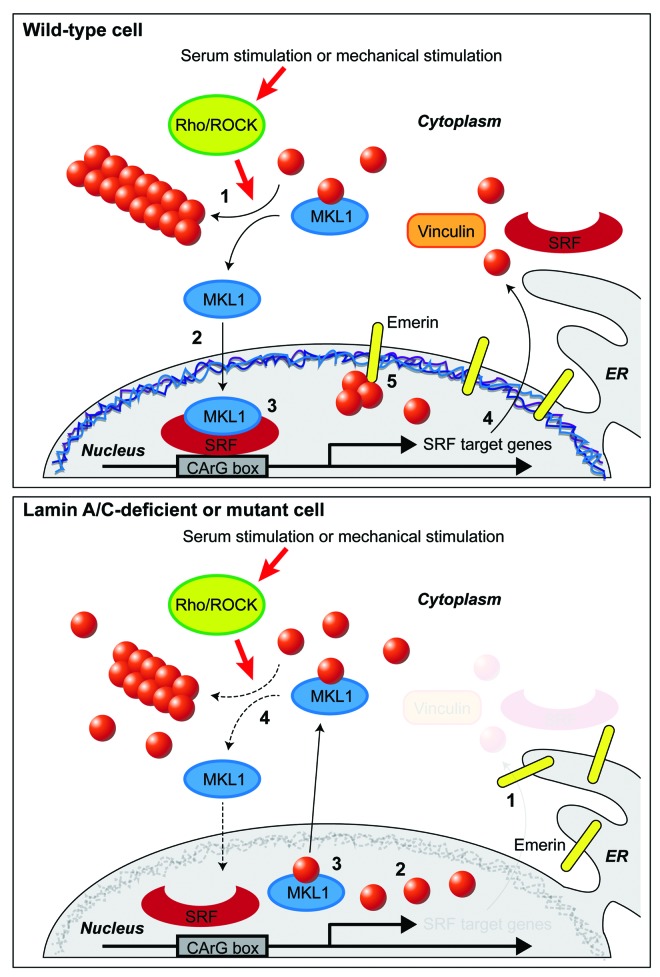
Laminopathies are a heterogeneous group of diseases that are caused by mutations in the nuclear envelope proteins lamins A and C. Laminopathies include dilated cardiomyopathy, Emery-Dreifuss muscular dystrophy, and familial partial lipodystrophy. Despite their near-ubiquitous expression, most laminopathies involve highly tissue-specific phenotypes, often affecting skeletal and cardiac muscle. The underlying mechanism(s) remain incompletely understood. We recently reported that altered actin dynamics in lamin A/C-deficient and mutant cells disturb nuclear shuttling of the transcriptional co-activator MKL1, which is critical for cardiac function. Expression of the inner nuclear membrane protein emerin rescues MKL1 translocation through modulating actin dynamics. Here, we elaborate on these findings, discuss new insights into the role of nuclear actin in MKL1activity, and demonstrate that primary human skin fibroblasts from a patient with dilated cardiomyopathy have impaired MKL1 nuclear translocation. These findings further strengthen the relevance of impaired MKL1 signaling as a potential contributor to the disease mechanism in laminopathies.
核纤层蛋白病是一类由核膜蛋白核纤层蛋白A和C发生突变引起的异质性疾病。核纤层蛋白病包括扩张型心肌病、埃默里-德赖富斯肌营养不良症和家族性部分脂肪营养不良症。尽管核纤层蛋白几乎在所有细胞中都有表达,但大多数核纤层蛋白病都涉及高度组织特异性的表型,常影响骨骼肌和心肌。其潜在机制仍未完全明确。我们最近报道,在缺乏核纤层蛋白A/C和发生突变的细胞中,肌动蛋白动力学的改变会干扰转录共激活因子MKL1的核穿梭,而MKL1对心脏功能至关重要。内核膜蛋白emerin的表达通过调节肌动蛋白动力学来挽救MKL1的易位。在此,我们详细阐述这些发现,讨论关于核肌动蛋白在MKL1活性中作用的新见解,并证明来自一名扩张型心肌病患者的原代人皮肤成纤维细胞存在MKL1核易位受损的情况。这些发现进一步强化了MKL1信号受损作为核纤层蛋白病疾病机制潜在促成因素的相关性。