Department of Applied Biological Science, Faculty of Agriculture, Kagawa University, Miki, Kagawa 761-0795, Japan.
Department of Chemistry, Faculty of Science and Technology, Keio University, 3-14-1 Hiyoshi, Kohoku, Yokohama 223-8522, Japan.
Molecules. 2014 May 26;19(6):6929-40. doi: 10.3390/molecules19066929.
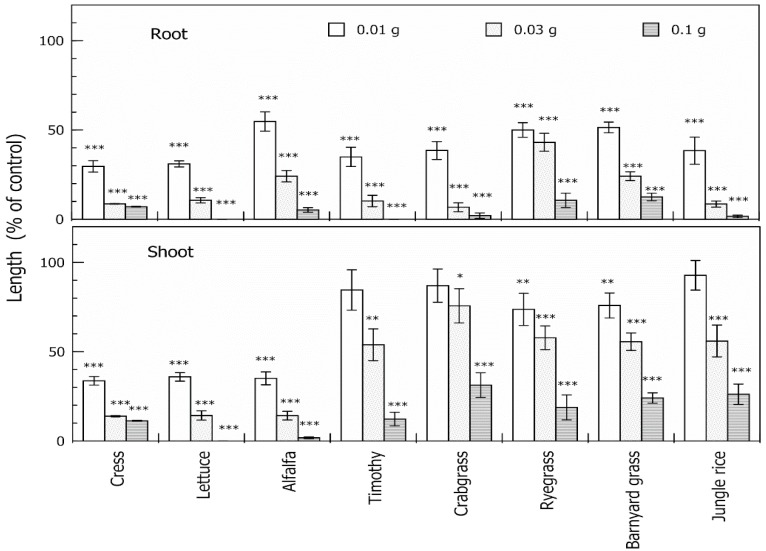
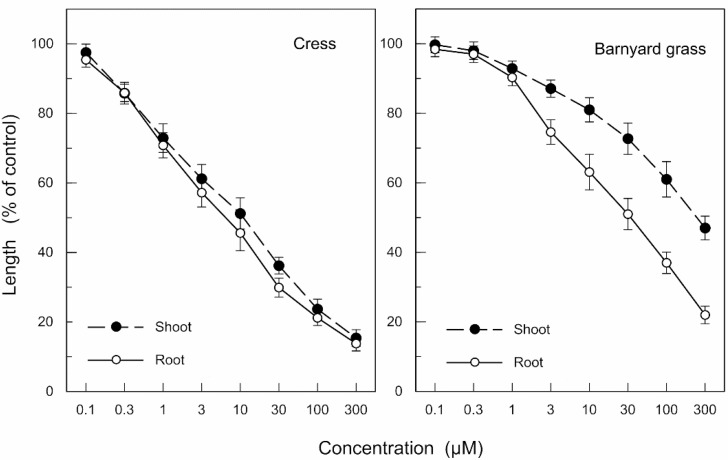
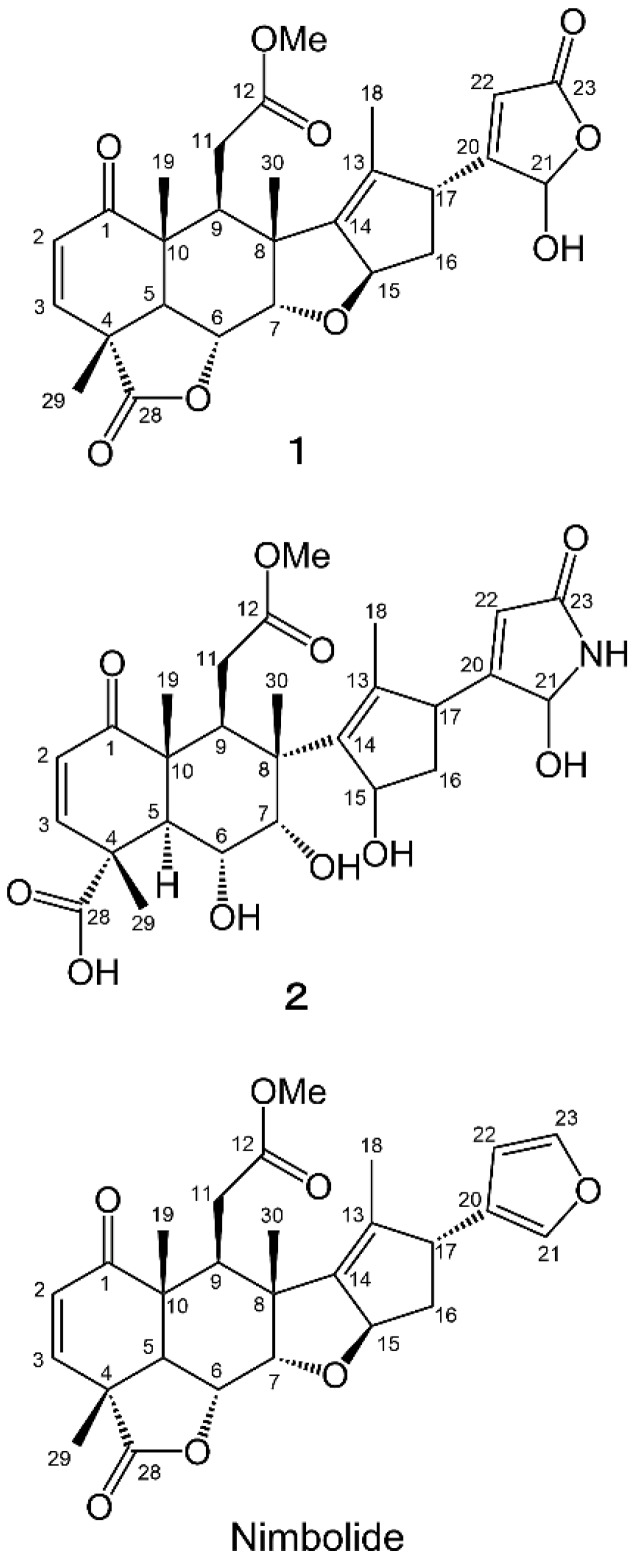
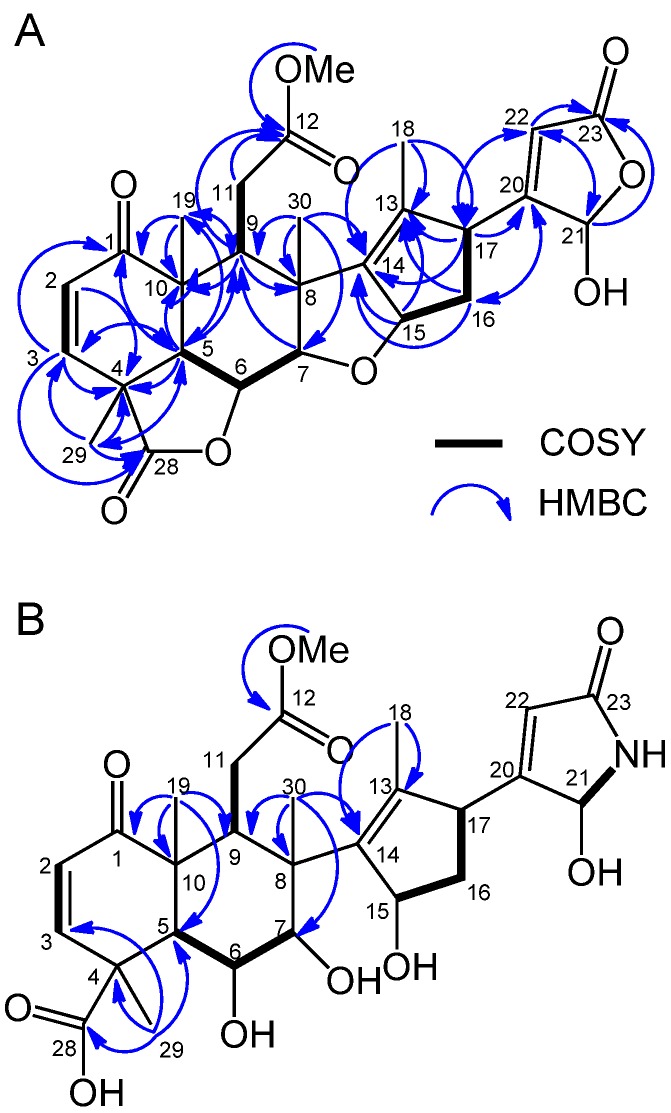
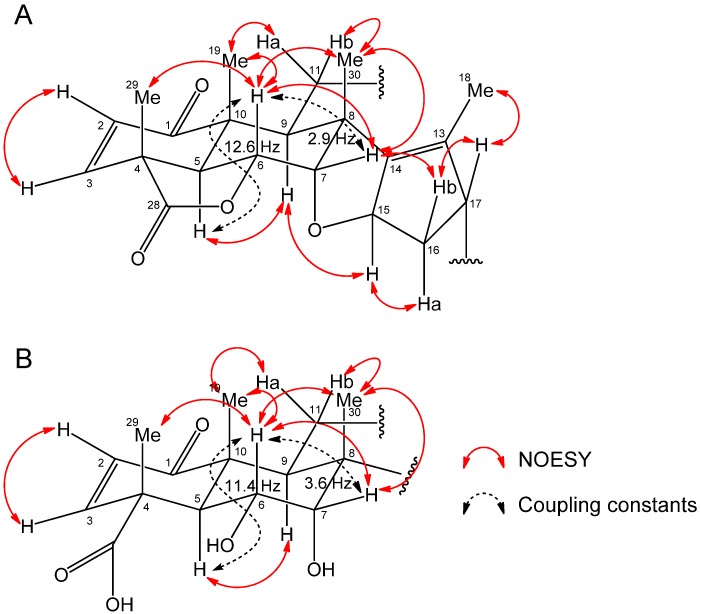
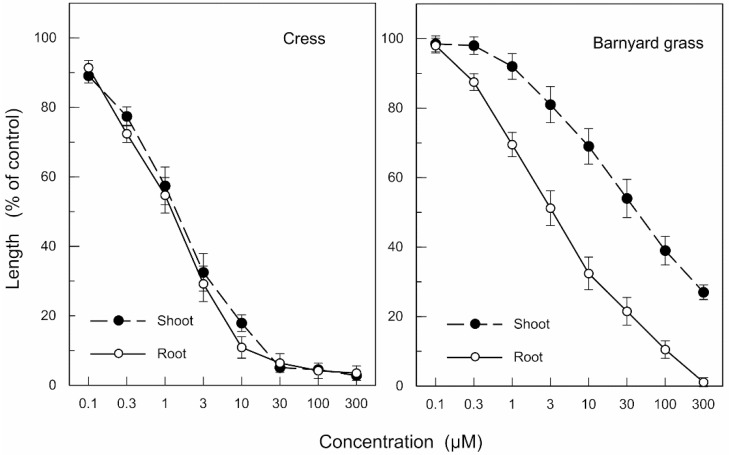
Neem (Azadirachta indica) has been widely used as a traditional medicine and several bioactive compounds have been isolated from this species, but to date no potent allelopathic active substance has been reported. Therefore, we investigated possible allelopathic property and phytotoxic substances with allelopathic activity in neem. An aqueous methanol extract of neem leaves inhibited the growth of roots and shoots of cress, lettuce, alfalfa, timothy, crabgrass, ryegrass, barnyard grass and jungle rice. The extracts were then purified by several chromatographic runs while monitoring the inhibitory activity and two phytotoxic substances were isolated. The chemical structures of the two substances were determined by spectral data to correspond to novel compounds, nimbolide B (1) and nimbic acid B (2). Nimbolide B inhibited the growth of cress and barnyard grass at concentrations greater than 0.1‒3.0 μM. Nimbic acid B inhibited the growth of cress and barnyard grass at concentrations greater than 0.3-1.0 μM. These results suggest that nimbolide B and nimbic acid B may contribute to the allelopathic effects caused by neem leaves.
印楝(Azadirachta indica)被广泛用作传统药物,从该物种中分离出了几种生物活性化合物,但迄今为止尚未报道具有强烈化感活性的物质。因此,我们研究了印楝中可能具有化感性质和化感活性的植物毒性物质。印楝叶的水甲醇提取物抑制了卷心莴苣、生菜、紫花苜蓿、梯牧草、稗草、黑麦草、狗尾草和野生稻的根和芽的生长。然后通过多次色谱分离对提取物进行纯化,同时监测抑制活性,分离出两种具有化感活性的植物毒性物质。两种物质的化学结构通过光谱数据确定,对应于新化合物,印楝内酯 B(1)和 nimbic 酸 B(2)。印楝内酯 B 在浓度大于 0.1-3.0 μM 时抑制了卷心莴苣和狗尾草的生长。Nimbic 酸 B 在浓度大于 0.3-1.0 μM 时抑制了卷心莴苣和狗尾草的生长。这些结果表明,印楝内酯 B 和 nimbic 酸 B 可能对印楝叶引起的化感作用有贡献。