Department of Neurology, College of Medicine, The Catholic University of Korea, Seoul, Korea.
J Mov Disord. 2013 Oct;6(2):23-7. doi: 10.14802/jmd.13006. Epub 2013 Oct 30.
Several reports on the elderly population have suggested that orthostatic hypotension is associated with white matter hyperintensities (WMH); however, little information is available on patients with Parkinson's disease (PD).
We analyzed the association blood pressure profiles during tilt table testing with WMH scores in 117 patients with PD. WMH were rated using the semiquantitative visual rating system proposed by Scheltens et al.
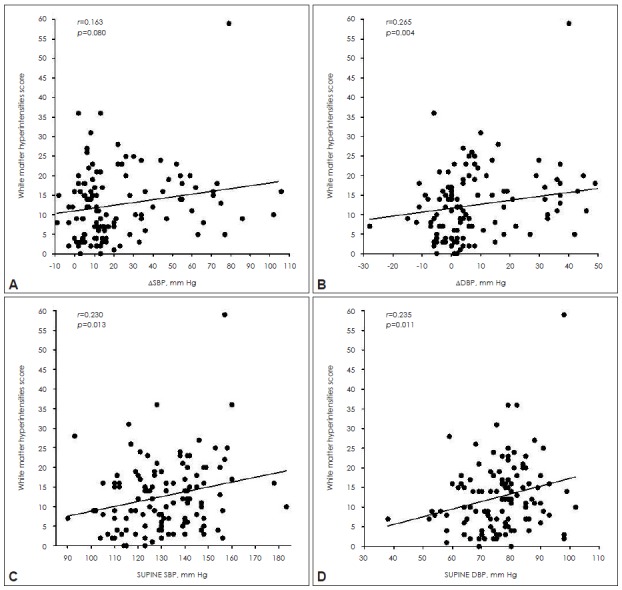
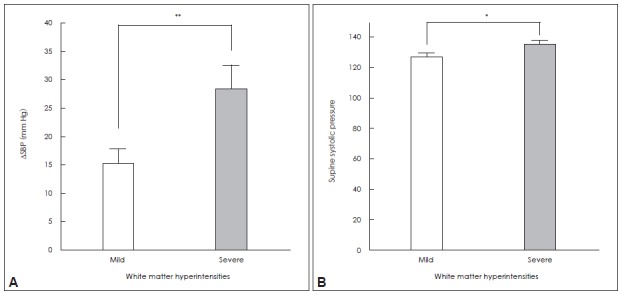
The presence of orthostatic hypotension was associated with increasing tendency of WMH score and the blood pressure changes during tilting and supine blood pressure were positively correlated with increasing WMH score.
This finding indicates that hemodynamic changes associated with orthostatic hypotension may be associated with white matter changes in patients with PD.
几项关于老年人的报告表明,直立性低血压与脑白质高信号(WMH)有关;然而,关于帕金森病(PD)患者的信息较少。
我们分析了 117 例 PD 患者倾斜试验期间血压曲线与 WMH 评分的关系。WMH 采用 Scheltens 等提出的半定量视觉评分系统进行评分。
直立性低血压的存在与 WMH 评分的增加趋势有关,倾斜期间的血压变化和仰卧位血压与 WMH 评分的增加呈正相关。
这一发现表明,与直立性低血压相关的血流动力学变化可能与 PD 患者的白质变化有关。