A Shirsath Morgana, O'Connor John D, Boyle Rory, Newman Louise, Knight Silvin P, Hernandez Belinda, Whelan Robert, Meaney James F, Kenny Rose Anne
The Irish Longitudinal Study on Ageing (TILDA), School of Medicine, Trinity College, University of, Ireland.
School of Engineering, Ulster University, Northern Ireland, UK.
Cereb Circ Cogn Behav. 2024 Feb 24;6:100212. doi: 10.1016/j.cccb.2024.100212. eCollection 2024.
Impaired recovery of blood pressure (BP) in response to standing up is a prevalent condition in older individuals. We evaluated the relationship between the early recovery of hemodynamic responses to standing and brain health in adults over 50.
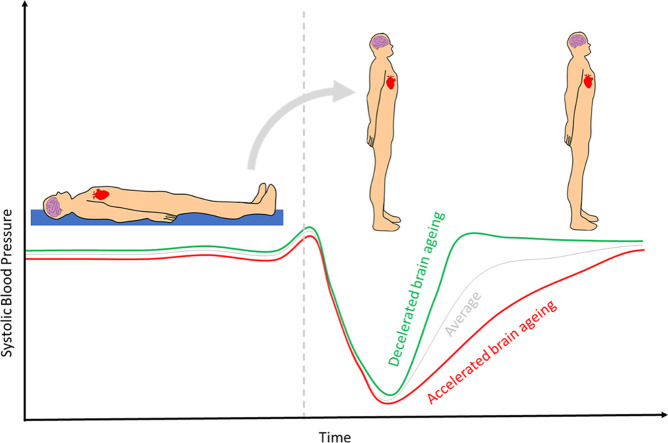
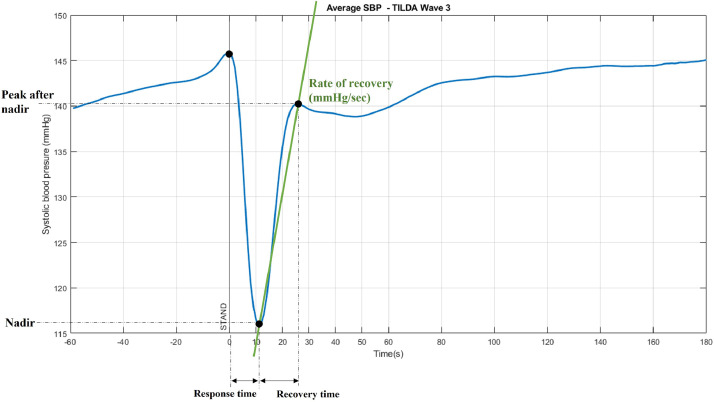
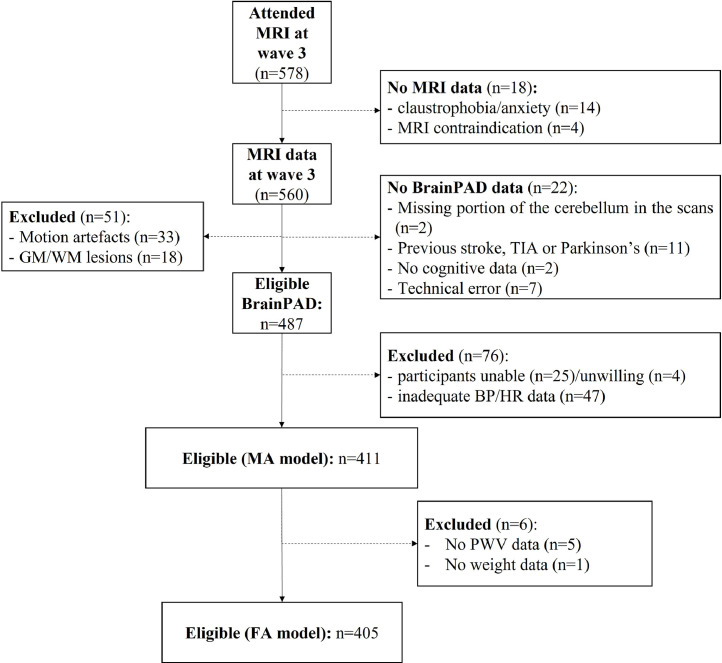
Participants from The Irish Longitudinal Study on Ageing (TILDA) (n=411; age 67.6 ± 7.3 years; 53.4 % women) performed an active stand challenge while blood pressure and heart rate were continuously monitored. The recovery of these parameters was determined as the slope of the BP and HR response, following the initial drop/rise after standing. We have previously reported a novel and validated measure of brain ageing using MRI data, which measures the difference between biological brain age and chronological age, providing a brain-predicted age difference (brainPAD) score.
Slower recovery of systolic and diastolic BP was found to be significantly associated with higher brainPAD scores (i.e., biologically older brains), where a one-year increase in brainPAD was associated with a decrease of 0.02 mmHg/s and 0.01 mmHg/s in systolic and diastolic BP recovery, respectively, after standing. Heart rate (HR) recovery was not significantly associated with brainPAD score.
These results demonstrate that slower systolic and diastolic BP recovery in the early phase after standing is associated with accelerated brain aging in older individuals. This suggests that the BP response to standing, measured using beat-to-beat monitoring, has the potential to be used as a marker of accelerated brain aging, relying on a simple procedure and devices that are easily accessible.
老年人中,站立时血压(BP)恢复受损是一种普遍情况。我们评估了50岁以上成年人站立时血流动力学反应的早期恢复与脑健康之间的关系。
来自爱尔兰老龄化纵向研究(TILDA)的参与者(n = 411;年龄67.6 ± 7.3岁;53.4%为女性)进行主动站立挑战,同时持续监测血压和心率。这些参数的恢复被确定为站立后初始下降/上升后血压和心率反应的斜率。我们之前报道了一种使用MRI数据测量脑老化的新的且经过验证的方法,该方法测量生物学脑年龄与实际年龄之间的差异,提供脑预测年龄差(brainPAD)分数。
发现收缩压和舒张压恢复较慢与较高的brainPAD分数显著相关(即生物学上脑年龄较大),站立后,brainPAD每增加一岁,收缩压和舒张压恢复分别下降0.02 mmHg/s和0.01 mmHg/s。心率(HR)恢复与brainPAD分数无显著关联。
这些结果表明,站立后早期收缩压和舒张压恢复较慢与老年人脑老化加速有关。这表明,使用逐搏监测测量的站立时血压反应有可能作为脑老化加速的标志物,其依赖于简单的程序和易于获得的设备。