Park Jae Sung
Department of Health Care Administration, Kosin University, Busan, Korea.
Healthc Inform Res. 2014 Apr;20(2):135-44. doi: 10.4258/hir.2014.20.2.135. Epub 2014 Apr 30.
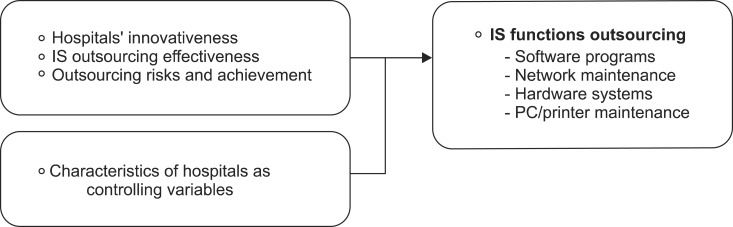
The purpose of this study was to identify the effects of hospitals' innovativeness on outsourcing decision-making regarding four information system (IS) functions, namely, software programs, network maintenance, hardware systems, and PC/printer maintenance.
Using the 2011 roster of the Korean Hospital Association, this study selected 311 general hospitals as a study population. After identifying the managers who were in charge of outsourcing, this study administered questionnaires. A total of 103 hospitals responded.
Of the responding hospitals, 55.34% outsourced at least one IS function, whereas 88.35% outsourced at least one managerial function. IS outsourcing was motivated by the need for outside experts, but other managerial functions were outsourced for cost savings. Innovative and early adopter hospitals were 4.52 and 4.91 times more likely to outsource IS functions related with work processes (i.e., software and network maintenance) than early and late majority hospitals, respectively. IT outsourcing effectiveness significantly influenced the outsourcing decisions regarding four IS functions. Hospitals that had perceived more risks of outsourcing significantly preferred non-outsourcing on their hardware systems, but the risks of outsourcing were not significant for outsourcing decisions regarding the other IS functions. Hospitals' innovativeness also significantly explained the quantity of innovation adoptions. Innovative and early adopter hospitals did more outsourcing than early and late majority hospitals.
Hospitals' innovativeness influences decision-making regarding outsourcing. Innovative hospitals are more likely to outsource their work-process-related IS functions. Thus, organizational traits, especially hospitals' innovativeness, should be considered as a key success factor for IS management.
本研究旨在确定医院的创新能力对四项信息系统(IS)功能(即软件程序、网络维护、硬件系统以及个人电脑/打印机维护)外包决策的影响。
本研究使用韩国医院协会2011年的名册,选取311家综合医院作为研究对象。在确定负责外包的管理人员后,本研究发放了问卷。共有103家医院做出了回应。
在做出回应的医院中,55.34%至少外包了一项信息系统功能,而88.35%至少外包了一项管理功能。信息系统外包的动机是需要外部专家,但其他管理功能外包是为了节省成本。创新型医院和早期采用者医院外包与工作流程相关的信息系统功能(即软件和网络维护)的可能性分别是早期和晚期多数医院的4.52倍和4.91倍。信息技术外包的有效性显著影响了四项信息系统功能的外包决策。认为外包风险较高的医院在硬件系统方面显著倾向于不外包,但外包风险对外包其他信息系统功能的决策并不显著。医院的创新能力也显著解释了创新采用的数量。创新型医院和早期采用者医院比早期和晚期多数医院外包得更多。
医院的创新能力影响外包决策。创新型医院更有可能外包与其工作流程相关的信息系统功能。因此,组织特征,尤其是医院的创新能力,应被视为信息系统管理的关键成功因素。