Park Jae Sung, Kim Hye Sook
Department of Health Care Administration, Kosin University, Busan, Korea.
Healthc Inform Res. 2010 Dec;16(4):290-8. doi: 10.4258/hir.2010.16.4.290. Epub 2010 Dec 31.
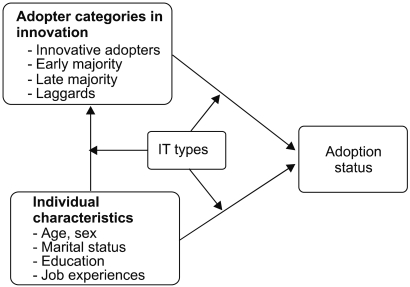
The purpose of this study is to identify the role of individual innovation to demographic variables for determining IT adoption behaviors. This study also examines the effect of individual innovation on IT adoption behaviors across IT types.
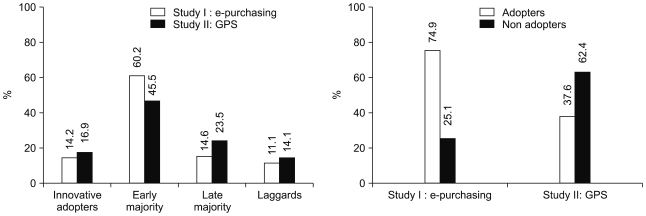
To verify the invariant effect of individual innovativeness, two groups of persons working in the health care field were surveyed. The first study subject group was radiologists and their adoption of e-purchasing the second group was emergency rescue crews and their adoption of GPS.
Adopter categories in innovations (ACI) as the measurement of individual innovation were a significant variable in both studies. Innovative adopters were more likely to use new IT tools than the majority of early adopters, and the early majority was more likely to adopt IT than the laggards. After merging the two data sets into one for testing the role of IT types as a moderator, the significance of ACI did not change, compared to the two separate analyses. In the merged data set, innovative adopters were 2.34 times more likely to be adopters than the early majority. The early majority was 2.32 times more likely to be adopters than laggards. Moreover, there were no moderating effects of IT types. Thus, there were no reversed adoption rates according to levels of ACI and demographic variables.
ACI has invariant effects on IT adoption behaviors regardless of IT types and demographic differences. To implement a new innovation, understanding individual innovativeness will provide more sophisticated implementation strategies for health care organizations and appropriate education programs for their employees.
本研究旨在确定个体创新在人口统计学变量对信息技术采纳行为的影响中所起的作用。本研究还考察了个体创新对不同类型信息技术采纳行为的影响。
为验证个体创新性的不变效应,对医疗保健领域的两组人员进行了调查。第一个研究对象组是放射科医生及其对电子采购的采纳情况,第二个组是急救人员及其对全球定位系统(GPS)的采纳情况。
作为个体创新衡量指标的创新采纳者类别(ACI)在两项研究中都是一个显著变量。创新采纳者比大多数早期采纳者更有可能使用新的信息技术工具,而早期多数采纳者比落后者更有可能采纳信息技术。在将两个数据集合并为一个以测试信息技术类型作为调节变量的作用后,与两项单独分析相比,ACI的显著性没有变化。在合并数据集中,创新采纳者成为采纳者的可能性是早期多数采纳者的2.34倍。早期多数采纳者成为采纳者的可能性是落后者的2.32倍。此外,信息技术类型没有调节作用。因此,根据ACI水平和人口统计学变量,不存在反向采纳率。
无论信息技术类型和人口统计学差异如何,ACI对信息技术采纳行为都有不变的影响。为实施一项新的创新,了解个体创新性将为医疗保健组织提供更完善的实施策略,并为其员工提供合适的教育项目。