1] Department of Otorhinolaryngology-Head and Neck Surgery, Osaka University, Graduate School of Medicine, Suita, 2-2 Yamadaoka, Osaka 565-0871, Japan [2] Department of Frontier Science for Cancer and Chemotherapy, Osaka University, Graduate School of Medicine, Suita, 2-2 Yamadaoka, Osaka 565-0871, Japan.
Department of Frontier Science for Cancer and Chemotherapy, Osaka University, Graduate School of Medicine, Suita, 2-2 Yamadaoka, Osaka 565-0871, Japan.
Br J Cancer. 2014 Jul 29;111(3):506-14. doi: 10.1038/bjc.2014.289. Epub 2014 May 29.
Cancer stem cells (CSCs) are responsible for treatment failure. However, their identification and roles in resistance are not well established in head and neck squamous cell carcinoma (HNSCC).
Three HNSCC cell lines (FaDu, Detroit562 and BICR6) were treated with cisplatin or radiation. Cell surface antigens were analysed by LyoPlate, a novel cell surface antigen array. The expression levels of antigens highly expressed after treatments were further compared between cisplatin-resistant Detroit562 cells and its parental line. Association of the candidate antigen with CSCs properties, namely sphere formation and in vivo tumourigenicity, was also examined.
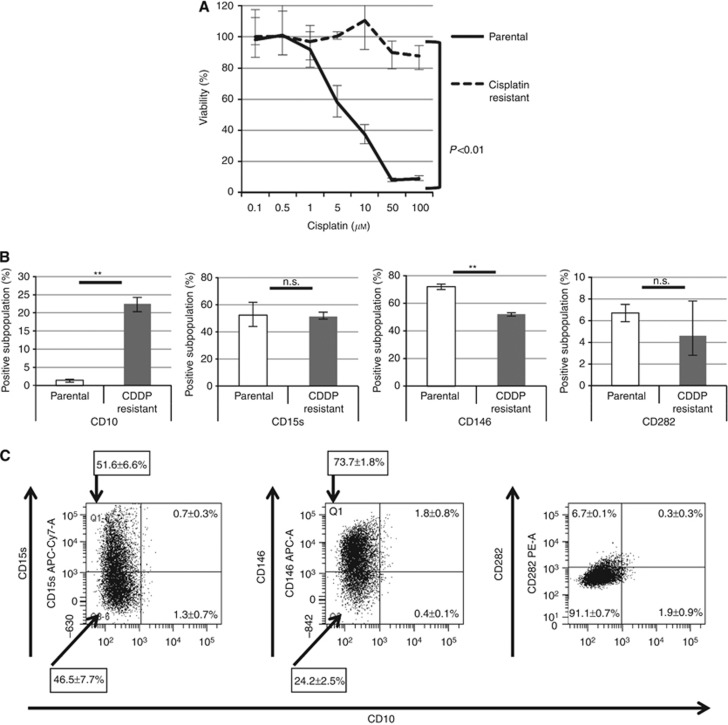
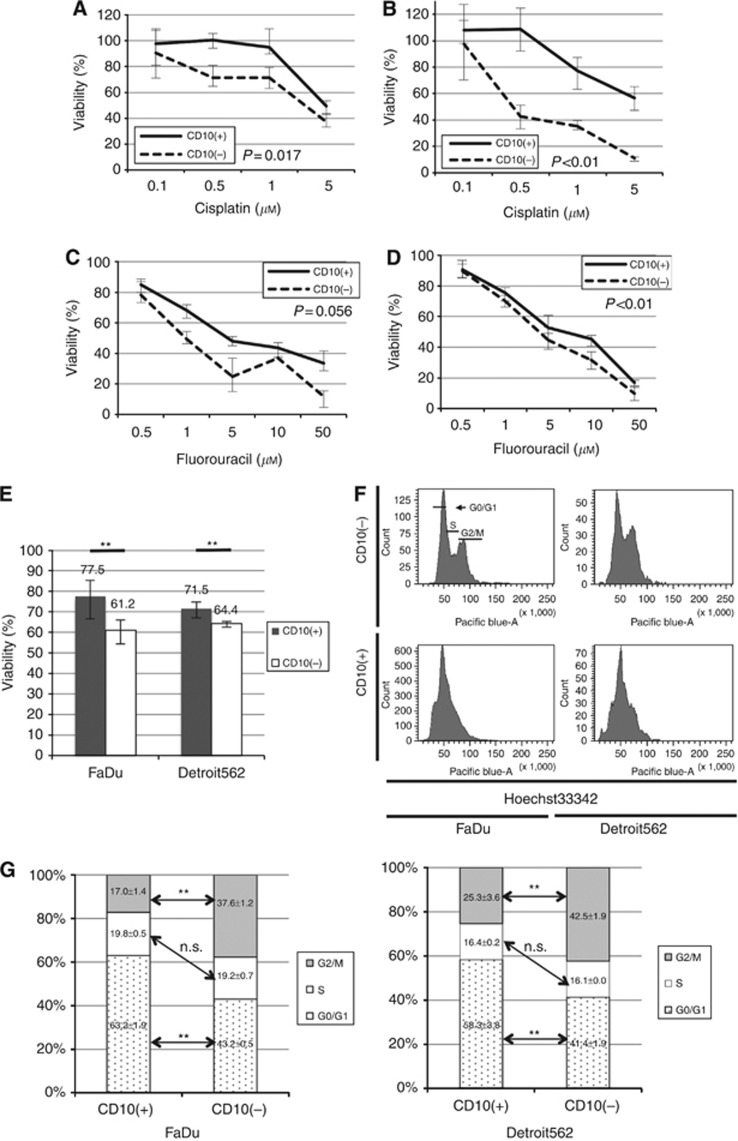
CD10, CD15s, CD146 and CD282 were upregulated across the treated cell lines, while the increased expression of CD10 was prominent in the cisplatin-resistant cell line. Isolation mediated by FACS revealed that the CD10-positive subpopulation was more refractory to cisplatin, fluorouracil and radiation than the CD10-negative subpopulation. It also showed an increased ability to form spheres in vitro and tumours in vivo. Moreover, the CD10-positive subpopulation expressed the CSC marker OCT3/4 at a higher level than that in the CD10-negative subpopulation.
CD10 is associated with therapeutic resistance and CSC-like properties of HNSCC. CD10 may serve as a target molecule in the treatment of refractory HNSCC.
癌症干细胞(CSCs)是导致治疗失败的原因。然而,它们在头颈部鳞状细胞癌(HNSCC)中的鉴定和作用尚不清楚。
用顺铂或辐射处理三种 HNSCC 细胞系(FaDu、Detroit562 和 BICR6)。通过 Lyoplate 分析细胞表面抗原,这是一种新型的细胞表面抗原阵列。进一步比较经处理后高度表达的抗原在顺铂耐药 Detroit562 细胞与其亲本系之间的表达水平。还检查了候选抗原与 CSCs 特性(即球体形成和体内致瘤性)的关联。
CD10、CD15s、CD146 和 CD282 在处理过的细胞系中上调,而 CD10 在顺铂耐药细胞系中的表达增加更为明显。通过 FACS 介导的分离表明,CD10 阳性亚群比 CD10 阴性亚群对顺铂、氟尿嘧啶和辐射更具抗性。它还显示出在体外形成球体和体内形成肿瘤的能力增加。此外,CD10 阳性亚群表达 CSC 标志物 OCT3/4 的水平高于 CD10 阴性亚群。
CD10 与 HNSCC 的治疗抵抗和 CSC 样特性有关。CD10 可作为治疗难治性 HNSCC 的靶分子。