Paljärvi Tapio, Martikainen Pekka, Leinonen Taina, Pensola Tiina, Mäkelä Pia
Alcohol and Drugs Unit, National Institute for Health and Welfare, Helsinki, Finland.
Population Research Unit, University of Helsinki, Helsinki, Finland.
PLoS One. 2014 May 29;9(5):e98620. doi: 10.1371/journal.pone.0098620. eCollection 2014.
Long-term patterning of non-employment among problem drinkers is poorly understood. We determined the level and timing of non-employment, and the relative contribution of various types of non-employment among middle-aged persons who died of alcohol-related causes.
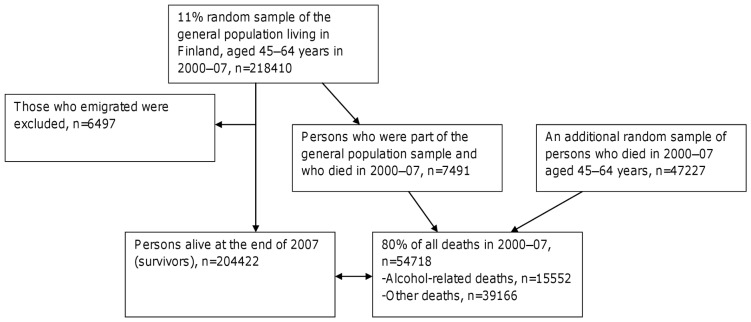
We conducted a longitudinal retrospective register-based study of Finnish men and women aged 45-64 years who died of alcohol-related causes (n = 15,552) or other causes (n = 39,166) in the period 2000-07, or who survived (n = 204,422) until the end of 2007. We traced back the number of days in employment and non-employment for up to 17 years before death or before the end of the study period for the survivors.
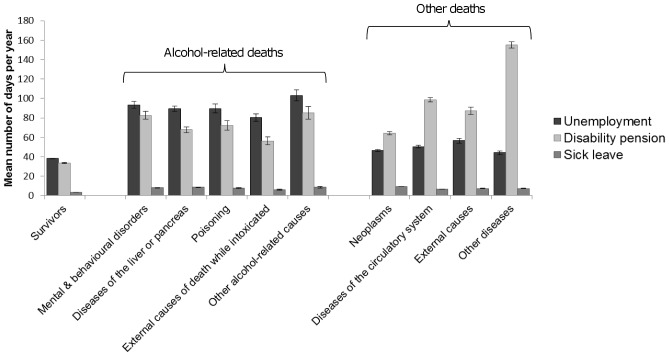
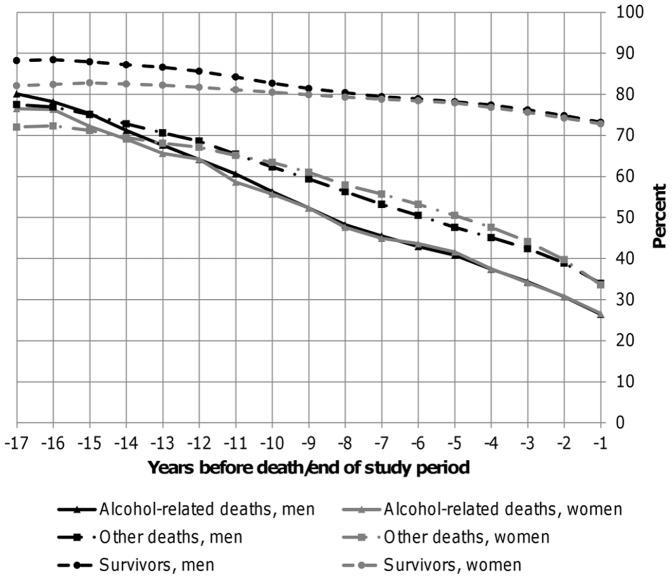
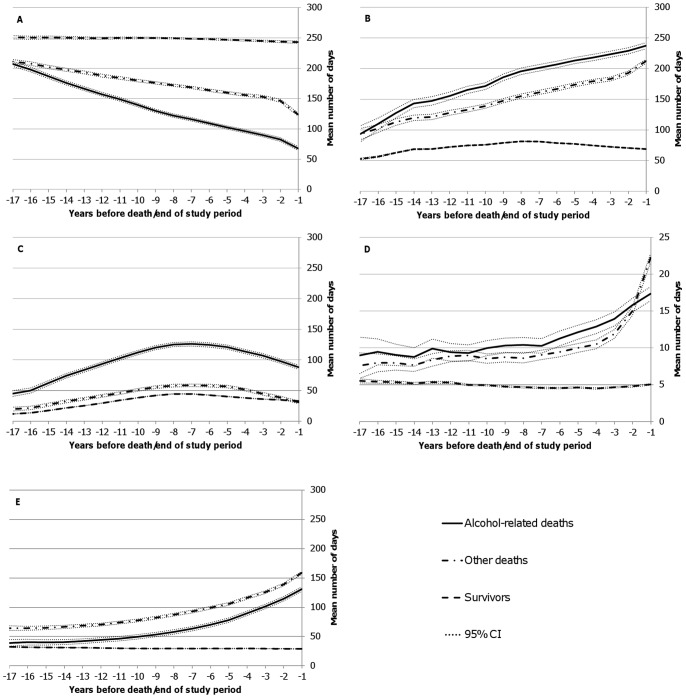
The majority (≥56%) of persons who died of alcohol-related causes were in employment up to ten years before death. Over the 17-year period before death, those who died of alcohol-related causes were in employment on average two years less (mean 6.3 years, 95%CI 6.2-6.4) than those dying of other causes (8.2, 8.1-8.3), and five years less than survivors (11.6, 11.5-11.7), when sex and age were adjusted for. The relative role of various types of non-employment differed markedly across the two mortality groups. Among those who died of alcohol-related causes, unemployment accounted for 54% of the total burden of non-employment, in comparison with 29% among those who died of other causes. In contrast, disability pension accounted for 41% of the total burden of non-employment among those who died of alcohol-related causes, but 65% among those who died of other causes.
The results indicate the feasibility of preventing movement out of employment among middle-aged men and women with severe alcohol-related harm, provided that they are identified early on during their working careers and offered effective interventions.
问题饮酒者长期无工作状态的模式尚不清楚。我们确定了无工作状态的程度和时间,以及在死于酒精相关原因的中年人群中各类无工作状态的相对影响。
我们对2000年至2007年期间死于酒精相关原因(n = 15552)或其他原因(n = 39166)的45至64岁芬兰男性和女性,或存活至2007年底的人群(n = 204422)进行了一项基于纵向回顾登记的研究。我们追溯了死亡前或研究期末幸存者长达17年的就业和无工作天数。
死于酒精相关原因的大多数人(≥56%)在死亡前十年都有工作。在死亡前的17年期间,调整性别和年龄后,死于酒精相关原因的人平均就业时间比死于其他原因的人少两年(平均6.3年,95%CI 6.2 - 6.4),比幸存者少五年(11.6,11.5 - 11.7)。两类死亡人群中各类无工作状态的相对作用有显著差异。在死于酒精相关原因的人群中,失业占无工作总负担的54%,而死于其他原因的人群中这一比例为29%。相反,残疾抚恤金在死于酒精相关原因的人群中占无工作总负担的41%,但在死于其他原因的人群中占65%。
结果表明,对于有严重酒精相关危害的中年男性和女性,只要在其职业生涯早期被识别并给予有效干预,防止其失去工作是可行的。